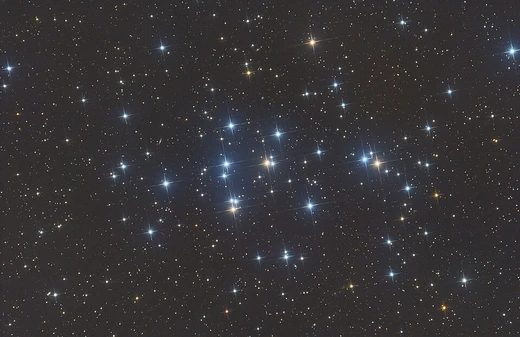
47 Tucanae
Second brightest globular cluster, rich in pulsars and exotic stars.

47 Tucanae, also known as NGC 104 and Caldwell 106, is a globular cluster in the southern constellation Tucana. It sits about 14,500 light-years from Earth and spans roughly 120 light-years in diameter. With an apparent magnitude of 4.1, it’s visible to the naked eye and stretches about 44 arcminutes across when you include its outermost edges. Because it lies just 18° from the south celestial pole, European astronomers didn’t catalog it until the 1750s, when Nicolas-Louis de Lacaille first spotted it from South Africa.
After Omega Centauri, 47 Tucanae is the sky’s second brightest globular cluster. Through a telescope, it reveals roughly ten thousand stars, many packed into a small, dense core. The cluster may harbor an intermediate-mass black hole.
Lacaille recorded the cluster in 1751–1752, initially mistaking it for the nucleus of a bright comet. He listed it as “Lac I-1,” the first entry in his deep-sky catalog. The number “47” came from Johann Elert Bode’s 1801 star catalog, *Allgemeine Beschreibung und Nachweisung der Gestirne nebst Verzeichniss*; Bode reordered Lacaille’s objects by constellation and right ascension without observing them himself. In the 19th century, Benjamin Apthorp Gould gave it the Greek letter ξ (Xi) as ξ Tucanae, but that name never caught on—it’s almost always called 47 Tucanae.
The cluster is one of the most massive in the Milky Way, containing millions of stars. Under ideal conditions, it appears about the size of the full moon. Although it sits next to the Small Magellanic Cloud in the sky, that galaxy is over fifteen times farther away, at roughly 200,000 light-years. The core’s dense stellar population was the target of a major Hubble Space Telescope planet hunt, which looked for partial eclipses of stars by planets. No planets turned up, even though ten to fifteen were expected based on rates around nearby Sun-like stars. A later ground-based survey in the cluster’s less crowded outer regions also came up empty when several planets were predicted. This strongly suggests that the low metallicity of the environment, not the crowding, is to blame.
47 Tucanae contains at least two distinct stellar populations, differing in age or metal content. Its dense core hosts a number of exotic stars, including at least 21 blue stragglers. The cluster efficiently sorts stars by mass, with heavier ones sinking toward the center.
- Distance
- 4.45 ± 0.01 kpc (14,500 ± 32.6 ly)
- Diameter
- 120 light years
- Apparent magnitude
- 4.1
- Angular size
- 44 arcminutes
- Constellation
- Tucana
- Designations
- NGC 104, Caldwell 106, Lac I-1
Lore & Background
The cluster was first recorded in 1751–2 by Nicolas-Louis de Lacaille from South Africa, who initially thought it was the nucleus of a bright comet. Lacaille listed it as 'Lac I-1', the first object in his deep-sky catalogue. The number '47' was assigned in 1801 by Johann Elert Bode in his catalogue, who reordered Lacaille's stars by constellation in order of right ascension. In the 19th century, Benjamin Apthorp Gould assigned the Greek letter ξ (Xi) to designate it ξ Tucanae, but this was not widely adopted.
47 Tucanae is noted for having a small, very bright, and dense core. It is one of the most massive globular clusters in the Galaxy, containing millions of stars. The cluster appears roughly the size of the full moon under ideal conditions. Though adjacent to the Small Magellanic Cloud, that galaxy is over fifteen times farther away. The cluster contains at least two stellar populations of different ages or metallicities, and its dense core hosts at least 21 blue stragglers. It also contains hundreds of X-ray sources, including cataclysmic variables and low-mass X-ray binaries, and 35 known millisecond pulsars—the second largest population in any globular cluster. The cluster's brightest star in visible and ultraviolet light is a blue giant of spectral class B8III, about 1,100 times the Sun's luminosity, with an effective temperature of about 10,850 K and about 54% the mass of the Sun.
A major Hubble Space Telescope survey for planets in the core found none, though ten to fifteen were expected, indicating planets are rare in globular clusters. A later ground-based survey in the outer regions also failed to detect planets, suggesting low metallicity rather than crowding is responsible. The cluster may contain an intermediate-mass black hole, but evidence is disputed: Hubble data constrain any black hole to less than about 1,500 solar masses, while a 2017 study suggested a black hole of about 2,200 solar masses based on pulsar motions, though a later analysis of more extensive timing data found no solid evidence for one.
Reader's Guide
47 Tucanae is significant as the second brightest globular cluster in the sky, a benchmark for studying stellar populations, exotic stars, and planetary formation in dense environments. Its dense core and massive size make it a natural laboratory for understanding mass segregation, where more massive stars sink to the center. The cluster's 35 millisecond pulsars—the second largest population in any globular cluster—provide insights into binary evolution and the transition from accreting low-mass X-ray binaries to millisecond pulsars, as exemplified by the system 47 Tuc W. The failure to detect planets in both core and outer regions strongly indicates that low metallicity, not crowding, suppresses planet formation in globular clusters. The ongoing debate over a possible central black hole, with conflicting evidence from pulsar timing and Hubble data, highlights the cluster's role in testing models of black hole formation in dense stellar systems. Modern discoveries include a claimed laser-like signal in 2008, evidence of mass segregation in 2015, and a possible radio source at the heart of the cluster detected in 2024, which could be a supermassive black hole.
More in Star Clusters 1-24
Spotted an error? Know more?
Reader corrections go straight into our review queue. Suggest an edit · How this site is sourced