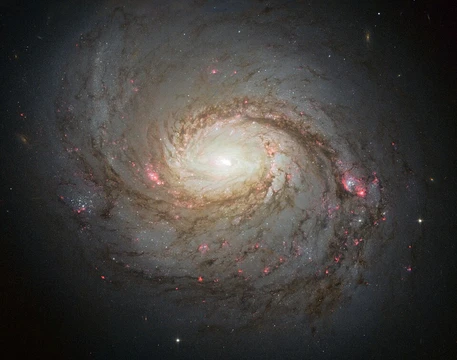
NGC 986
Barred spiral galaxy in Fornax with intense nuclear star formation.

NGC 986 is a barred spiral galaxy in the southern constellation Fornax, roughly 76 million light-years from Earth. It belongs to the Fornax Cluster. The galaxy’s nucleus is undergoing intense star formation, and its core contains an H II region. A large central bar, about 14 kiloparsecs across, is rich in dense gas. Two long, slightly warped arms extend from the bar’s ends in an S-shape; a tidally disrupted dwarf galaxy may lie at the tip of the northern arm. The galaxy’s morphological classification is (R′1)SB(rs)b, meaning it has a barred spiral structure with an outer pseudo-ring, an incomplete inner ring, and moderately wound arms. Its plane is tilted 37° from Earth’s line of sight, and its major axis runs at a position angle of 127°. The galaxy’s angular size is 3.8 by 1.9 arcminutes, with a visual magnitude of 10.9. It was discovered on August 5, 1826, by Scottish astronomer James Dunlop, who described it as a “faint nebula, of an irregular round figure.” A nearby companion, NGC 986A, lies at an angular separation of 17 arcminutes (a projected distance of 110 kiloparsecs), but the two appear unconnected. One supernova has been observed in NGC 986: SN 2018lei, a Type Ic event of magnitude 16.8, discovered by ASAS-SN on December 31, 2018.
Quick Facts
- Epoch
- J2000
- Constellation Name
- Fornax
- Ra
- 02 · 33 · 34.349
- Dec
- −39 · 02 · 42.21
- Z
- 0.006606
- Dist Ly
- 23.2 Mpc / 56 million ly
- Group Cluster
- Fornax Cluster
- Appmag V
- 10.9
- Appmag B
- 11.74
Facts from the source article.
Lore & Background
NGC 986 was discovered on August 5, 1826, by Scottish astronomer James Dunlop, who described it as a 'faint nebula, of an irregular round figure'. It belongs to the Fornax Cluster of galaxies and has a nearby companion, NGC 986A, at an angular separation of 17′, corresponding to a projected separation of 110 kpc; the two appear unconnected.
The galaxy's morphological class is (R′1)SB(rs)b, indicating a barred spiral with an outer pseudo-ring, an incomplete inner ring, and moderately wound spiral arms. Its galactic plane is inclined at 37° to the line of sight, with the major axis aligned at a position angle of 127°. The nucleus is undergoing intense star formation and contains an H II region at the core. The large central bar extends approximately 14 kpc and is rich in dense gas. Two large, extended, slightly warped arms begin at each end of the bar, forming an S-shape. There may be a tidally-disrupted dwarf galaxy at the end of its northern arm.
Reader's Guide
NGC 986 is significant as a barred spiral galaxy within the Fornax Cluster, offering insights into the structure and dynamics of barred galaxies. Its intense nuclear star formation and central H II region highlight active stellar birth processes. The large bar, extending about 14 kpc and rich in dense gas, plays a key role in funneling material toward the nucleus. The galaxy's two S-shaped arms, slightly warped, and the possible tidally-disrupted dwarf galaxy at the end of the northern arm suggest past or ongoing gravitational interactions. The observation of one supernova, SN 2018lei (Type Ic, magnitude 16.8), discovered on December 31, 2018, adds to its astrophysical interest. Its companion NGC 986A, though appearing unconnected, provides a nearby comparison for studying galaxy interactions. The galaxy's classification and inclination angle aid in modeling spiral structure and bar dynamics.
Did You Know?
- NGC 986 was discovered by Scottish astronomer James Dunlop on August 5, 1826.
- The galaxy has a large central bar extending about 14 kpc, rich in dense gas.
- One supernova, SN 2018lei (Type Ic, mag. 16.8), was observed on December 31, 2018.
More in Spiral Galaxies, Part 2 1-24
Spotted an error? Know more?
Reader corrections go straight into our review queue. Suggest an edit · How this site is sourced