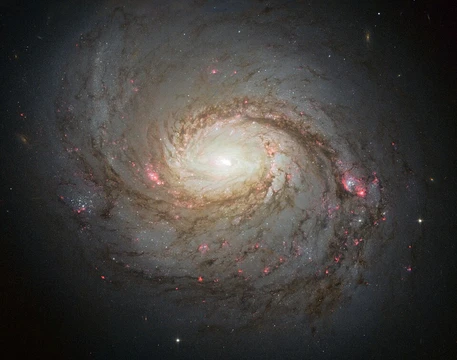
Markarian 471
A barred spiral Seyfert galaxy with a dusty, star-forming nucleus.

Markarian 471, designated MRK 471, is a Seyfert galaxy of Type 1 in the constellation Boötes. It has a redshift (z) of 0.0341 and was first identified by Thomas F. Adams in January 1977 during a survey of Seyfert galaxies. The galaxy is classified as an SBa barred spiral, sometimes described as theta-shaped. Its circumnuclear region appears dust-obscured; ultraviolet images reveal a point-like nucleus and scattered star-forming blobs, along with numerous star clusters. Several dust lanes run along the galactic bar and extend into the circumnuclear area. The spiral arms appear to curve inward. Within the stellar bar, dust structures connect and curve toward the center, forming a GD-type structure. A nuclear spiral region is present, with an approximate mass surface density of 16 M☉ pc⁻². Multi-wavelength spectral studies classify it as a Type 1.9 Seyfert galaxy, with a narrow-line region that is heavily reddened. No highly variable broad components have been detected. One supernova has been observed: SN 2026dds, a Type Ia event with magnitude 19.9161, discovered by the Zwicky Transient Facility on 7 February 2026.
Quick Facts
- Epoch
- J2000
- Constellation Name
- Boötes
- Ra
- 14 · 22 · 55.33
- Dec
- +32 · 51 · 02.43
- Z
- 0.034189
- H Radial V
- 10,250 km/s ± 2
- Dist Ly
- 489 Mly
- Appmag V
- 14.42
- Appmag B
- 15.27
- Names
- UGC 9214, CG 0411, CGCG 192-009, MCG +06-32-014, IRAS 14207+3304, PGC 51371, NSA 081577
Facts from the source article.
Lore & Background
Markarian 471 is classified as a type SBa barred spiral galaxy or a theta-shaped spiral. Its circumnuclear region has a dust-obscured appearance, with ultraviolet imaging revealing a point-like nucleus and star-forming blob regions scattered in all directions, along with many star clusters. Several dust lanes are present along the direction of the galaxy's galactic bar, which enters the circumnuclear region. The spiral arms are suggested to curve inward. Dust structures within the stellar bar region connect together and go toward the center in a curve formation, forming a type GD structure. A nuclear spiral region is present with an approximate mass surface density of 16 M☉ pc−2.
Reader's Guide
A multi-wavelength study of the galaxy's spectrum found it is a Type 1.9 Seyfert galaxy with a narrow-line region that is extremely reddened. However, there are no signs of any broad components classified as very variable. One supernova has been observed in Markarian 471: SN 2026dds (Type Ia, mag. 19.9161), discovered by the Zwicky Transient Facility on 7 February 2026. The galaxy's significance lies in its complex dust and star-forming structures, its dual Seyfert classification, and the detection of a supernova, which contribute to understanding the dynamics and evolution of barred spiral Seyfert galaxies.
Did You Know?
- Markarian 471 was discovered by Thomas F. Adams in January 1977.
- The galaxy has a nuclear spiral region with a mass surface density of about 16 M☉ pc−2.
- One supernova, SN 2026dds (Type Ia), was observed in Markarian 471 on 7 February 2026.
- The galaxy's spectrum shows it is a Type 1.9 Seyfert with an extremely reddened narrow-line region.
From Curious Nebulae to a New Class
In 1908, astronomers Edward A. Fath and Vesto Slipher, working with the Lick Observatory, were examining the spectra of objects then called spiral nebulae. Among their targets, NGC 1068 stood out because it displayed six bright emission lines, a pattern that contrasted sharply with the absorption spectra typical of stellar objects. Two decades later, Edwin Hubble examined the emission signatures of NGC 1068 and two comparable objects and formally recognized them as extragalactic. The class truly crystallized in 1943 when Carl Keenan Seyfert identified additional galaxies sharing these traits and reported that they possess extraordinarily bright, star-like nuclei producing broad emission lines. By the close of the 1950s, researchers had pinned down key physical parameters: the nuclei are extremely compact, spanning less than 100 parsecs, and host masses on the order of a billion solar masses, with peak nuclear emission lasting well over a hundred million years. During the 1960s and 1970s, direct size measurements revealed that the emission-line regions in objects like NGC 1068 extend over a thousand light-years in diameter, deepening the picture of how these engines operate.
The Engine at the Core
At the heart of every Seyfert galaxy sits a supermassive black hole, encircled by a swirling accretion disc of material spiralling inward under gravity. Astronomers believe this disc is the primary source of the intense ultraviolet radiation that makes these objects stand out in surveys. The ultraviolet emission and absorption lines, in particular, serve as the most reliable diagnostic tools for determining the chemical composition of the gas surrounding the nucleus. In visible light, the host galaxy often appears unremarkable, resembling an ordinary spiral, but the core alone can rival the combined output of every star in a Milky Way-sized galaxy. Quantitatively, Seyfert nuclei shine with luminosities spanning roughly 10^8 to 10^11 times that of our Sun. This places them firmly between ordinary galaxies and quasars: in a typical Seyfert the nuclear source emits visible radiation on par with the galaxy's stellar population, whereas in a quasar the nucleus outshines the stars by at least two orders of magnitude. Markarian 471, as a member of this class, embodies that same extraordinary concentration of power in a region far too small to resolve without instruments.
Spectral Signatures and Subclassification
What sets Seyfert galaxies apart in the spectrum is the presence of strong, high-ionisation emission lines that betray the extreme conditions near the nucleus. Because not all Seyfert spectra look alike, astronomers devised a practical two-tier system: Type I and Type II, distinguished primarily by the relative width of their emission lines. Over time, it became clear that some nuclei display intermediate characteristics, prompting further subdivision into types 1.2, 1.5, 1.8, and 1.9. A defining hallmark shared across the class is a pronounced ultraviolet excess in the nuclear region, which is precisely the criterion Benjamin Markarian used when he began publishing lists of such galaxies starting in 1967. His catalogue, which grew to include several hundred objects with positional measurements refined by other researchers in 1973, became a cornerstone reference. Spectrophotometric surveys carried out during the 1960s and 1970s confirmed that the ultraviolet and optical emission patterns vary systematically from one Seyfert to the next, making spectral classification an essential first step in any detailed study of the population.
How Common Are They? The Markarian Context
Early estimates suggested that roughly one percent of spiral galaxies host a Seyfert nucleus, and the broader figure of about ten percent of all galaxies carried the Seyfert label. More recent surveys, which deliberately include low-luminosity and obscured nuclei that earlier brightness-biased counts missed, push that fraction to approximately sixteen percent, with a margin of plus or minus five percent. In the local universe, within roughly twenty-seven megaparsecs of the Milky Way, several dozen galaxies exhibit the Seyfert phenomenon, underscoring that these are not rare curiosities but a regular feature of galactic evolution. By 1977 it was well established that the vast majority of Seyferts are spiral or barred-spiral galaxies, with ellipticals being a rare exception. The Markarian Catalogue, which lists galaxies showing a clear ultraviolet excess in their nuclei, contains a substantial fraction of Seyfert objects, making it one of the most important compilations for researchers studying active galactic nuclei. Susan Simkin's photographic survey of nearby Seyferts between 1975 and 1979, conducted on the UK and Palomar Schmidt telescopes, further refined our understanding of their morphologies and the relationship between spiral gas structure and nuclear bar resonances.
Frequently Asked Questions
Who is Markarian 471?
Markarian 471, catalogued as MRK 471, is a Type 1 Seyfert galaxy located in the constellation Boötes. It was first identified by Thomas F. Adams in January 1977 during a dedicated survey of Seyfert galaxies.
What are Markarian 471's powers/role?
As an SBa barred spiral with a theta-shaped appearance, MRK 471 drives a dust-obscured active nucleus that emits strongly in the ultraviolet and hosts scattered star-forming blobs and young clusters. Its spiral arms curve inward, and multiple dust lanes trace the galactic bar all the way into the circumnuclear region.
Why is Markarian 471 important?
MRK 471 serves as a useful template for studying how a barred spiral's central active region shapes its surrounding dust, star clusters, and arm structure. Its well-defined theta morphology and clearly traced dust lanes make it a frequently cited example in discussions of circumnuclear star formation in Seyfert galaxies.
Where and when was Markarian 471 discovered?
Thomas F. Adams catalogued MRK 471 in January 1977 as part of a broader survey targeting Seyfert-type galaxies. The object sits in Boötes at a redshift of 0.0341, placing it in the relatively nearby universe compared to more distant quasars.
More in Spiral Galaxies, Part 2 1-24
Spotted an error? Know more?
Reader corrections go straight into our review queue. Suggest an edit · How this site is sourced