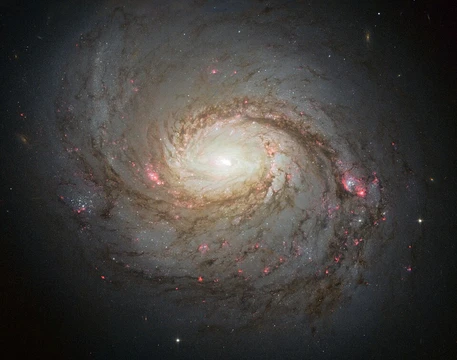
IC 1816
Isolated face-on barred spiral with an active Seyfert nucleus.

IC 1816 is a barred spiral galaxy located in the constellation of Fornax, approximately 245 million light-years from Earth. It is notable for its isolated face-on orientation, three spiral arms, and an active nucleus originally classified as a type 1 Seyfert galaxy but later reclassified as type 2 due to lacking broad emission lines.
Quick Facts
- Epoch
- J2000
- Constellation Name
- Fornax
- Ra
- 02 · 31 · 50.97
- Dec
- -36 · 40 · 19.64
- Z
- 0.016945 ± 0.000020
- H Radial V
- 5,080 km/s
- Dist Ly
- 245 Mly
- Names
- ESO 355-G025, MCG -06-06-011, AM 0229-365, IRAS 02297-3653, 6dF J0231510-364019, PGC 9634
- Appmag V
- 13.1
Facts from the source article.
Lore & Background
IC 1816 was first discovered by Lewis Swift on 12 October 1896, who classified it as a small faint round object. It is an isolated face-on spiral galaxy with three spiral arms; the northwest arm is the brightest and most detached. Two of the arms are distinctive and appear to open up as the spiral structure travels inward. The galaxy also shows a prominent curved dust lane, a clearly resolved ring, and a smaller elongated structure interpreted as a nuclear bar. An inner bar might be present given the observation of a small counter-rotation located from its nucleus, although a nuclear disk is suggested.
The nucleus of IC 1816 is active. It was originally classified as a type 1 Seyfert galaxy but later reclassified as a type 2 Seyfert galaxy due to lacking broad emission lines. The Seyfert spectrum extends as far as 3.4 arcseconds east from the nucleus, and a hydrogen alpha component is seen broadening, likely caused by the blending of nitrogen lines.
IC 1816 has an extended narrow line region showing highly ionized gas, indicated by the presence of coronal line emission, with the region mainly centering in its star-forming ring. The gas located in its nuclear region is mainly blueshifted with a peak velocity dispersion of 320 kilometers per second, suggesting the active galactic nucleus is powered through outflows.
Reader's Guide
IC 1816 is significant as an isolated face-on barred spiral galaxy that provides a clear example of a Seyfert galaxy reclassified from type 1 to type 2 due to the absence of broad emission lines. Its three spiral arms, with the northwest arm being the brightest and most detached, along with a prominent curved dust lane and a resolved ring, make it a valuable object for studying spiral structure and nuclear activity. The presence of a nuclear bar and a possible inner bar, indicated by a small counter-rotation, adds to its complexity. The extended narrow line region with highly ionized gas and coronal line emission, centered on its star-forming ring, highlights the interplay between star formation and active galactic nucleus feedback. The blueshifted gas in the nuclear region with a peak velocity dispersion of 320 kilometers per second suggests that outflows power the active nucleus, offering insights into the dynamics of Seyfert galaxies. Its discovery by Lewis Swift in 1896 as a small faint round object underscores how modern observations have revealed its intricate structure and active nature.
Frequently Asked Questions
What is IC 1816?
IC 1816 is a barred spiral galaxy situated in the constellation Fornax, roughly 245 million light-years from Earth. It presents a clean face-on view with three distinct spiral arms wrapping around a central bar structure.
Who discovered IC 1816 and when?
American astronomer Lewis Swift first catalogued this galaxy on 12 October 1896. Swift was well known for his prolific deep-sky and comet discoveries during the late nineteenth century.
What happened with IC 1816's Seyfert classification?
The active nucleus at the center was initially labeled a type 1 Seyfert, but later observations revealed an absence of broad emission lines, prompting a reclassification to type 2. This shift suggests our line of sight is obscured by surrounding dust rather than the nucleus being intrinsically different.
How large is IC 1816 and how fast does it form stars?
The galaxy spans roughly 136,000 light-years across, making it comparable in scale to the Milky Way. Its current star-formation rate sits at about 0.74 solar masses per year, placing it in a moderate, steady state of stellar birth.
Why do astronomers find IC 1816 useful to study?
Its isolated position and unobstructed face-on geometry make it an excellent target for mapping spiral-arm structure without the confusion of nearby companions. The combination of a clear bar, three well-defined arms, and an active Seyfert nucleus in one object gives researchers a rich system to test models of galaxy dynamics.
More in Spiral Galaxies, Part 2 1-24
Spotted an error? Know more?
Reader corrections go straight into our review queue. Suggest an edit · How this site is sourced