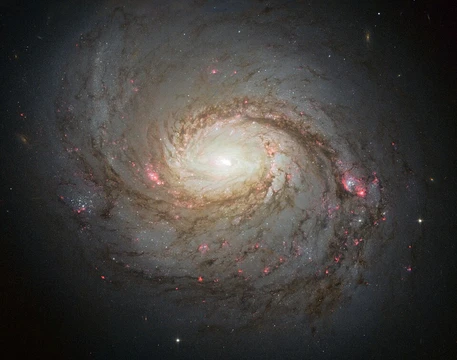
IC 5201
Isolated barred spiral with bright bar and rich HII regions.

IC 5201 is a barred spiral galaxy located in the constellation Grus, approximately 35 million light years from Earth. It is notable for its bright bar, multiple thin arms rich in HII regions, and its status as an isolated galaxy that is the largest in its area of the universe.
Quick Facts
- Epoch
- J2000
- Ra
- 22 · 20 · 57.4
- Dec
- -46 · 02 · 09
- Dist Ly
- 36.4 ± 17.6 Mly (11.2 ± 5.4 Mpc)
- Z
- 0.003052 ± 0.000007
- H Radial V
- 915 ± 2 km/s
- Appmag V
- 10.8
- Constellation Name
- Grus
- Names
- ESO 289-G018, PGC 68618
Facts from the source article.
Lore & Background
IC 5201 was discovered by Joseph Lunt in 1900. It is characterized by a bright bar measuring 0.6 × 0.16 arcminutes, and its multiple thin arms contain a large number of HII regions where new stars are born. The largest of these HII regions have a diameter of about 5 arcseconds, and HII region activity has also been detected in the galaxy's nucleus. The total star formation rate is estimated at 1.7 solar masses per year. The galaxy is close enough that its stars can be resolved, with the brightest having an apparent magnitude of about 21.5. One ultra-luminous X-ray source has been detected in IC 5201. Despite being isolated and not belonging to a galaxy group, it is the largest galaxy in an area that also contains other galaxies such as NGC 7462.
Reader's Guide
IC 5201's significance lies in its combination of features that make it a valuable subject for studying star formation and galactic structure. Its bright bar and multiple thin arms, rich in HII regions, provide a clear example of how barred spiral galaxies channel gas to fuel star formation. The detection of HII region activity in its nucleus suggests ongoing nuclear star formation or activity. The presence of an ultra-luminous X-ray source adds to its interest for high-energy astrophysics. The galaxy's isolation, despite being the largest in its region, offers a contrast to galaxies in dense groups, allowing study of star formation in a relatively undisturbed environment. The observation of one supernova, SN 1978G, a Type II event discovered in its early stages, provides a rare opportunity to study the explosion of a massive star in this galaxy. Its resolvable stars, with the brightest at magnitude 21.5, enable detailed stellar population studies.
Did You Know?
- The galaxy has a star formation rate of 1.7 solar masses per year.
- One supernova, SN 1978G, was observed in IC 5201; it was a Type II supernova discovered on November 24.5 UTC.
- IC 5201 is an isolated galaxy, not belonging to any galaxy group.
Frequently Asked Questions
What is IC 5201?
IC 5201 is a barred spiral galaxy sitting in the southern constellation Grus, roughly 35 million light years from Earth. It stretches about 90,000 light years across and features a prominent central bar flanked by several thin spiral arms.
What makes IC 5201 visually distinctive?
Its central bar is notably bright, spanning 0.6 by 0.16 arcminutes on the sky, and the galaxy is threaded by multiple thin arms densely packed with HII regions. Together these traits give it a crisp, well-defined structure that sets it apart from many other spirals.
Is IC 5201 part of a galaxy group or cluster?
No—IC 5201 is an isolated galaxy with no nearby companions, and it is in fact the largest galaxy in its local patch of the universe. That complete isolation is a major reason it stands out in surveys of the Grus region.
How active is IC 5201 in forming new stars?
The galaxy is generating roughly 1.7 solar masses of new stars each year, a rate fueled largely by the HII regions scattered along its spiral arms. Its brightest individual star reaches an apparent magnitude of about 21.5, so it remains a demanding target for small telescopes.
Why do galaxy fans consider IC 5201 worth studying?
Its combination of a luminous bar, rich star-forming arms, and total isolation makes it a textbook example of a barred spiral evolving in a quiescent environment. At 35 million light years it is far enough to be intriguing yet close enough for dedicated observers to resolve its structure.
More in Spiral Galaxies, Part 2 1-24
Spotted an error? Know more?
Reader corrections go straight into our review queue. Suggest an edit · How this site is sourced