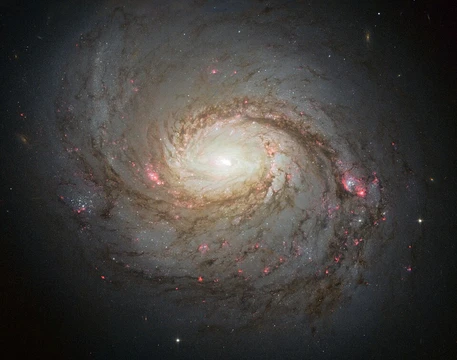
Dwingeloo 1
A barred spiral galaxy hidden behind the Milky Way's disk.

Dwingeloo 1 is a barred spiral galaxy located about 10 million light-years away in the constellation Cassiopeia. It lies in the Zone of Avoidance, where it is heavily obscured by the Milky Way, making it difficult to observe in visible light. The galaxy is notable for being discovered through radio observations of neutral hydrogen, and its size and mass are comparable to those of the Triangulum Galaxy.
Quick Facts
- Epoch
- J2000
- Ra
- 02 · 56 · 51.9
- Dec
- +58 · 54 · 42
- Constellation Name
- Cassiopeia
- Z
- 0.000368
- H Radial V
- 110.3 ± 0.4 km/s
- Gal V
- 257 km/s
- Dist Ly
- ~ 10 Mly (~3 Mpc)
- Group Cluster
- IC 342/Maffei
- Appmag V
- 13.08 (V-band)
- Names
- LEDA 100170, CAS 2
Facts from the source article.
Lore & Background
Dwingeloo 1 was discovered in 1994 by the Dwingeloo Obscured Galaxy Survey (DOGS) using the Dwingeloo Radio Observatory, which searched for neutral hydrogen (HI) radio emissions at 21 cm wavelength from objects in the Zone of Avoidance. Earlier that same year, it had been noted as an unremarkable feature on Palomar Sky Survey plates but was not recognized as a galaxy. It was also independently discovered a few weeks later by another team using the Effelsberg 100-m Radio Telescope. The galaxy was named after the 25m radio telescope in the Netherlands that first detected it.
The galaxy has a central bar and two distinct spiral arms that begin at the ends of the bar at nearly right angles and wind counterclockwise, with arm lengths up to 180°. The disk is inclined at an angle of 50° relative to the observer. Its visible radius is about 4.2', corresponding to roughly 4 kpc at its estimated distance, while neutral hydrogen extends out to 6 kpc. The total mass out to that radius is about 31 billion Solar masses, roughly one-quarter that of the Milky Way. The neutral hydrogen distribution is flat with a minimum in the center or along the bar, typical for barred spirals. The galaxy is molecular gas-poor, with molecular hydrogen mass not exceeding 10% of the neutral hydrogen mass. Around 15 H II regions have been observed, mainly along the spiral arms.
Dwingeloo 1 is a member of the IC 342/Maffei Group of galaxies and has two smaller satellite galaxies: Dwingeloo 2, an irregular galaxy, and MB 3, likely a dwarf spheroidal galaxy. Distance estimates have varied: initially about 3 Mpc via the Tully–Fisher relation, later increased to 3.5–4 Mpc, then a 1999 estimate claimed more than 5 Mpc using the infrared Tully–Fisher relation. As of 2011, the distance is thought to be approximately 3 Mpc based on its likely group membership.
Reader's Guide
Dwingeloo 1 holds significance as a galaxy discovered through radio astronomy in the Zone of Avoidance, demonstrating the power of 21 cm neutral hydrogen surveys to find galaxies hidden behind the Milky Way's gas and dust. Its discovery by the Dwingeloo Obscured Galaxy Survey in 1994, using the Dwingeloo Radio Observatory, and its independent detection by the Effelsberg telescope, highlight the collaborative nature of astronomical discovery. The galaxy's classification as a barred spiral with two distinct arms and a central bar, along with its measured properties such as recession speed, mass, and hydrogen distribution, provide a detailed case study of a nearby but obscured galaxy. Its membership in the IC 342/Maffei Group and its two satellite galaxies place it within a larger galactic environment. The ongoing uncertainty in its distance—ranging from 3 to over 5 Mpc depending on the method—underscores the challenges of studying heavily obscured objects. Dwingeloo 1's legacy lies in its role as a key target for understanding galaxies in the Zone of Avoidance and for refining distance measurement techniques in such regions.
Did You Know?
- The galaxy is heavily obscured by the Milky Way and lies in the Zone of Avoidance.
- Dwingeloo 1 has two satellite galaxies: Dwingeloo 2 (irregular) and MB 3 (likely a dwarf spheroidal).
The 1957 Andromeda Measurement
In 1957, the Dwingeloo Radio Observatory put its newly commissioned 25-meter radio telescope to work on one of the most persistent puzzles in astrophysics. Henk van de Hulst and his collaborators turned the instrument toward M31, the Andromeda galaxy, and produced what would become the first measurement of an extended rotation curve in good agreement with modern data. This was no small achievement. Decades of earlier attempts had stumbled: Jan Oort's 1932 solar-neighborhood measurements were later judged essentially erroneous, and Horace Babcock's 1939 PhD thesis, while noting that the mass-to-luminosity ratio of Andromeda increased with radius, produced results that disagreed substantially with later observations. Babcock had attributed the anomaly to light absorption or modified outer dynamics rather than missing mass. The Dwingeloo result, by contrast, gave the astronomical community a clean, reliable velocity curve for a nearby spiral, finally anchoring the rotation-curve problem in solid observational ground and setting the stage for the dark-matter debate that would follow.
Schmidt's Mass Distribution Insight
Running alongside van de Hulst's 1957 Dwingeloo observations was a companion paper by Maarten Schmidt, which extracted a crucial physical interpretation from the new velocity data. Schmidt demonstrated that the rotation curve of Andromeda could be successfully modeled by a flattened mass distribution that extended considerably farther than the visible light of the galaxy. This was a significant conceptual step. The prevailing expectation, rooted in Keplerian orbital mechanics familiar from star-planet and planet-moon systems, held that orbital speeds should decline with distance from the center in an inverse-square-root fashion. Yet the Dwingeloo data showed stars and gas maintaining roughly constant or even increasing speeds over large radial ranges. Schmidt's flattened mass model offered a way to reconcile those flat curves without immediately invoking unobservable matter, though it did point firmly toward the conclusion that the luminous component of a galaxy accounted for only a fraction of its true gravitational mass. The finding sharpened the discrepancy between what telescopes could see and what gravity demanded.
Volders and the Triangulum Galaxy
Two years after the landmark Andromeda measurement, the Dwingeloo 25-meter telescope was put to work on a second spiral. In 1959, Louise Volders used the same instrument to study M33, the Triangulum galaxy, and demonstrated that it too failed to rotate in accordance with Keplerian dynamics. The significance of this follow-up cannot be overstated: by showing that the anomalous, flat rotation profile was not an idiosyncrasy of one particular galaxy but a repeatable feature across different spiral systems, Volders helped transform the rotation-curve puzzle from a single-galaxy curiosity into a general problem in galactic dynamics. If both M31 and M33 exhibited the same departure from the inverse-square-root velocity decline predicted by Newtonian gravity applied to visible matter, then the explanation had to be systemic. The Dwingeloo observations thus provided two independent, high-quality data sets that collectively reinforced the growing suspicion that galaxies harbored far more mass than their light output suggested, a suspicion that would only be fully articulated in the decades that followed.
Dwingeloo Between Oort and Rubin
The Dwingeloo 25-meter telescope's contributions in 1957 and 1959 occupied a pivotal position in the long arc of rotation-curve research. Before Dwingeloo, the field had been marked by promising but flawed efforts: Oort's 1932 solar-neighborhood work was later found to be essentially erroneous, and Babcock's 1939 Andromeda curve, though groundbreaking in its ambition, disagreed substantially with subsequent measurements. After Dwingeloo, the next major leap came in the late 1960s and early 1970s, when Vera Rubin and Kent Ford at the Carnegie Institution used a new sensitive spectrograph to measure edge-on spiral velocity curves with unprecedented precision. Their 1975 American Astronomical Society announcement—that most stars in spirals orbit at roughly the same speed, implying masses growing linearly with radius well beyond the bulge—drew directly on the kind of flat-curve evidence Dwingeloo had first established. Rubin's influential 1980 paper then crystallized the argument that up to half or more of galactic mass resided in a dark halo. Dwingeloo's role was to supply the first trustworthy extended rotation curves that made all of this possible.
Frequently Asked Questions
Who is Dwingeloo 1?
Dwingeloo 1 is a barred spiral galaxy sitting roughly 10 million light-years out in Cassiopeia, with a total mass of about 31 billion solar masses measured out to 6 kiloparsecs. Fans often compare it to the Triangulum Galaxy, since the two are remarkably similar in overall scale.
What is Dwingeloo 1's signature trait or 'power'?
Its defining characteristic is that it hides squarely in the Zone of Avoidance, where the Milky Way's own dust and stars block it from optical view. It was effectively 'unmasked' only when astronomers detected its neutral hydrogen emission in the radio band, making it a textbook case of a galaxy that radio astronomy revealed before any visible-light survey could.
Why does Dwingeloo 1 matter to the broader 'canon'?
Its discovery helped prove that the Zone of Avoidance was not truly empty but was concealing whole galaxies from optical catalogs. That finding reshaped how the astronomical community estimates the local density of galaxies and the completeness of sky surveys.
How big is Dwingeloo 1 compared to other local spirals?
Its visible disk spans about 4 arcminutes, which at a distance of 3 Mpc corresponds to a radius of roughly 4 kiloparsecs. That places it squarely in the same size class as the Triangulum Galaxy, making it a solid mid-sized barred spiral in the local neighborhood.
More in Spiral Galaxies, Part 2 1-24
Spotted an error? Know more?
Reader corrections go straight into our review queue. Suggest an edit · How this site is sourced