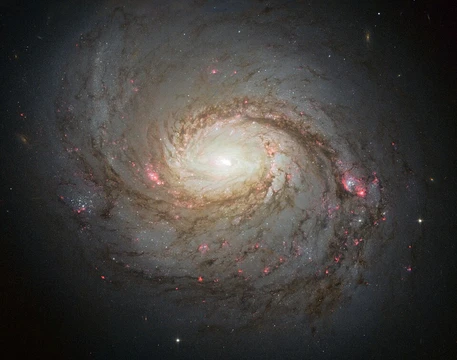
IC 758
Barred spiral galaxy in Ursa Major with an active nucleus.

IC 758 is a barred spiral galaxy located in the constellation Ursa Major. It is notable as an active galactic nucleus candidate, meaning it has a compact central region emitting significant energy across the electromagnetic spectrum beyond what stars alone produce. The galaxy is a member of the NGC 4036 group, which is part of the Ursa Major Cloud within the Virgo Supercluster.
Quick Facts
- Epoch
- J2000
- Constellation Name
- Ursa Major
- Ra
- 12 · 04 · 11.9363
- Dec
- +62 · 30 · 19.199ned
- Z
- 0.004256 · 0.000006ned
- Dist Ly
- 26.700 ± 3.400 Mpcned
- Group Cluster
- NGC 4036 Group (LGG 266)
- Appmag V
- 14.2ned
Facts from the source article.
Lore & Background
IC 758 was discovered by American astronomer Lewis Swift on 17 April 1888. Its velocity with respect to the cosmic microwave background is 1,402±9 km/s, yielding a Hubble distance of 67.4 ± 4.7 Mly. However, two non-redshift measurements suggest a much farther distance of 87.08 ± 11.09 Mly, introducing uncertainty about its true distance.
The galaxy is an active galactic nucleus candidate, indicating a compact central region that emits substantial energy across the electromagnetic spectrum, with characteristics not produced by stars. One supernova, SN 1999bg (Type II, magnitude 15.5), was observed in IC 758, discovered by the Lick Observatory Supernova Search on 28 March 1999.
According to A.M. Garcia, IC 758 is one of five members of the NGC 4036 galaxy group (also known as LGG 266), which includes NGC 4036, NGC 4041, UGC 7009, and UGC 7019. A more recent study claims this group has 13 members, adding several other galaxies. The NGC 4036 Group is part of the Ursa Major Cloud, which is part of the Virgo Supercluster.
Reader's Guide
IC 758's significance lies in its dual nature as a barred spiral galaxy and an active galactic nucleus candidate, offering a laboratory for studying the energetic processes at galactic centers. The discrepancy between its Hubble distance (67.4 ± 4.7 Mly) and non-redshift measurements (87.08 ± 11.09 Mly) highlights the challenges in determining extragalactic distances, a key issue in cosmology. Its membership in the NGC 4036 group, with varying membership counts (five or thirteen galaxies), underscores the evolving understanding of group dynamics within the Ursa Major Cloud and Virgo Supercluster. The observation of SN 1999bg, a Type II supernova, provides a data point for stellar evolution and distance calibration. As an IC object, it contributes to the catalog of galaxies discovered in the late 19th century, with its discovery by Lewis Swift adding historical context to the study of the northern sky.
Did You Know?
- IC 758 is an active galactic nucleus candidate, with a compact central region emitting energy across the electromagnetic spectrum.
- One supernova, SN 1999bg (Type II, mag. 15.5), was discovered in IC 758 on 28 March 1999 by the Lick Observatory Supernova Search.
- The galaxy's distance is uncertain: Hubble distance is 67.4 ± 4.7 Mly, but two non-redshift measurements give 87.08 ± 11.09 Mly.
Discovery and Celestial Identity
IC 758 is a barred spiral galaxy located in the constellation Ursa Major. It was discovered on 17 April 1888 by the American astronomer Lewis Swift, whose observations in the late nineteenth century contributed numerous deep-sky objects to the astronomical catalogues of the era. The IC designation places it within the Index Catalogue, a supplementary list that complemented earlier galaxy surveys. As a barred spiral, IC 758 features a prominent elongated central bar of stellar material connecting its spiral arms, distinguishing it from unbarred spiral types. Its position within Ursa Major situates it among a dense field of galaxies in the northern sky, and its membership in a recognized galaxy group and larger supercluster structure anchors it within the broader architecture of the local universe. Although modest in apparent brightness, IC 758 has attracted sustained scientific interest over more than a century and a third, from its basic morphological classification to the potentially extraordinary energetic processes occurring in its central region. The galaxy remains listed among the IC objects and is represented in multiple astronomical databases and image archives.
The Distance Discrepancy
Estimating the distance to IC 758 presents an interesting puzzle for astronomers. Its recessional velocity, measured relative to the cosmic microwave background, is 1,402 ± 9 km/s. Applying the Hubble law to this redshift yields a distance of approximately 67.4 ± 4.7 million light-years, or 20.67 ± 1.45 megaparsecs. However, two independent non-redshift measurements paint a considerably different picture, placing the galaxy at roughly 87.08 ± 11.09 million light-years, equivalent to 26.700 ± 3.400 megaparsecs. This gap of nearly twenty million light-years between the redshift-based and non-redshift-based estimates is significant enough to affect how IC 758 is interpreted within its local galactic environment. The uncertainty ranges in both methods overlap only marginally, suggesting that either the galaxy's peculiar velocity relative to the Hubble flow is non-trivial, or that the non-redshift distance indicators carry systematic uncertainties not fully captured by their stated error bars. Resolving this discrepancy would sharpen our understanding of IC 758's true position within the NGC 4036 group and the Ursa Major Cloud.
A Candidate Active Galactic Nucleus
Perhaps the most scientifically intriguing aspect of IC 758 is its status as an active galactic nucleus candidate. This classification means that observations have identified a compact region at the galaxy's center that emits a substantial amount of energy spanning a wide range of the electromagnetic spectrum. Crucially, the characteristics of this emission indicate that the luminosity is not produced by ordinary stellar processes. In a typical galaxy, the central region's light is dominated by the combined output of countless stars, but in an active nucleus the energy source is thought to be something far more concentrated and powerful, often associated with a supermassive black hole accreting surrounding material. For IC 758, the fact that it is listed as a candidate rather than a confirmed AGN suggests that the evidence, while suggestive, has not yet reached the threshold of definitive confirmation. The compactness of the emitting region and the spectral properties of the radiation together point toward a central engine operating at energies that transcend what the galaxy's stellar population alone could produce, making it a valuable target for further multi-wavelength study.
Group Membership and the 1999 Supernova
IC 758 is not an isolated object but a member of the NGC 4036 galaxy group, also designated LGG 266. According to the work of A.M. Garcia, this group comprises five galaxies: NGC 4036, NGC 4041, UGC 7009, UGC 7019, and IC 758 itself. A more recent study has expanded the membership considerably, identifying thirteen galaxies in total by adding NGC 3945, PGC 37567, PGC 38027, PGC 2608163, PGC 4001456, PGC 4011735, PGC 4011191, and PGC 4074702. The NGC 4036 Group is itself embedded within the Ursa Major Cloud, a larger concentration of galaxies that is part of the Virgo Supercluster, one of the great structures in the nearby universe. In 1999, IC 758 hosted a notable transient event: supernova SN 1999bg, a Type II explosion reaching a magnitude of 15.5, was discovered on 28 March 1999 by the Lick Observatory Supernova Search. This single recorded supernova provides a snapshot of the galaxy's ongoing stellar evolution and death processes.
Frequently Asked Questions
What is IC 758?
IC 758 is a barred spiral galaxy situated in the constellation Ursa Major. It is classified as an active galactic nucleus candidate, meaning its compact core radiates energy well above what its stellar population alone could account for.
Who discovered IC 758 and when?
The American astronomer Lewis Swift first cataloged this galaxy on April 17, 1888. It was subsequently assigned the catalog designation IC 758.
What group or cluster does IC 758 belong to?
It is a member of the NGC 4036 group, which itself sits within the larger Ursa Major Cloud. That cloud is part of the Virgo Supercluster.
How far is IC 758 from us?
Based on its recession velocity of roughly 1,402 km/s relative to the cosmic microwave background, IC 758 lies at a Hubble distance of approximately 67.4 million light-years, or about 20.7 megaparsecs.
Why is IC 758 notable among spiral galaxies?
Its compact central region produces energy across the electromagnetic spectrum that exceeds what normal starlight can explain, making it a candidate for hosting an active galactic nucleus. This sets it apart from many other barred spirals sharing the same group.
More in Spiral Galaxies, Part 2 1-24
Spotted an error? Know more?
Reader corrections go straight into our review queue. Suggest an edit · How this site is sourced