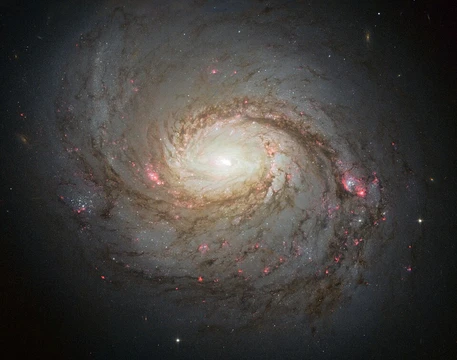
Malin 1
First verified low surface brightness galaxy and one of the largest spirals.

Malin 1 is a giant low surface brightness (LSB) spiral galaxy in the constellation Coma Berenices. It is one of the largest known spiral galaxies, with an approximate diameter of 650,000 light-years, making it over six times the diameter of the Milky Way. Discovered by astronomer David Malin in 1986, it is the first LSB galaxy verified to exist.
Quick Facts
- Epoch
- J2000.0
- Constellation Name
- Coma Berenices
- Ra
- 12 · 36 · 59.34697
- Dec
- +14 · 19 · 49.1585
- Z
- 0.082702 · 0.000013
- Mass
- ~12
- Appmag V
- 15.809 · 0.009
- Absmag V
- -22.01 · 0.50
- Notes
- Surrounded by a H I disk
- Names
- PGC 42102, LEDA 42102, VPC 1091, 2MASX J12365934+1419494, Gaia DR2 3932516418935413504
Facts from the source article.
Lore & Background
Malin 1 was discovered by astronomer David Malin in 1986, from which it derives its name, and is the first LSB galaxy verified to exist. Its bright center is an SB0a-type barred-spiral, 30,000 light-years across, with a bulge of 10,000 light-years. The galaxy exhibits giant and very faint spiral arms, with some segments estimated to be nearly 650,000 light-years in diameter. Observations by Galaz et al. in April 2014 revealed a detailed view of the spiral structure in optical bands, as well as possible stellar streams and formation regions.
Malin 1 is unique in several ways: its diameter alone makes it the largest barred spiral galaxy ever observed. It was found to possibly be interacting with two other galaxies, Malin 1B and SDSS J123708.91+142253.2. Malin 1B is estimated to be located 46,000 light-years away from the high surface brightness central spiral of Malin 1, which may be responsible for the formation of the galaxy's central bar. SDSS J123708.91+142253.2 is located within the huge, faint halo of Malin 1 and might have caused the formation of the extended low surface brightness disc through tidal stripping.
Malin 1B is a possible companion galaxy that may have interacted with Malin 1 and influenced its unusually large structure. It is primarily composed of intergalactic filament, likely as an originally larger galaxy that shrank due to the tidal forces experienced during its merger with Malin 1.
Reader's Guide
Malin 1 holds significance as the first verified low surface brightness galaxy, confirming the existence of a class of galaxies with extremely faint, diffuse structures. Its enormous size—over six times the diameter of the Milky Way—makes it one of the largest known spiral galaxies and the largest barred spiral galaxy ever observed. The galaxy's possible interactions with two companions, Malin 1B and SDSS J123708.91+142253.2, are noted as potential influences on its central bar and extended low surface brightness disc. Observations from April 2014 by Galaz et al. provided detailed optical views of its spiral structure and revealed possible stellar streams and formation regions. The galaxy's legacy lies in its role as a benchmark for understanding low surface brightness galaxies and the processes that shape giant spiral structures.
Did You Know?
- Malin 1 is the first low surface brightness galaxy verified to exist.
- It is over six times the diameter of the Milky Way, at about 650,000 light-years across.
Frequently Asked Questions
What is Malin 1?
Malin 1 is a giant low surface brightness spiral galaxy sitting in the constellation Coma Berenices, roughly 1.19 billion light-years from Earth. Its core is classified as an SB0a barred type, with a bright central region spanning about 30,000 light-years.
How big is Malin 1 compared to the Milky Way?
At roughly 650,000 light-years across, Malin 1 is more than six times the diameter of our own galaxy. That scale makes it one of the largest spiral galaxies we have confirmed so far.
Who discovered Malin 1 and when?
Astronomer David Malin identified the galaxy back in 1986. It earned a place in the record books as the first low surface brightness spiral galaxy whose existence was independently verified.
What makes Malin 1 unique in the galaxy catalog?
Before Malin 1, many astronomers doubted that LSB spirals were real objects rather than observational noise, so its confirmation proved an entire class of faint, diffuse galaxies was genuine. Its matter is spread so thinly over 650,000 light-years that the bright core covers only a tiny fraction of the full disk.
Where can I find Malin 1 in the sky?
Look toward the constellation Coma Berenices, though at 366 megaparsecs (about 1.19 billion light-years) it is far beyond the reach of backyard telescopes. Professional wide-field imaging is really the only practical way to appreciate its enormous, faint spiral structure.
More in Spiral Galaxies, Part 2 1-24
Spotted an error? Know more?
Reader corrections go straight into our review queue. Suggest an edit · How this site is sourced