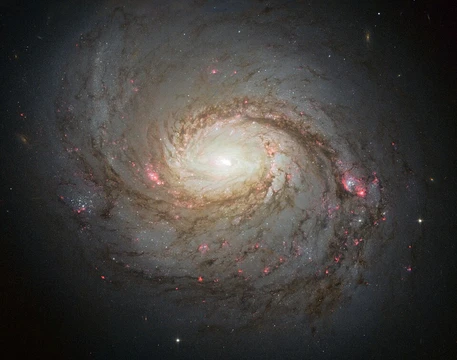
IC 4687
Luminous infrared spiral galaxy with a weak active nucleus.

IC 4687, also known as IRAS 18093-5744 or F18093-5744, is an Sb spiral galaxy located in the constellation of Pavo, approximately 250 million light years from Earth. Discovered by Royal Harwood Frost on August 1, 1904, it is notable as a luminous infrared galaxy with a star formation rate of 30 solar masses per year and a weak active galactic nucleus.
Quick Facts
- Epoch
- J2000
- Constellation Name
- Pavo
- Ra
- 18 · 13 · 39.70
- Dec
- -57 · 43 · 30.97
- Z
- 0.017345
- H Radial V
- 5,200 km/s
- Dist Ly
- 253 Mly (76.95 Mpc)
- Appmag V
- 0.33
- Appmag B
- 0.43
- Names
- ESO 140-IG10, IRAS 18093-5744, PGC 61602, FAIRALL 045
Facts from the source article.
Lore & Background
IC 4687 was discovered by Royal Harwood Frost on August 1, 1904, who described the object as having a brighter middle with a magnitude of 14 and a surface brightness of 12.5. It is classified as a luminous infrared galaxy, with an infrared luminosity of 10^11.3 L☉, compatible with a star formation rate of 30 M☉ yr−1. Although its energy output is dominated by star formation, the galaxy hosts a weak active galactic nucleus.
The galaxy's regions contain high amounts of molecular gas, with surface densities of log ΣH2 (M☉ pc−2) = 2.9 ± 0.2, and it produces stars at a rapid rate, with log ΣSFR (M☉ yr−1 kpc−2) = 0.7 ± 0.4, about 10 times higher than extreme values in nearby galaxies. Its velocity field is mainly controlled by rotation, and it has a defined kinematic center synchronous with its nucleus.
IC 4687 forms an interacting galaxy trio with IC 4686 and IC 4689, both spiral-like galaxies located about 10 and 20 kiloparsecs away, respectively. Due to a close merger with IC 4686—a starburst and Wolf-Rayet galaxy—IC 4687 appears distorted. Hubble images show a distorted morphology with interstellar dust and gas obscuring its companion, and a large curly tidal tail resulting from the merger. The weak interaction from IC 4686 may have triggered its starburst.
Reader's Guide
IC 4687 is significant as a luminous infrared galaxy whose energy output is dominated by star formation, yet it also hosts a weak active galactic nucleus, illustrating the coexistence of these processes. Its high molecular gas surface densities and extreme star formation rate surface density—about ten times higher than extreme values in nearby galaxies—make it a key example of rapid star formation in an interacting system. The galaxy's distorted morphology and large curly tidal tail, resulting from a close merger with the starburst and Wolf-Rayet galaxy IC 4686, provide direct evidence of merger-driven starburst activity. As part of an interacting trio with IC 4686 and IC 4689, IC 4687 offers insights into how gravitational interactions can trigger intense star formation and shape galactic structure. Its defined kinematic center and rotation-dominated velocity field further contribute to understanding the dynamics of merging galaxies.
Did You Know?
- It has an infrared luminosity of 10^11.3 L☉ and a star formation rate of 30 M☉ yr−1.
- The galaxy's star formation rate surface density is about 10 times higher than extreme values in nearby galaxies.
- IC 4687 forms an interacting trio with IC 4686 and IC 4689, and its distorted morphology includes a large curly tidal tail.
Frequently Asked Questions
What is IC 4687?
IC 4687 is an Sb-type spiral galaxy that also carries the designations IRAS 18093-5744 and F18093-5744. It is catalogued as a luminous infrared galaxy residing in the southern constellation Pavo.
Who discovered IC 4687 and when?
Royal Harwood Frost first recorded the galaxy on August 1, 1904. It has since attracted the attention of infrared astronomers studying vigorous star-forming systems.
How far away is IC 4687 from Earth?
The galaxy sits roughly 250 million light years away in the direction of Pavo. At that range it presents an apparent magnitude near 14, making it a demanding target for small telescopes.
What makes IC 4687 stand out among spiral galaxies?
It radiates intensely in the infrared with a luminosity on the order of 10^11.3 solar luminosities while churning out new stars at about 30 solar masses per year. Despite that prodigious star formation, its central active galactic nucleus remains only weakly active.
How bright does IC 4687 appear to an observer on Earth?
With an apparent magnitude of 14 and a surface brightness of 12.5, it is faint enough to demand a large aperture or long integration times for a clear view. Its infrared output, however, dwarfs what is visible in ordinary optical light.
More in Spiral Galaxies, Part 2 1-24
Spotted an error? Know more?
Reader corrections go straight into our review queue. Suggest an edit · How this site is sourced