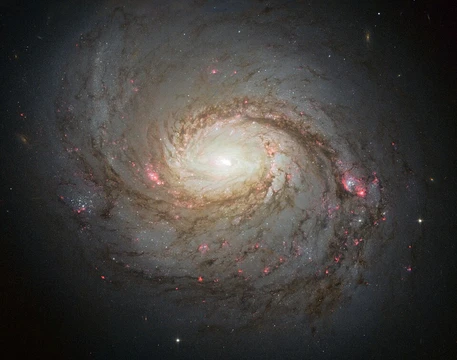
ESO 137-001
Barred spiral galaxy stripped by hot gas, forming a starry tail.

ESO 137-001, often called the Jellyfish Galaxy, is a barred spiral galaxy found in the constellation Triangulum Australe and belonging to the Abell 3627 galaxy cluster. As it races toward the cluster's center at 1,900 kilometers per second, hot gas strips material from the galaxy, creating a tail that stretches 260,000 light-years. This process is known as ram pressure stripping. The intergalactic gas in Abell 3627 reaches 100 million Kelvin, which triggers star formation within the tail. The galaxy contains a low amount of neutral hydrogen (H I) regions, with a combined mass of 3.5 × 10⁸ solar masses; only 10% of that mass resides in the galaxy's main disk.
Ming Sun discovered ESO 137-001 in 2005.
The ongoing loss of gas is expected to heavily influence the galaxy's evolution. It removes cold gas, halts new star formation within the galaxy, and alters the appearance of its inner spiral arms and bulge due to the effects of star formation.
Quick Facts
- Constellation Name
- Triangulum Australe
- Epoch
- J2000
- Ra
- 16 · 13 · 27.305
- Dec
- -60 · 45 · 50.59
- H Radial V
- 4630 ± 58 km/s
- Z
- 0.015565
- Dist Ly
- 220 million ly
- Notes
- Trail of gas
- Names
- ESO 137-001, ESO 137-1, ESO-LV 137-0010, PGC 57532
Facts from the source article.
Lore & Background
ESO 137-001 was discovered by Ming Sun in 2005. As the galaxy moves toward the center of the galaxy cluster Abell 3627 at 1900 km/s, it is stripped by hot intergalactic gas at 100 million Kelvin, a process called ram pressure stripping (RPS). This stripping creates a 260,000 light-year long tail where star formation occurs. The galaxy has a low amount of HI regions, with a total mass of 3.5 × 10^8 solar masses, only 10% of which is located in the main disk of ESO 137-001.
Reader's Guide
The stripping of gas is thought to have a significant effect on the galaxy's development. It removes cold gas from the galaxy, shutting down the formation of new stars in the galaxy, and changing the appearance of inner spiral arms and bulges because of the effects of star formation. This makes ESO 137-001 a key example of how ram pressure stripping can transform a spiral galaxy in a dense cluster environment, providing insight into the fate of galaxies that fall into cluster centers.
Did You Know?
- ESO 137-001 is also called the Jellyfish Galaxy.
- It moves toward the center of Abell 3627 at 1900 km/s.
- Its tail extends 260,000 light-years and hosts star formation.
- Only 10% of its total HI mass is in the main disk.
A Single Thread in an Enormous Tapestry
ESO 137-001 exists as one entry among an almost incomprehensible population of galaxies. Current estimates place the number of galaxies in the observable universe at well over two trillion, a figure so vast that any individual object becomes a statistical grain. Within that ocean, structure organizes itself into nested groupings: the Local Group contains roughly fifty-one galaxies, while the broader Local Supercluster swells to around one hundred thousand. ESO 137-001, like the vast majority of its peers, does not enjoy the distinction of being a naked-eye object visible to keen observers on a dark, high-altitude night under stable skies. It is, instead, a member of the larger census—identified by its systematic designation rather than a popular name, and catalogued alongside millions of others in the ongoing effort to map what lies beyond the Milky Way's immediate neighbourhood.
The Slow Art of Cataloguing the Sky
Systematic attempts to enumerate galaxies only gained real momentum in the 1960s. The Catalogue of Galaxies and Clusters of Galaxies recorded twenty-nine thousand four hundred and eighteen objects, while the Morphological Catalogue of Galaxies, aiming for completeness above photographic magnitude fifteen, listed thirty thousand six hundred and forty-two. By the 1980s, the Lyons Groups of Galaxies had organized four hundred and eighty-five groups containing nearly four thousand member galaxies. The twenty-first century brought a different scale: Galaxy Zoo, launched in July 2007, has since classified more than one million galaxy images drawn from the Sloan Digital Sky Survey, the Hubble Space Telescope, and the Cosmic Assembly Near-Infrared Deep Extragalactic Legacy Survey. ESO 137-001 sits within this layered heritage of ever-expanding inventories, a single data point in a project that has never truly finished.
Beyond the Poetic Name
Astronomers distinguish between galaxies that carry a memorable common name and those known only through a catalogue entry, a set of coordinates, or a systematic designation. The well-known named galaxies—those recognized by something other than a list entry—form a small, celebrated subset. ESO 137-001 belongs to the far larger group: an object whose identity is carried by its designation in a survey catalogue rather than by a title that has entered popular astronomy. This is not a mark of lesser importance; it simply reflects the reality that the overwhelming majority of the two-trillion-plus galaxies in the observable universe will never acquire a nickname. Their significance lies in the data they provide, their position within the Local Supercluster's hundred-thousand-galaxy structure, and their contribution to the statistical picture of how galaxies distribute themselves across space.
The Burden of Confirmation
The history of galaxy discovery is littered with objects whose claimed redshifts were later disputed, unreplicated, or based on misidentified spectral lines. MACS0647-JD, UDFy-38135539, A1689-zD1, and numerous others have been excluded from definitive lists because spectroscopic confirmation never materialized. In 1999, STIS 123627+621755 was misassigned a redshift due to an oxygen line being mistaken for hydrogen. Even in 1975, 3C 123 was incorrectly placed at a redshift far from its true value. These episodes underscore the rigorous standard that separates a verified entry in a catalogue from a tentative detection. ESO 137-001, like any galaxy whose properties are recorded in systematic surveys, represents an object that has passed through the necessary observational checks to earn its place in the record rather than remaining a disputed footnote in a timeline of firsts.
Frequently Asked Questions
What is ESO 137-001?
ESO 137-001 is a barred spiral galaxy sitting in the southern constellation Triangulum Australe. It is a member of the Abell 3627 galaxy cluster and is best known for its dramatic, elongated tail of stripped material.
Why is ESO 137-001 nicknamed the Jellyfish Galaxy?
The galaxy earned that nickname because its long, trailing stream of gas and dust looks strikingly like the tentacles of a jellyfish drifting through the void. That tail stretches roughly 260,000 light-years behind the galaxy's main body.
What causes the tail on ESO 137-001?
The tail is produced by ram pressure stripping, a process in which the galaxy plows through the cluster's hot intergalactic gas at about 1,900 kilometers per second. The sheer force of that collision tears gas and dust away from the galaxy's outer regions and drags it into a long stream trailing behind.
Where can I find ESO 137-001 in the sky?
It lies in the constellation Triangulum Australe, a small southern-sky constellation best viewed from the Southern Hemisphere. The galaxy is a member of the Abell 3627 cluster, and its rapid motion toward the cluster's core is what drives the stripping process.
Does the tail of ESO 137-001 form new stars?
Yes — the intergalactic gas in Abell 3627 reaches temperatures around 100 million Kelvin, and that extreme heat actually triggers star formation within the stripped tail. The trailing stream is therefore an active site of new star birth rather than merely dead gas drifting away.
More in Spiral Galaxies, Part 2 1-24
Spotted an error? Know more?
Reader corrections go straight into our review queue. Suggest an edit · How this site is sourced