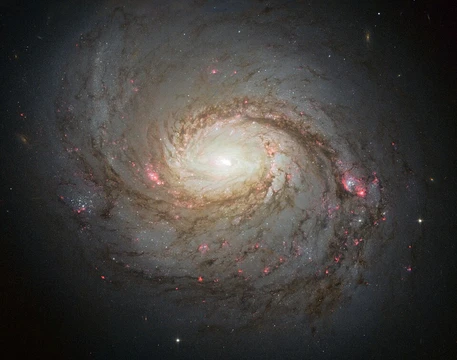
Markarian 382
A narrow-line Seyfert galaxy with X-ray variability and a barred spiral host.

Markarian 382 is a Type 1 Seyfert galaxy with an active galactic nucleus, situated in the constellation Lynx. Its redshift (z) is 0.0331, and it was first detected during the 1415 GHz survey by A.G. de Bruyn and A.S. Wilson in November 1976. The galaxy is classified as radio-quiet.
This narrow-line Seyfert galaxy shows X-ray variability, alternating between high and low flux states. In the high state, its optical spectrum appears soft, accompanied by low fractional variability in X-ray bands; the low state produces the opposite spectral characteristics. The host galaxy is a barred spiral of type SBa, as revealed by Hubble Space Telescope imaging. Its structure consists of a single bulge and disk with spiral arms, a bar encircled by a ring feature, and an outer pseudo-ring formed by the spiral arms. A curved dust lane lies northwest of the bright nucleus, running along the edge of the stellar bar.
The central supermassive black hole has an estimated mass of 0.90 ± 0.12 × 10⁷ M☉. However, a December 2022 study instead calculated it as 6.50⁺⁰·¹⁹₋₀·₂₉ M☉, with an Eddington luminosity of 0.81 L_Edd. In X-ray energy bands, the spectrum contains two warm absorbing components, each with turbulent velocities of 100 kilometers per second. An absorption system around the galaxy comprises at least four velocity components. Two of these are weak H I components with column densities around 10¹²·⁸ and 10¹³·³ cm⁻², and blueshifted velocities of -62 and -228 kilometers per second. Doubly ionized silicon absorption has also been detected.
Quick Facts
- Epoch
- J2000
- Constellation Name
- Lynx
- Ra
- 07 · 55 · 25.29
- Dec
- +39 · 11 · 09.90
- Z
- 0.033165
- H Radial V
- 9,943 km/s ± 14
- Dist Ly
- 474 Mly
- Appmag V
- 16.11
- Appmag B
- 16.45
- Names
- CGCG 207-005, KIG 0214, PGC 22190, MCG +07-17-001, SIG 0319, UNAM-KIAS 0045, KUG 0752+393, IRAS F07520+3918, MRK 382
Facts from the source article.
Lore & Background
Markarian 382 was first discovered in the 1415 GHz survey by A.G. de Bruyn and A.S. Wilson in November 1976. It has been classified as radio-quiet and specifically categorized as a narrow-line Seyfert galaxy. The galaxy is known to be X-ray variable with two flux states: a high flux state and a low flux state. When in a high flux state, its optical spectrum has a soft appearance, characterized by a low fractional variability state in X-ray bands; the low flux state shows the opposite spectrum.
The host galaxy of Markarian 382 is a barred spiral galaxy of type SBa, as imaged by the Hubble Space Telescope. It is modeled by a single bulge and disk showing spiral arms. The galaxy displays a bar surrounded by a ring feature, with its spiral structure forming a pseudo-ring on its outer side. A curved dust lane is located northwest from the central bright nucleus and along the edge of the stellar bar.
The central supermassive black hole has two estimates: one of 0.90 ± 0.12 × 10^7 M☉, and another from a December 2022 study of 6.50+0.19-0.29 M☉ with an Eddington luminosity of 0.81 LEdd. The X-ray spectrum contains two warm absorbing components with turbulent velocities of 100 and 100 kilometers per second. An absorption system around the galaxy is made up of at least four velocity components, including two weak H I components with column densities around 10^12.8 and 10^13.3 cm−2 and blueshifted velocities of -62 and -228 km/s. Doubly ionized silicon absorption has also been detected.
Reader's Guide
Markarian 382 is significant as a narrow-line Seyfert galaxy that exhibits clear X-ray variability between high and low flux states, providing a natural laboratory for studying the behavior of active galactic nuclei. Its classification as radio-quiet distinguishes it from many other Seyfert galaxies. The host galaxy's barred spiral structure, including a ring and pseudo-ring, along with a curved dust lane, offers insight into the morphology of galaxies hosting active nuclei. The presence of two conflicting black hole mass estimates—one from an earlier study and another from December 2022—highlights ongoing uncertainty in measuring supermassive black holes. The detection of multiple absorption components, including weak H I and doubly ionized silicon, adds to the understanding of the galaxy's circumgalactic medium. Its legacy lies in its role as a well-studied example of a variable, radio-quiet Seyfert galaxy with complex host morphology and absorption features.
Did You Know?
- The galaxy has two conflicting black hole mass estimates: 0.90 ± 0.12 × 10^7 M☉ and 6.50+0.19-0.29 M☉.
- Its host galaxy is a barred spiral of type SBa with a pseudo-ring and a curved dust lane northwest of the nucleus.
- The X-ray spectrum contains two warm absorbing components, each with a turbulent velocity of 100 km/s.
Frequently Asked Questions
What is Markarian 382?
Markarian 382 is a Type 1 Seyfert galaxy with an active galactic nucleus, and its host structure is a barred spiral. It also falls under the more specific subclass of narrow-line Seyfert galaxies.
Where in the sky can you find Markarian 382?
It resides in the constellation Lynx. A measured redshift of 0.0331 places it at a moderate cosmological distance from the Milky Way.
How was Markarian 382 first detected?
A.G. de Bruyn and A.S. Wilson identified it in November 1976 while conducting a 1415 GHz radio survey. Despite being catalogued through that radio work, the galaxy is classified as radio-quiet.
What makes Markarian 382's X-ray behavior notable?
The galaxy cycles between high and low X-ray flux states, a pattern astronomers call X-ray variability. In the high-flux phase the optical spectrum appears soft and X-ray fractional variability is low, while the low-flux phase reverses those spectral traits.
Why is Markarian 382 important to astrophysics?
As a narrow-line Seyfert embedded in a barred spiral, it offers a concrete case for studying how a central supermassive black hole interacts with its host structure. Its radio-quiet classification paired with measurable variability makes it a useful benchmark for AGN energetics models.
More in Spiral Galaxies, Part 2 1-24
Spotted an error? Know more?
Reader corrections go straight into our review queue. Suggest an edit · How this site is sourced