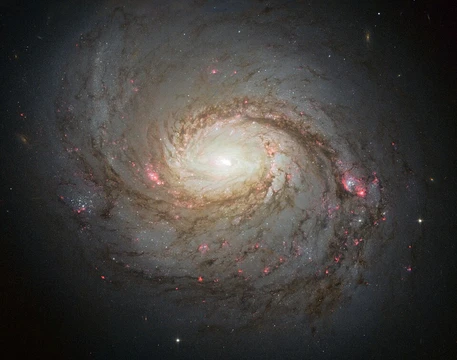
IC 860
A peculiar post-starburst galaxy with a dust-obscured nucleus.

IC 860 is a barred spiral galaxy in the constellation of Coma Berenices, located 155 million light years away. It is notable as a peculiar, nearby post-starburst galaxy in the early stages of transforming into its quiescent state, and as a vibrationally excited HCN luminous infrared galaxy (LIRG).
Quick Facts
- Epoch
- J2000
- Constellation Name
- Coma Berenices
- Ra
- 13 · 15 · 03.50
- Dec
- +24 · 37 · 07.79
- Z
- 0.012909
- H Radial V
- 3,870 km/s
- Dist Ly
- 155 Mly (47.52 Mpc)
- Appmag V
- 0.044
- Appmag B
- 0.057
- Names
- CGCG 130-023, IRAS 13126+2452, ECO 03976, MCG +04-31-015, PGC 46086
- Notes
- luminous infrared galaxy
Facts from the source article.
Lore & Background
IC 860 was discovered on June 16, 1892, by French astronomer Stephan Javelle. It is classified as a nearby post-starburst galaxy in early stages of transitioning to a quiescent state. It is also a vibrationally excited HCN luminous infrared galaxy (LIRG) with LHCN-VIB/LIR of 3.2 × 10⁻⁸. Its nucleus is dust-obscured, making it difficult to determine whether it hosts a starburst or an active galactic nucleus (AGN). The galaxy contains HI and OH absorption towards its central region. Its implied black hole mass is 4 × 10^7 M☉ based on a rotation velocity of vrot = 226 km s−1, and its Eddington luminosity is 2 × 10^12 L☉.
Low [C II] 157.7 μm-to-LFIR ratios and mid-infrared silicate absorption suggest IC 860 has a warm compact region in a current phase of rapid evolution, where inflows accumulate column densities of interstellar dust and gas sufficient to fuel star formation or its AGN. Optical imaging reveals a massive V-shaped kiloparsec dust structure. The nuclear gas has an outflow velocity of vout = 170–200 km s−1, which is insufficient to escape the galaxy unless accelerated. Additionally, IC 860 contains 4.83 GHz formaldehyde emission with a peak flux density of 2.0–2.2 mJy, observed by Arecibo Observatory, with three unique emission compartments centered between 3830 and 3990 km s−1.
Reader's Guide
IC 860 is significant as a nearby laboratory for studying the transformation of a post-starburst galaxy into a quiescent state. Its dust-obscured nucleus and ambiguous nature—whether powered by starburst or AGN—highlight the challenges in classifying such transitional galaxies. The detection of vibrationally excited HCN and low [C II] ratios points to a warm, compact region undergoing rapid evolution, with inflows building up gas and dust that may fuel future activity. The massive V-shaped kiloparsec dust structure and slow nuclear outflow (170–200 km s−1) suggest that gas cannot escape without additional acceleration, implying that feedback mechanisms are still developing. The formaldehyde emission at 4.83 GHz, with three distinct velocity components, provides a unique kinematic probe of the galaxy's central region. As described in the source article, IC 860 exemplifies an early-stage quiescent transition, where the interplay of inflows, outflows, and obscured activity shapes its future evolution.
Did You Know?
- It has a dust-obscured nucleus, making it unclear whether it is a starburst galaxy or an active galactic nucleus.
- The galaxy contains a massive V-shaped kiloparsec dust structure seen in optical imaging.
- It exhibits 4.83 GHz formaldehyde emission with three unique velocity compartments between 3830 and 3990 km s−1.
Scale, Mass, and Standing in the Local Group
The Triangulum Galaxy occupies a distinctive middle position among its nearest galactic neighbors. Measured at the D25 isophote—the surface brightness threshold of 25 magnitudes per square arcsecond—its disk spans roughly 18.74 kiloparsecs, or about 61,100 light-years, making it approximately seventy percent the diameter of the Milky Way. It ranks as the third-largest member of the Local Group, trailing only Andromeda and our own galaxy, yet it is also the second-smallest true spiral in that assembly, surpassed in compactness only by the Large Magellanic Cloud. Star counts tell a similar story of modesty: an estimated forty billion suns orbit within its disk, compared to four hundred billion in the Milky Way and a full trillion in Andromeda. The baryonic budget adds up to roughly ten billion solar masses when disk matter and gas are combined, but the dark matter halo extends the total to around fifty billion solar masses within a radius of seventeen kiloparsecs. Its proximity to Andromeda—about 0.75 million light-years—has led astronomers to suspect a gravitational partnership, with the two galaxies possibly orbiting each other or rebounding from a close encounter.
From Hodierna's Cloud to Hubble's Cepheids
The first recorded sighting of this galaxy likely belongs to the Sicilian astronomer Giovanni Battista Hodierna, who before 1654 noted a cloud-like nebulosity near the Triangle constellation in his treatise on cometary orbits. The magnitude he recorded matches what we now call M33, making his observation the earliest probable identification. Over a century later, Charles Messier independently logged the object on the night of August 25–26, 1764, and it entered his 1771 catalog as number thirty-three. William Herschel, who deliberately avoided duplicating most of Messier's entries, made a notable exception: on September 11, 1784, he catalogued the galaxy as H V-17. Herschel also singled out its most luminous H II region—eventually designated NGC 604—praising its spectrum as analogous to the Orion Nebula and noting its extraordinary span of nearly fifteen hundred light-years. Three smaller emission regions earned separate entries as well. By 1850, Lord Rosse had resolved the object into a true spiral, placing it among the first confirmed spiral nebulae.
The Faintest Permanent Object the Naked Eye Can Reach
Under the darkest skies on Earth, the Triangulum Galaxy pushes the boundary of unaided human vision to its absolute limit. At roughly 2.88 million light-years, it sits about half again as far away as the Andromeda Galaxy, making it the most distant permanent celestial entity that some observers can discern without any optical aid. Because of its true physical extent, it appears as a soft, diffuse patch of light rather than a pinpoint, even to the unaided eye. However, the practical challenge is significant. The galaxy's total apparent V-magnitude is 5.72, but Crumey's analysis shows its effective visual magnitude is closer to 6.6, meaning an observer must be able to detect stars at least that faint. In deep rural locations with a transparent, moonless sky, direct vision may suffice; in shallower rural settings, averted vision becomes necessary. This very difficulty is why the galaxy serves as one of the benchmark objects on the Bortle Dark-Sky Scale, a tool for quantifying how much light pollution a site suffers.
Cepheids, Eclipsing Binaries, and the Distance Puzzle
The transformation of spiral nebulae from vague smudges into confirmed external galaxies owes much to work done on this particular object. In 1922–23, John Charles Duncan and Max Wolf identified variable stars within its disk. Edwin Hubble then demonstrated in 1926 that thirty-five of those variables were classical Cepheids, whose period-luminosity relationship allowed him to estimate distances. The results aligned with the emerging view that spiral nebulae were independent island universes of gas and dust, not mere wisps inside the Milky Way. Determining the galaxy's exact distance has remained an ongoing challenge. Averages of over one hundred published estimates since 1987 settle near 2.88 million light-years, though individual measurements span from 2.38 to 3.07 million. In 2004, both the Cepheid method and the tip-of-the-red-giant-branch technique yielded values of approximately 2.77 and 2.59 million light-years respectively. A 2006 discovery of an eclipsing binary within the galaxy offered yet another geometric lever, reinforcing the picture of a distance slightly greater than Andromeda's own 2.54 million light-years.
Frequently Asked Questions
What is IC 860?
IC 860 is a barred spiral galaxy currently caught in the early phase of winding down its star formation, earning it a post-starburst label. It also qualifies as a luminous infrared galaxy showing vibrationally excited HCN emission, making it a dual curiosity for observers.
Where in the sky can I find IC 860?
The galaxy sits in the constellation Coma Berenices, roughly 155 million light years from Earth. Its heavily dust-shrouded nucleus makes it a tougher target for optical imaging than many nearby spirals.
Who discovered IC 860 and when?
French astronomer Stephan Javelle identified the galaxy on June 16, 1892. It was subsequently entered into the Index Catalogue under the designation IC 860.
What makes IC 860 unusual among nearby galaxies?
It is a relatively close example of a peculiar post-starburst system caught mid-transition toward a quiescent state, with a dust-obscured core. Its status as a vibrationally excited HCN LIRG adds another layer of distinctiveness to an already atypical profile.
How massive is the black hole at the center of IC 860?
Estimates place the implied mass of its central supermassive black hole at roughly four times ten to the seventh solar masses. That is a respectable engine for a barred spiral of this size, though far below the titanic cores found in giant ellipticals.
More in Spiral Galaxies, Part 2 1-24
Spotted an error? Know more?
Reader corrections go straight into our review queue. Suggest an edit · How this site is sourced