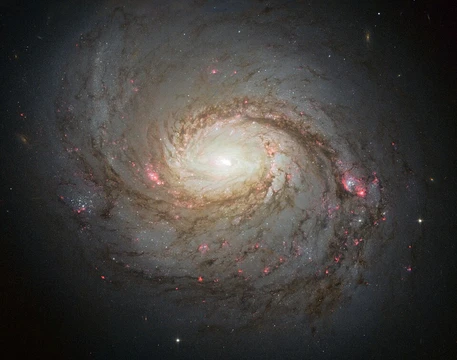
GAMA202627
A barred spiral galaxy with two massive satellite companions like the Milky Way.

GAMA202627, also cataloged as G202627 and PGC 165514, is a barred spiral galaxy resembling the Milky Way. It lies roughly 700 million light-years from Earth in the constellation Hydra. The galaxy was identified in a 2012 study by astronomer Dr. Aaron Robotham, who was affiliated with both the University of Western Australia node of the International Centre for Radio Astronomy Research (ICRAR) and the University of St Andrews in Scotland. His work involved searching for galaxy groups similar to our own within the Galaxy And Mass Assembly (GAMA) survey, an international project led by ICRAR and the Australian Astronomical Observatory that maps the local Universe in high detail. GAMA202627 has a redshift of z = 0.051219 ± 0.000123, corresponding to a distance of 705 million light-years, or 216 megaparsecs.
What makes this galaxy especially rare is its possession of two large satellite galaxies orbiting nearby. Dr. Robotham noted that only about 3% of Milky Way-like galaxies host companion galaxies comparable to the Magellanic Clouds, making such systems uncommon. His survey found just 14 galaxy systems resembling our own, with two of those being near-perfect matches. GAMA202627 is one such match: like the Milky Way, which is accompanied by the Large and Small Magellanic Clouds visible in the southern sky, this galaxy has two massive satellites in close proximity—a configuration few other galaxies share.
Quick Facts
- Epoch
- J2000
- Constellation Name
- Hydra
- Ra
- 08 · 42 · 28.3
- Dec
- -00 · 16 · 18
- Appmag V
- 16.1
- Z
- 0.051219 · 0.000123
- Dist Ly
- 700 Mly
- Names
- PGC 165514, IRAS 08399-0005
Facts from the source article.
Lore & Background
GAMA202627 was described in a 2012 paper by astronomer Dr Aaron Robotham, jointly from the University of Western Australia node of the International Centre for Radio Astronomy Research (ICRAR) and the University of St Andrews in Scotland. He searched for groups of galaxies similar to ours in the most detailed map of the local Universe yet, the Galaxy And Mass Assembly survey (GAMA), an international collaboration led from ICRAR and the Australian Astronomical Observatory. The galaxy has a redshift measured at z = 0.051219 +/- 0.000123, corresponding to a distance of 705 Mly, or 216 Mpc.
The Milky Way is surrounded by its close companions, the Large and Small Magellanic Clouds, which are visible in the southern sky. Many galaxies have smaller galaxies in orbit around them, but few have two that are as large as the Magellanic Clouds. Dr Robotham noted, 'We found about 3% of galaxies similar to the Milky Way have companion galaxies like the Magellanic Clouds, which is very rare indeed. In total we found 14 galaxy systems that are similar to ours, with two of those being an almost exact match.' GAMA202627 is one of those rare systems, making it unique for having two massive satellite galaxies in close proximity.
Reader's Guide
GAMA202627's significance lies in its rarity as a galaxy system with two massive satellite companions, analogous to the Milky Way's Magellanic Clouds. Dr Robotham's 2012 study, using the GAMA survey, found that only about 3% of galaxies similar to the Milky Way have such companions. Out of 14 galaxy systems identified as similar to ours, only two were an almost exact match, and GAMA202627 is one of them. This makes it a key object for understanding the frequency and conditions under which large satellite pairs occur, providing a comparative benchmark for the Milky Way's own structure. The galaxy's redshift and distance measurements (z = 0.051219 +/- 0.000123; 705 Mly or 216 Mpc) place it firmly in the local Universe, allowing detailed study within the context of the GAMA survey's comprehensive mapping.
Did You Know?
- GAMA202627 is a barred spiral galaxy similar to the Milky Way.
- It is located 700 million light-years from Earth in the constellation of Hydra.
- The galaxy was identified in a 2012 paper by Dr Aaron Robotham using the GAMA survey.
Frequently Asked Questions
What is GAMA202627?
GAMA202627 is a barred spiral galaxy that closely mirrors the structure of our own Milky Way, including two large satellite companions orbiting alongside it. It sits approximately 700 million light-years away in the direction of the constellation Hydra.
Who first identified GAMA202627?
The galaxy was cataloged in a 2012 study by Dr. Aaron Robotham, who worked at both ICRAR's University of Western Australia node and the University of St Andrews. His research focused on finding galaxy groups that resemble our own Local Group using data from the GAMA survey.
What other designations does GAMA202627 carry?
Beyond its primary GAMA202627 label, the galaxy is also listed as G202627 and PGC 165514 in various astronomical catalogs. Its measured redshift of roughly 0.051219 places it at about 216 megaparsecs from Earth.
Why do fans and astronomers consider GAMA202627 significant?
It serves as a rare nearby analog to the Milky Way, featuring a similar barred spiral morphology paired with two massive companion galaxies. This makes it a valuable reference point for understanding how our own galactic neighborhood might look to outside observers.
How far away is GAMA202627 and where can I find it in the sky?
The galaxy is roughly 700 million light-years distant, meaning its light has been traveling for that span before reaching us. It appears in the sky toward the constellation Hydra, though it is far too faint for casual observation without serious equipment.
More in Spiral Galaxies, Part 2 1-24
Spotted an error? Know more?
Reader corrections go straight into our review queue. Suggest an edit · How this site is sourced