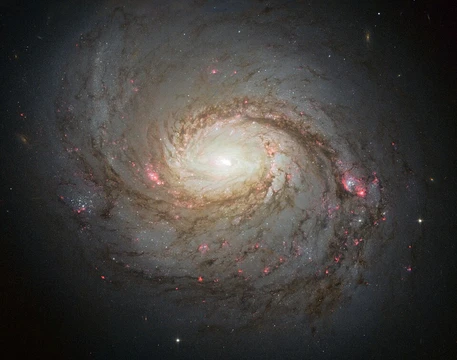
NGC 959
A spiral galaxy with uncertain classification in Triangulum.

NGC 959 is a spiral galaxy in the northern constellation Triangulum, discovered by French astronomer Édouard Stephan on 9 November 1876. It lies about 36 million light-years away and is moving away from Earth at a heliocentric radial velocity of 596 km/s. The galaxy belongs to the NGC 1023 Group.
Its morphological classification is listed as Sdm:, meaning it is a spiral with irregular, disorganized arms and no central bulge, though the colon indicates some uncertainty. The galaxy has a visual magnitude of 12.4. Its plane is tilted at an angle of 50° to the sky, giving it an elliptical appearance, with the major axis oriented at a position angle of 65°. The D25 ellipse—where surface brightness drops to magnitude 25—measures 2.3 by 1.4 arcminutes.
When images of NGC 959 are corrected for dust extinction, a central bar becomes visible, along with a noticeable bulge or central condensation. This suggests the galaxy may instead be classified as SBcd. It also shows a cuspy central density profile and a bulge-like steady decrease in ellipticity toward the core.
Quick Facts
- Epoch
- J2000
- Constellation Name
- Triangulum
- Ra
- 02 · 32 · 23.923
- Dec
- +35 · 29 · 40.46
- Dist Ly
- 11.0 Mpc
- Group Cluster
- NGC 1023 Group
- Appmag V
- 12.380.14
- Appmag B
- 12.950.14
Facts from the source article.
Lore & Background
NGC 959 was discovered on 9 November 1876 by French astronomer Édouard Stephan. It lies at a distance of 36 million light years and is receding with a heliocentric radial velocity of 596 km/s. The galaxy is a member of the NGC 1023 Group. Its morphological class is listed as Sdm:, indicating a spiral with disorganized, irregular arms and no central bulge, though the colon denotes uncertainty. The galactic plane is inclined at 50° to the plane of the sky, giving it an elliptical profile with the major axis aligned at a position angle of 65°. The D25 ellipse, where surface brightness drops to magnitude 25, measures 2.3 × 1.4 arcminutes.
Reader's Guide
When images of NGC 959 are corrected for extinction from dust, a central bar feature becomes discernible, and the galaxy shows a non-negligible bulge or central condensation. This suggests it may instead have a morphological type of SBcd. It displays a cuspy central density profile and a bulge-like monotonic decrease in ellipticity toward the core. These details highlight the importance of dust correction in classifying spiral galaxies and underscore the uncertainty inherent in morphological typing, as the galaxy's true structure may differ from its apparent classification.
Did You Know?
- Its morphological class is listed as Sdm: with a colon indicating uncertainty.
- When corrected for dust extinction, a central bar feature and bulge become visible, suggesting a possible SBcd classification.
More in Spiral Galaxies, Part 2 1-24
Spotted an error? Know more?
Reader corrections go straight into our review queue. Suggest an edit · How this site is sourced