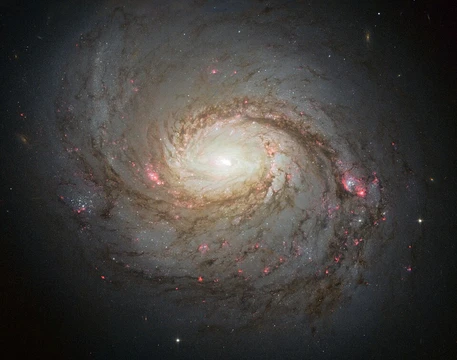
NGC 958
Barred spiral Seyfert II galaxy in Cetus with three supernovae.

NGC 958 is a barred spiral galaxy located in the constellation Cetus. It is notable as a Seyfert II galaxy, meaning it has a quasar-like nucleus with very high surface brightness and strong, high-ionization emission lines, yet its host galaxy remains clearly detectable. It is also classified as a luminous infrared galaxy (LIRG) by the NASA/IPAC Extragalactic Database.
Quick Facts
- Constellation Name
- Cetus
- Epoch
- J2000
- Ra
- 02 · 30 · 42.8350
- Dec
- -02 · 56 · 20.126
- Dist Ly
- 81.20 ± 5.69 Mpc
- Z
- 0.019150
- H Radial V
- 5741 ± 2 km/s
- Appmag V
- 12.2
Facts from the source article.
Lore & Background
NGC 958 was discovered by German-British astronomer William Herschel on 20 September 1784. Its velocity with respect to the cosmic microwave background is 5505 ± 17 km/s, which corresponds to a Hubble distance of 81.20 ± 5.69 Mpc (~265 million light-years). However, 19 non-redshift measurements give a closer distance of 58.93 ± 12.91 Mpc (~192 million light-years), indicating a discrepancy between the two distance estimates.
The galaxy is classified as a Seyfert II galaxy, characterized by a quasar-like nucleus with very high surface brightness and spectra revealing strong, high-ionization emission lines, but unlike quasars, the host galaxy is clearly detectable. The NASA/IPAC Extragalactic Database (NED) also lists NGC 958 as a luminous infrared galaxy (LIRG).
Three supernovae have been observed in NGC 958: SN 2005A (Type Ia, mag. 17.1) discovered by the Lick Observatory Supernova Search on 5 January 2005; SN 2022ao (Type Ic, mag. 17.997) discovered by ATLAS on 5 January 2022; and SN 2022acbu (Type II, mag. 20.34) discovered by the Zwicky Transient Facility on 30 November 2022.
Reader's Guide
NGC 958's significance lies in its dual classification as both a Seyfert II galaxy and a luminous infrared galaxy, making it a valuable object for studying active galactic nuclei and star formation in infrared-bright environments. The presence of three supernovae—SN 2005A (Type Ia), SN 2022ao (Type Ic), and SN 2022acbu (Type II)—provides a record of stellar explosions across different types, contributing to supernova statistics and progenitor studies. The distance discrepancy between the Hubble distance (81.20 Mpc) and the average of 19 non-redshift measurements (58.93 Mpc) highlights the challenges in extragalactic distance determination, with the non-redshift values suggesting a closer proximity. Discovered by William Herschel in 1784, NGC 958 has been observed by multiple surveys, including LOSS, ATLAS, and the Zwicky Transient Facility, and its data are accessible via the NASA/IPAC Extragalactic Database and WikiSky. Its legacy includes serving as a target for multi-wavelength studies, as indicated by the external links to DSS2, SDSS, GALEX, IRAS, Hydrogen α, and X-Ray imagery.
Did You Know?
- NGC 958 is a barred spiral galaxy in the constellation Cetus.
- It is a Seyfert II galaxy with a quasar-like nucleus but a clearly detectable host galaxy.
- The galaxy's distance is disputed: Hubble distance gives ~265 million light-years, while 19 non-redshift measurements average ~192 million light-years.
More in Spiral Galaxies, Part 2 1-24
Spotted an error? Know more?
Reader corrections go straight into our review queue. Suggest an edit · How this site is sourced