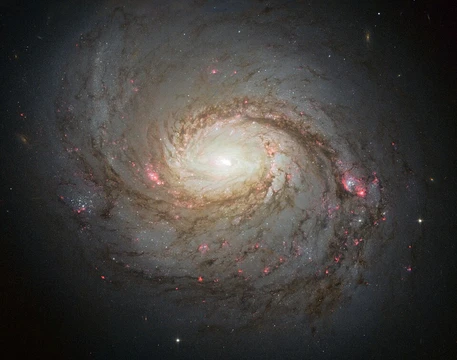
NGC 945
Barred spiral galaxy in Cetus, brightest in its group.

NGC 945 is a barred spiral galaxy situated in the constellation Cetus, south of the celestial equator. It lies about 200 million light-years from the Milky Way and spans roughly 135,000 light-years across. William Herschel first spotted it on November 28, 1785. The galaxy forms a gravitationally bound pair with NGC 948, a spiral galaxy discovered by Lewis Swift in 1886. NGC 948 has a Hubble distance of about 205 million light-years, a luminosity class of III, a broad HI line, and is considered a low surface brightness galaxy due to its surface brightness of 14.17 mag/am². Other nearby galaxies in the same region include NGC 942, NGC 943, NGC 950, and IC 230.
Two supernovae have been observed in NGC 945: SN 1998dt, a Type Ib event at magnitude 17.7 discovered on September 1, 1998, by T. Shefler as part of the Lick Observatory Supernova Search; and SN 2020obd, a Type II event at magnitude 17.3 discovered by ATLAS on July 6, 2020.
NGC 945 is the brightest member of a group of at least seven galaxies named after it. The other six are NGC 948, NGC 950, NGC 977, MCG -2-7-20, MCG -2-7-32, and MCG -2-7-337.
Quick Facts
- Epoch
- J2000
- Appmag B
- 1202h 28m 36s
- Dec
- -10° 32 20
- Ra
- 02h 28m 36s
- Sbrightness
- 23.01 mag/arcsec2
Facts from the source article.
Lore & Background
NGC 945 was discovered by astronomer William Herschel on November 28, 1785. It is a barred spiral galaxy located south of the celestial equator in the constellation Cetus. The galaxy is estimated to be 200 million light-years from the Milky Way and about 135,000 light-years in diameter. It lies extremely close to NGC 948, with which it forms a gravitationally bound pair of galaxies. In the same area of the sky are the galaxies NGC 942, NGC 943, NGC 950, and IC 230.
Two supernovae have been observed in NGC 945: SN 1998dt (Type Ib, magnitude 17.7) discovered by T. Shefler of the University of California at Berkeley on 1 September 1998 as part of the LOSS program at Lick Observatory, and SN 2020obd (Type II, magnitude 17.3) discovered by ATLAS on 6 July 2020. NGC 945 is the brightest galaxy in a group of at least seven members that bears its name, which includes NGC 948, NGC 950, NGC 977, MCG -2-7-20, MCG -2-7-32, and MCG -2-7-337.
Reader's Guide
NGC 945 holds significance as the brightest galaxy in its namesake group, a collection of at least seven galaxies that includes NGC 948, NGC 950, NGC 977, and several MCG objects. Its gravitational pairing with NGC 948 provides a clear example of interacting galaxies, a key area of study in extragalactic astronomy. The two supernovae recorded in NGC 945—SN 1998dt (Type Ib) and SN 2020obd (Type II)—offer valuable data on stellar explosions in barred spiral systems. Discovered by William Herschel in 1785, the galaxy has been observed for over two centuries, contributing to our understanding of galaxy structure and dynamics. Its location in Cetus, south of the celestial equator, and its membership in a well-defined group make it a useful reference point for studies of galaxy clustering and evolution. The presence of a low surface brightness companion, NGC 948, further enriches the context for research on galaxy diversity.
More in Spiral Galaxies, Part 2 1-24
Spotted an error? Know more?
Reader corrections go straight into our review queue. Suggest an edit · How this site is sourced