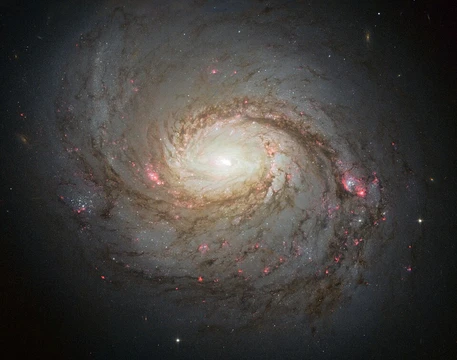
NGC 925
Barred spiral with offset bar and dominant southern arm.

NGC 925 is a barred spiral galaxy roughly 30 million light-years from Earth in the constellation Triangulum. It was first observed by William Herschel on September 13, 1784. Classified as SB(s)d, the galaxy features a bar and spiral arms that are loosely wound, with no ring structure. The southern spiral arm is more pronounced than the northern one, which appears flocculent and less organized. The bar is not centered on the galaxy’s core and hosts star formation along its entire length. These two traits—a dominant spiral arm and an offset bar—are typical of Magellanic spiral galaxies. The galaxy is tilted 55° relative to our line of sight, at a position angle of 102°.
NGC 925 belongs to the NGC 1023 Group, a nearby cluster of galaxies bound by gravity. The closest other member of the group lies at least 650,000 light-years (200,000 parsecs) away. A neutral hydrogen cloud with a mass of 10 million solar masses is connected to NGC 925 by a streamer. It is unclear whether this cloud is a dwarf satellite galaxy, the remnant of a past tidal interaction, or a primordial gas cloud.
No supernovae have been observed in NGC 925, but a luminous red nova, designated AT 2023nzt (type LRN, magnitude 19), was detected there on July 26, 2023.
Quick Facts
- Epoch
- J2000
- Constellation Name
- Triangulum
- Ra
- 02 · 27 · 16.913
- Dec
- +33 · 34 · 43.97
- Z
- 553 ± 3 km/s
- H Radial V
- 564 km/s
- Dist Ly
- 30.3 ± 2.3 million light years (9.29 ± 0.69 Mpc)
- Group Cluster
- NGC 1023 Group
- Appmag V
- 10.7
Facts from the source article.
Lore & Background
German-British astronomer William Herschel discovered NGC 925 on 13 September 1784. Its morphological classification is SB(s)d, indicating a bar structure and loosely wound spiral arms with no ring. The spiral arm to the south is stronger than the northern arm, with the latter appearing flocculent and less coherent. The bar is offset from the center of the galaxy and is the site of star formation all along its length. Both of these morphological traits—a dominant spiral arm and the offset bar—are typically characteristics of a Magellanic spiral galaxy. The galaxy is inclined at an angle of 55° to the line of sight along a position angle of 102°.
NGC 925 is a member of the NGC 1023 Group, a nearby, gravitationally-bound group of galaxies associated with NGC 1023. However, the nearest member lies at least 650,000 ly (200,000 pc) distant from NGC 925. There is a 10 million solar mass (M☉) cloud of neutral hydrogen attached to NGC 925 by a streamer. It is uncertain whether this is a satellite dwarf galaxy, the remnant of a past tidal interaction, or a cloud of primordial gas. Although no supernovae have been observed in NGC 925 yet, a luminous red nova, designated AT 2023nzt (type LRN, mag. 19), was discovered on 26 July 2023.
Reader's Guide
NGC 925 is significant as a nearby example of a barred spiral galaxy with Magellanic spiral characteristics, including an offset bar and a dominant southern spiral arm. Its classification SB(s)d places it among galaxies with loosely wound arms and no ring structure. The galaxy's offset bar, which hosts star formation along its entire length, and the asymmetry between its spiral arms provide insight into the dynamics of Magellanic-type galaxies. As a member of the NGC 1023 Group, it offers a case study of a relatively isolated group member, with the nearest companion at least 650,000 light-years away. The attached neutral hydrogen cloud of 10 million solar masses, whose nature remains uncertain—whether a satellite dwarf, tidal remnant, or primordial gas—adds to its interest for studies of galaxy interactions and gas accretion. The discovery of the luminous red nova AT 2023nzt in 2023, though no supernovae have been observed, marks a notable transient event in this galaxy.
Did You Know?
- NGC 925 was discovered by William Herschel on 13 September 1784.
- The galaxy has an offset bar that is the site of star formation along its entire length.
- A 10 million solar mass cloud of neutral hydrogen is attached to NGC 925 by a streamer, but its origin is uncertain.
- A luminous red nova, AT 2023nzt, was discovered in NGC 925 on 26 July 2023.
More in Spiral Galaxies, Part 2 1-24
Spotted an error? Know more?
Reader corrections go straight into our review queue. Suggest an edit · How this site is sourced