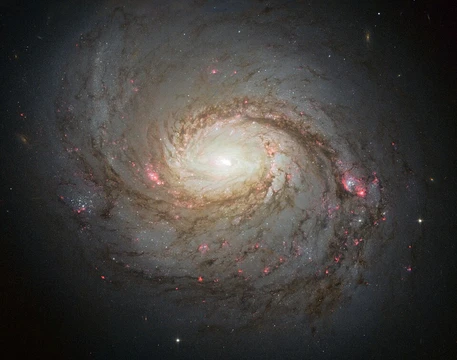
NGC 922
One of the nearest known collisional galaxies in Fornax.

NGC 922 is a peculiar barred spiral galaxy in the southern constellation of Fornax, notable as one of the nearest known collisional galaxies. It was discovered by German-British astronomer William Herschel on 17 November 1784. The galaxy is distinguished by a C-shaped ring of H-alpha emission resulting from a merger with a gas-rich dwarf galaxy, and it hosts a starburst with a star formation rate of 7–8 solar masses per year.
Quick Facts
- Epoch
- J2000
- Constellation Name
- Fornax
- Ra
- 02 · 25 · 04.4634ned
- Dec
- -24 · 47 · 16.798ned
- Dist Ly
- 43.4 Mpc
- Appmag V
- 12.21
Facts from the source article.
Lore & Background
NGC 922 was originally described as a dust-obscured grand-design galaxy, but observation of its features suggests it has undergone a merger with a gas-rich dwarf galaxy, resulting in a distinctive C-shaped ring of H-alpha emission. The main galaxy has a stellar mass estimated at 5.47 billion solar masses, while the dwarf companion has 28.2 million solar masses. The net mass of NGC 922 is estimated as 75 billion solar masses within a radius of 13.4 kpc, with 72% being dark matter and 20% neutral hydrogen. It is a starburst galaxy, with star formation occurring at a rate of 7–8 solar masses per year. New star clusters have formed in the ring or bar with a mean age of 16 million years, whereas older clusters of 50 million years or more are predominantly found in the nuclear region. The tidal plume pointing toward the companion mainly consists of much older stars, indicating little new star formation in that feature.
About 104 kpc away from NGC 922, there is a dwarf galaxy called S2 that was once thought to have been responsible for NGC 922's structure. A stellar plume extends from the galaxy in the direction of S2, located about 8′ away. However, the stellar plume is not connected to S2, and S2 also has its own tidal structure, which would not be possible if it had already 'punched' through NGC 922. The object was described by the Herschels as 'considerably faint, pretty large, round, gradually pretty much brighter middle.'
Reader's Guide
NGC 922 holds significance as one of the nearest known collisional galaxies, providing a close-up laboratory for studying the effects of galaxy mergers. The article notes that it was originally described as a dust-obscured grand-design galaxy, but subsequent observations revealed it has undergone a merger with a gas-rich dwarf galaxy, producing a distinctive C-shaped ring of H-alpha emission. The presence of a dwarf companion S2 about 104 kpc away, along with a stellar plume pointing toward it, initially suggested S2 was responsible for the galaxy's structure. However, the article explicitly states that the plume is not connected to S2, and S2 has its own tidal structure, which would not be possible if it had already passed through NGC 922. This unresolved detail underscores the complexity of interpreting merger remnants. The galaxy's starburst activity, with a star formation rate of 7–8 solar masses per year, and the age distribution of star clusters—young clusters in the ring or bar versus older clusters in the nuclear region—offer insights into how collisions trigger star formation. The high dark matter fraction (72%) and neutral hydrogen content (20%) further characterize its mass composition. Three supernovae have been observed in NGC 922, adding to its observational record.
Did You Know?
- NGC 922 is one of the nearest known collisional galaxies.
- Three supernovae have been observed in NGC 922: SN 2002gw, SN 2008ho, and SN 2024fa.
More in Spiral Galaxies, Part 2 1-24
Spotted an error? Know more?
Reader corrections go straight into our review queue. Suggest an edit · How this site is sourced