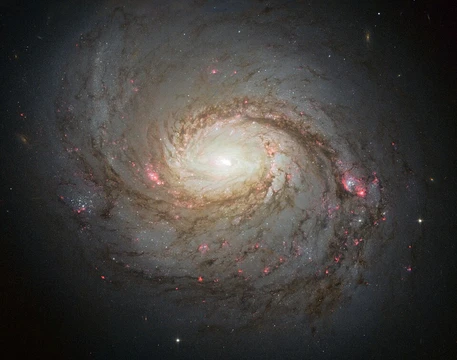
NGC 871
Barred spiral galaxy in Aries, member of gas-rich group LGG 53.

NGC 871 is a barred spiral galaxy in the constellation Aries. William Herschel first observed it on October 14, 1784, and included it in his 1786 Catalogue of Nebulae and Clusters of Stars. Astronomers classify NGC 871 as a member of LGG 53, a group of nine galaxies that also includes UGC 1693, UGC 1761, NGC 876, NGC 877, UGC 1817, IC 1791, and UGC 1773, based on their radial velocities and distances.
The group containing NGC 871, NGC 876, and NGC 877 is notable for its gas-rich interactions. In 2012, astronomers used the Giant Metrewave Radio Telescope and the Canada–France–Hawaii Telescope to measure HI emissions from NGC 871 and other LGG 53 members. The group resides within a common HI distribution with a total mass of 6 × 10¹⁰ M☉, a rare structure in the local Universe—galaxies with an HI mass exceeding 10¹⁰ M☉ account for less than 2 percent of cases, and each large spiral in this group surpasses that threshold. The study found that seven of the eight gas-rich detections (three spirals and four dwarfs) contain stellar components and behave like standard dark-matter-dominated galaxies formed during the epoch of galaxy assembly. One member, AGC 749170, with a mass of approximately 10⁹·³ M☉, likely resulted from major mergers and intense tidal interactions, producing the massive structure observed today.
Quick Facts
- Epoch
- J2000
- Ra
- 02 · 17 · 10.7
- Dec
- +14 · 32 · 53
- Constellation Name
- Aries
- Appmag V
- 13.4 mag
- Appmag B
- 14.1 mag
- Z
- +0.012475 · 0.000003
- H Radial V
- 3740 ± 1 km/s
- Names
- NGC 0871 • UGC 1759 • PGC 8722 • CGCG 438-046 • MCG -02-06-053 • IRAS 02144+1419 • 2MASX J02171073+1432521 • CN 513
- Dist Ly
- 52,2 ± 3,7 / (170 ± 12)6 ly)
Facts from the source article.
Lore & Background
NGC 871 was discovered and first described by William Herschel on October 14, 1784, with the findings made public through his Catalogue of Nebulae and Clusters of Stars in 1786. Astronomers assign this galaxy to LGG 53 along with eight other members: UGC 1693, UGC 1761, NGC 876, NGC 877, UGC 1817, IC 1791, and UGC 1773. The group is also referred to as NGC 871/6/7.
In 2012, astronomers conducted an extensive survey to measure HI emissions from NGC 871 and other galaxies in LGG 53, using the Giant Metrewave Radio Telescope and Canada–France–Hawaii Telescope. This galaxy group first attracted attention due to its gas-rich interaction and for harboring AGC 749170, a galaxy with a mass of ~10^9.3 M☉. The group resides in a common HI distribution with a total HI mass of 6 × 10^10 M☉, a massive structure very rare in the local Universe (galaxies with HI mass > 10^10 M☉ represent less than 2 percent of cases). Each large spiral in NGC 871/6/7 seems to exceed this value.
The study suggests seven of the eight gas-rich detections (three spirals and four dwarfs) contain stellar components and appear to be standard dark-matter dominated galaxies built during the epoch of galaxy assembly. AGC 749170, however, is probably the result of major mergers and very active tidal interaction, resulting in the massive structure observed today.
Reader's Guide
NGC 871's significance lies in its membership in LGG 53, a gas-rich galaxy group that provides a laboratory for studying tidal interactions and galaxy evolution. The 2012 survey using the Giant Metrewave Radio Telescope and Canada–France–Hawaii Telescope revealed that the group resides in a common HI distribution with a total mass of 6 × 10^10 M☉, a rare structure in the local Universe. This massive HI envelope, along with the presence of AGC 749170—a galaxy likely formed through major mergers and active tidal interaction—offers insight into how gas-rich interactions shape galaxy assembly. The study found that most galaxies in the group are standard dark-matter dominated systems built during the epoch of galaxy assembly, while AGC 749170 represents a more dynamically evolved product. NGC 871 itself, as a barred spiral in this interacting environment, contributes to understanding how such groups evolve and how tidal forces influence galactic structure and star formation. The group's rarity (less than 2% of local galaxies have HI mass exceeding 10^10 M☉) underscores its value for studying extreme gas-rich systems.
Did You Know?
- NGC 871 was discovered by William Herschel on October 14, 1784, and published in his 1786 Catalogue of Nebulae and Clusters of Stars.
- It is a member of LGG 53, a group of nine galaxies including NGC 876 and NGC 877.
- AGC 749170, a galaxy in this group with mass ~10^9.3 M☉, is likely the result of major mergers and very active tidal interaction.
More in Spiral Galaxies, Part 2 1-24
Spotted an error? Know more?
Reader corrections go straight into our review queue. Suggest an edit · How this site is sourced