NGC 685
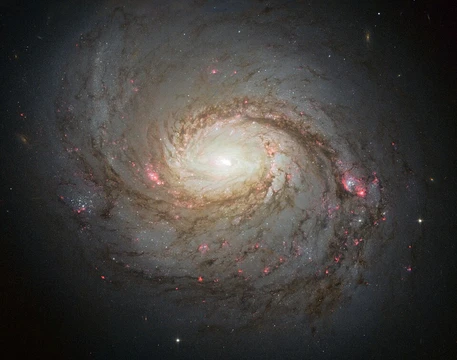
A barred spiral galaxy with patchy arms and bright star clusters.

NGC 685 is a barred spiral galaxy located in the constellation Eridanus, approximately 55 million light-years from Earth. It is notable for its nearly face-on orientation, bright central bar, and patchy, curving arms that complete three-quarters of a revolution before fading. The galaxy spans about 74,000 light-years, making it slightly more than half the size of the Milky Way.
Quick Facts
- Epoch
- J2000
- Ra
- 01 · 47 · 42.8593
- Dec
- -52 · 45 · 42.446
- Dist Ly
- 50–58 Mly (15.2-17.8 Mpc)
- Z
- 0.004546 ± 0.000010
- H Radial V
- 1,363 ± 3 km/s
- Appmag V
- 11.2
- Constellation Name
- Eridanus
Facts from the source article.
Lore & Background
NGC 685 was discovered by John Herschel on October 3, 1834. It is seen nearly face-on, with an inclination of 23°, revealing a bright central bar and patchy, curving arms of low surface brightness that emerge from the bar and complete three-quarters of a revolution before fading. Along the arms, patches of bright blue indicate star clusters—groups of stars held together by mutual gravitational attraction. Wisps of dark red near the central bar depict interstellar gas and dust, the raw material for star formation. The southeast edge of the galaxy features three bright HII regions, which Halton Arp argued are a companion galaxy. H-alpha emission is stronger in the southeastern half, and the total star formation rate is estimated at 0.42 solar masses per year. At the galaxy's center, a supermassive black hole is predicted, with a mass estimated between 7.6 and 40 million solar masses based on the spiral arm pitch angle.
Reader's Guide
NGC 685 is significant as a barred spiral galaxy that offers a clear, nearly face-on view of its structure, allowing detailed study of its spiral arms, star clusters, and interstellar medium. The galaxy's low-surface-brightness arms and the presence of bright blue star clusters highlight ongoing star formation, while the dark red wisps of gas and dust near the bar indicate regions where new stars may form. The three bright HII regions on the southeast edge, argued by Halton Arp to be a companion galaxy, introduce an element of uncertainty regarding the galaxy's immediate environment. The estimated star formation rate of 0.42 solar masses per year provides a measure of its current activity. The predicted supermassive black hole at its center, with a mass range derived from spiral arm pitch angle, adds to its astrophysical interest. NGC 685's legacy lies in its representation of a typical barred spiral galaxy, offering insights into galactic structure, star formation processes, and the relationship between spiral arm morphology and central black hole mass.
Did You Know?
- NGC 685 is about 74,000 light-years across, a little more than half the size of the Milky Way.
- The galaxy's spiral arms complete three-quarters of a revolution before fading.
- The central supermassive black hole's mass is estimated between 7.6 and 40 million solar masses.
More in Spiral Galaxies, Part 2 1-24
Spotted an error? Know more?
Reader corrections go straight into our review queue. Suggest an edit · How this site is sourced