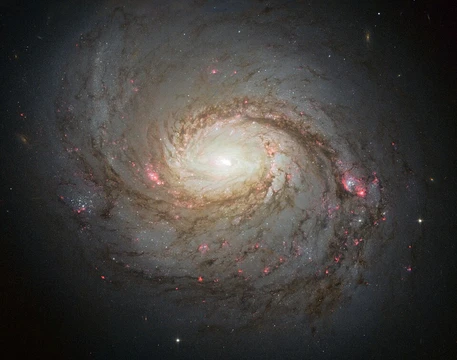
NGC 672
Barred spiral galaxy interacting with IC 1727 in Triangulum.

NGC 672 is a barred spiral galaxy located in the northern constellation of Triangulum, approximately 23.4 megalight-years from the Milky Way. It is notable for forming an interacting pair with the irregular galaxy IC 1727, with a tidal bridge observed between them in the neutral hydrogen radio band.
Quick Facts
- Epoch
- J2000
- Constellation Name
- Triangulum
- Ra
- 01 · 47 · 54.47627
- Dec
- +27 · 25 · 57.9948
- Z
- 0.001403
- H Radial V
- 425 km/s
- Dist Ly
- 7.18 ±
- Appmag V
- 11.09 · 0.03
Facts from the source article.
Lore & Background
The original object designated NGC 672 was discovered by the German-born astronomer William Herschel on 26 October 1786, but this was later cataloged as NGC 614. The object now identified as NGC 672 was discovered by John Herschel on 11 November 1827. The galaxy is positioned around 2° to the southwest of the star Alpha Trianguli.
NGC 672 is located at a distance of approximately 23.4 megalight-years from the Milky Way, where it forms an interacting pair with the irregular galaxy IC 1727. In the neutral hydrogen radio band, a tidal bridge is observed between the galaxies. NGC 672 appears to be the more massive of the two, and hence IC 1727 shows more distortion from the interaction. Together they form members of a combined group of galaxies that includes NGC 784.
The morphological classification of NGC 672 is SB(s)cd, indicating it is a barred spiral galaxy with no ring structure around the central bar and moderately to loosely-wound spiral arms. In the visual spectrum, the galaxy appears symmetrical with clearly defined spiral arms. It is gas-rich with an estimated mass of 38 billion times the mass of the Sun and a star formation rate of 0.3 M☉ yr−1.
Reader's Guide
NGC 672 is significant as a nearby barred spiral galaxy that is actively interacting with its companion, IC 1727. The tidal bridge detected in neutral hydrogen radio observations provides direct evidence of gravitational interaction between the pair. As the more massive galaxy, NGC 672 has experienced less distortion than its companion, making it a valuable case study for understanding how mass differences affect galaxy interactions. Its classification as SB(s)cd places it among galaxies with moderately to loosely-wound spiral arms and no ring structure, and its gas-rich nature supports ongoing star formation at a rate of 0.3 solar masses per year. The galaxy is part of a combined group that includes NGC 784, indicating it resides in a small galaxy association. Discovered by John Herschel in 1827, NGC 672 also has a historical note: an earlier object designated NGC 672 by William Herschel was later re-cataloged as NGC 614. This entry clarifies the identity of the galaxy now known as NGC 672.
Did You Know?
- NGC 672 is the more massive of the pair, causing IC 1727 to show more distortion.
- The galaxy has an estimated mass of 38 billion solar masses and a star formation rate of 0.3 M☉ yr−1.
More in Spiral Galaxies, Part 2 1-24
Spotted an error? Know more?
Reader corrections go straight into our review queue. Suggest an edit · How this site is sourced