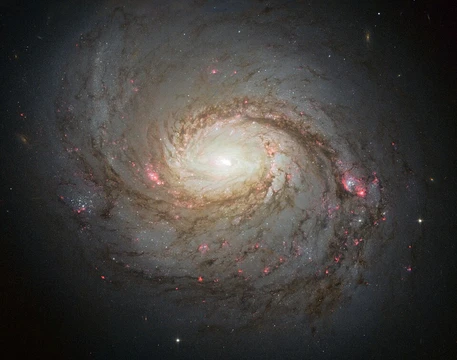
NGC 638
Barred spiral in Pisces with ultraviolet nucleus and broad hydrogen line.

NGC 638 is a barred spiral galaxy in the constellation Pisces. Its velocity relative to the cosmic microwave background is 2,864 ± 21 km/s, which, under Hubble’s law, corresponds to a distance of about 42.2 ± 3.0 megaparsecs (roughly 138 million light-years). The galaxy was discovered by American astronomer Lewis A. Swift in 1886. It exhibits a broad hydrogen line, and its nucleus emits strongly in the ultraviolet, earning it the designation Mrk 1003 (MK 1003) in the Markarian catalogue. Two non-redshift distance measurements place it at approximately 55.330 ± 1.273 megaparsecs (about 180 million light-years), a value that falls outside the Hubble-derived range. According to the NASA/IPAC database, if the Hubble distance is used to calculate its diameter, NGC 638 would measure roughly 11.1 kiloparsecs (about 36,200 light-years). The galaxy belongs to the NGC 645 group, which includes at least five galaxies: NGC 638, NGC 632, UGC 1137, and UGC 1172.
Quick Facts
- Constellation Name
- Pisces
- Epoch
- J2000
- Ra
- 01 · 39 · 37.8
- Dec
- 07 · 14 · 14
- Dist Ly
- 42.24 ±
- Z
- +0.0105470.000007
- Sbrightness
- 12.81 mag/am
- Appmag V
- 13.8
- Appmag B
- 14.5
- H Radial V
- 3,162 km/s
- Names
- PGC 6145, Mrk 1003, / CGCG 412-11
Facts from the source article.
Lore & Background
NGC 638 was discovered by American astronomer Lewis A. Swift in 1886. It is a barred spiral galaxy whose nucleus shines in the ultraviolet domain, and it exhibits a broad Hydrogen line. The galaxy is listed in the Markarian catalogue under the code Mrk 1003 (MK 1003).
Its velocity relative to the cosmic microwave background is 2,864 ± 21 km/s, which corresponds to a Hubble's law distance of 42.2 ± 3.0 Mpc (~138 million light-years). However, two non-redshift measurements give a distance of 55.330 ± 1.273 Mpc (~180 million light-years), which lies outside the Hubble distance values, indicating a discrepancy.
NGC 638 is part of the NGC 645 group, which includes at least five galaxies. The other three galaxies in this group are NGC 632, UGC 1137, and UGC 1172.
Reader's Guide
NGC 638's significance lies in its dual distance measurements, which highlight a tension between redshift-based and non-redshift methods. The Hubble law distance of about 138 million light-years contrasts with the non-redshift average of about 180 million light-years, a discrepancy preserved in the source article. Its inclusion in the Markarian catalogue as Mrk 1003 underscores its ultraviolet-bright nucleus, a characteristic of active or starburst galaxies. The broad Hydrogen line further suggests energetic processes in its interstellar medium. As a member of the NGC 645 group, it contributes to understanding galaxy clustering in Pisces. The NASA/IPAC database's method for calculating diameter—using the average of independent measurements—yields a potential diameter of about 11.1 kpc if the Hubble law distance is used, though this value is conditional. The galaxy's discovery by Lewis A. Swift in 1886 places it within the early era of systematic deep-sky surveys. Its legacy is as an object of interest for studies of galaxy distances, ultraviolet emission, and group dynamics.
Did You Know?
- Its nucleus shines in the ultraviolet domain and it is listed as Mrk 1003 in the Markarian catalogue.
- Two non-redshift measurements give a distance of about 180 million light-years, which differs from the Hubble law distance of about 138 million light-years.
More in Spiral Galaxies, Part 2 1-24
Spotted an error? Know more?
Reader corrections go straight into our review queue. Suggest an edit · How this site is sourced