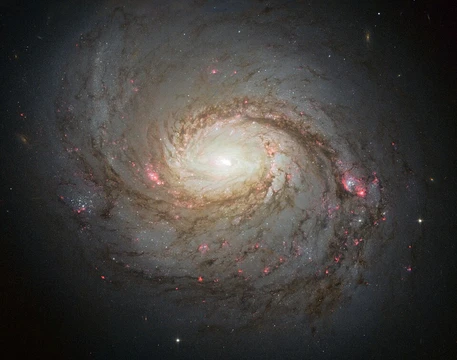
NGC 613
Barred spiral galaxy with a radio-emitting nucleus and a historic supernova.

NGC 613 is a barred spiral galaxy located 67 million light years away in the southern constellation of Sculptor. It is notable for its relatively broad but irregular bar, well-defined spiral arms, and a nucleus that is a source of radio emission. The galaxy was discovered by William Herschel in 1798 and later re-discovered by James Dunlop in 1826, and it was first photographed in 1912, revealing its spiral form.
Quick Facts
- Epoch
- J2000
- Constellation Name
- Sculptor
- Ra
- 01 · 34 · 18.235
- Dec
- –29 · 25 · 06.56
- Z
- 0.004940 · 0.0000167ned
- H Radial V
- +1,487
- Dist Ly
- 67.5 Mly (20.7 Mpc)
- Appmag V
- 10.0
Facts from the source article.
Lore & Background
NGC 613 was discovered by German-English astronomer William Herschel on 9 December 1798, then re-discovered and catalogued by Scottish astronomer James Dunlop on 5 August 1826. It was first photographed in 1912, which revealed the spiral form of the nebula. During the twentieth century, radio telescope observations showed that a linear feature in the nucleus was a relatively strong source of radio emission.
The galaxy is inclined by an angle of 37° to the line of sight from Earth along a position angle of 125°. Its morphological classification is SBbc(rs), indicating a spiral galaxy with a bar across the nucleus, a weak inner ring structure circling the bar, and moderate to loosely wound spiral arms. The bar is relatively broad but irregular in profile with a position angle that varies from 115–124° and dust lanes located along the leading edges. Star formation is occurring at the ends of the bar and extending along the well-defined spiral arms. The central bulge is readily apparent, with a radius of 14″.
The nucleus is classified as type HII, matching the spectrum of an H II region. Near the core, the stars have a velocity dispersion of 136 ± 20 km/s. The nucleus is a source of radio emission with the form of an inner ring with a radius of about 1,100 ly (350 pc) and a linear feature that is perhaps perpendicular to it. The latter consists of three discrete blobs spanning approximately 2,000 ly (600 pc). Observations suggest the presence of a supermassive black hole at the core with a mass in the range (1.9–9.6) × 10^7 times the mass of the Sun.
Reader's Guide
NGC 613 holds significance as a well-studied barred spiral galaxy that has contributed to understanding galactic structure and nuclear activity. Its classification SBbc(rs) provides a clear example of a galaxy with a bar, inner ring, and moderately wound arms. The detection of radio emission from its nucleus, including an inner ring and a linear feature of three discrete blobs, highlights the complex radio structures that can exist in galactic cores. The presence of a supermassive black hole with a mass in the range (1.9–9.6) × 10^7 solar masses adds to the galaxy's importance for studies of black hole demographics. Additionally, the galaxy gained notability through the discovery of supernova SN 2016gkg on September 20, 2016, by amateur astronomer Victor Buso, captured just as it started to erupt. This Type IIb supernova showed a double peak and its progenitor star was identified in Hubble Space Telescope images as likely a yellow supergiant, providing rare direct evidence of a supernova's precursor. The galaxy's legacy includes its role in linking amateur and professional astronomy, as well as its contributions to understanding supernova progenitors and nuclear activity in spiral galaxies.
Did You Know?
- NGC 613 was discovered by William Herschel on 9 December 1798 and re-discovered by James Dunlop on 5 August 1826.
- The nucleus of NGC 613 is a source of radio emission with an inner ring of radius about 1,100 ly and a linear feature of three discrete blobs spanning about 2,000 ly.
- Supernova SN 2016gkg, a Type IIb supernova, was captured in NGC 613 just as it started to erupt on September 20, 2016, by amateur astronomer Victor Buso.
- The progenitor star of SN 2016gkg was identified in Hubble Space Telescope images and is likely to have been a yellow supergiant.
More in Spiral Galaxies, Part 2 1-24
Spotted an error? Know more?
Reader corrections go straight into our review queue. Suggest an edit · How this site is sourced