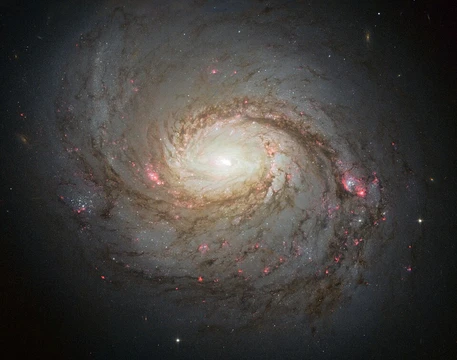
NGC 55
A Magellanic barred spiral near the Local Group.

NGC 55, often called the String of Pearls Galaxy, is a barred spiral of the Magellanic type, situated roughly 6.5 million light-years from Earth in the constellation Sculptor. Scottish astronomer James Dunlop first spotted it on July 7, 1826. Together with its galactic neighbor NGC 300, it ranks among the closest galaxies to the Local Group, likely positioned somewhere between the Milky Way and the Sculptor Group. Its mass is estimated at (2.0 ± 0.4) × 10¹⁰ solar masses.
Though NGC 55 and the spiral NGC 300 were long considered members of the Sculptor Group, more recent distance measurements suggest they actually lie in the foreground. The two galaxies probably form a gravitationally bound pair.
Visually, NGC 55 appears nearly edge-on and asymmetrical, with some dust near its diffuse, broad, somewhat elongated bulge. The south edge of the bulge is sharp; to the southeast, the galaxy curves strongly, lined with four or five faint knots, while the north edge of the curve is sharp. Burnham described it as “one of the outstanding galaxies of the southern heavens,” resembling a smaller version of the Large Magellanic Cloud. In September 1897, comet hunter Lewis Swift, observing from Echo Mountain, California with a 16-inch refractor, mistook the galaxy’s faint eastern section for a new discovery—even though John Herschel had already drawn it—leading to its additional catalog entry as IC 1537.
Quick Facts
- Epoch
- J2000
- Constellation Name
- Sculptor
- Ra
- 00 · 14 · 53.6
- Dec
- -39 · 11 · 47.9
- Z
- 0.000437
- H Radial V
- 131 ± 2 km/s
- Dist Ly
- 6.5 ± 0.65 Mly / (2.00 ± 0.2 Mpc) / A · a · none
- Appmag V
- 7.87
- Mass
- (2.0 ± 0.4) × 10 / 10
- Names
- PGC 1014, Caldwell 72, 2MASS J00145360-3911478, IRAS F00124-3929, ESO 293-50, MCG -07-01-013
Facts from the source article.
Lore & Background
NGC 55 and the spiral galaxy NGC 300 have traditionally been identified as members of the Sculptor Group, but recent distance measurements indicate that the two galaxies actually lie in the foreground. It is likely that NGC 55 and NGC 300 form a gravitationally bound pair. The Webb Society Deep-Sky Observer's Handbook describes NGC 55 as nearly edge-on and asymmetrical with some signs of dust near the bulge, which is diffuse, broad and somewhat elongated with the south edge sharp; southeast of the bulge it is strongly curved and lined with 4 or 5 faint knots; the north edge of the curve is sharp. Burnham calls it 'one of the outstanding galaxies of the southern heavens', somewhat resembling a smaller version of the Large Magellanic Cloud. In September 1897, the famous New York comet hunter Lewis Swift observed the galaxy from Echo Mountain, California with a 16-inch refractor. He mistook the galaxy's faint eastern section as a new find (even though John Herschel had drawn it) and that is how it got cataloged as IC 1537.
Reader's Guide
NGC 55 is notable as one of the closest galaxies to the Local Group, likely lying between the Milky Way and the Sculptor Group. Its proximity and Magellanic type make it a valuable object for studying barred spiral structure and galaxy interactions. The galaxy's traditional association with the Sculptor Group has been questioned by recent distance measurements, which place it and NGC 300 in the foreground, possibly forming a gravitationally bound pair. This uncertainty highlights ongoing refinements in extragalactic distance scales. The galaxy's visual appearance, described in detail by the Webb Society, shows an asymmetrical, nearly edge-on disk with dust lanes and knots, resembling a smaller Large Magellanic Cloud. Its discovery by James Dunlop in 1826 and the later misidentification of its eastern section by Lewis Swift as IC 1537 add historical interest. With an estimated mass of (2.0 ± 0.4) × 10^10 solar masses, NGC 55 provides a benchmark for understanding low-mass barred spirals near our own cosmic neighborhood.
Did You Know?
- NGC 55 is also known as the String of Pearls Galaxy.
- It was discovered on 7 July 1826 by Scottish astronomer James Dunlop.
- Its faint eastern section was mistakenly cataloged as IC 1537 by Lewis Swift in September 1897.
- NGC 55 and NGC 300 likely form a gravitationally bound pair.
More in Spiral Galaxies, Part 2 1-24
Spotted an error? Know more?
Reader corrections go straight into our review queue. Suggest an edit · How this site is sourced