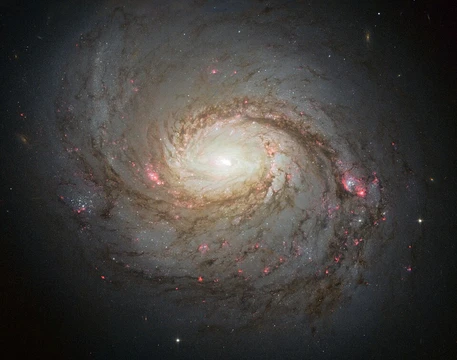
NGC 536
Barred spiral galaxy in Andromeda with a LINER nucleus.

NGC 536 is a barred spiral galaxy located in the constellation Andromeda, approximately 200 million light-years from Earth. It is notable as a member of Hickson Compact Group 10 and the Perseus–Pisces Supercluster, and for hosting a low-ionization nuclear emission-line region (LINER) active galactic nucleus.
Quick Facts
- Epoch
- J2000
- Ra
- 01 · 26 · 21.8
- Dec
- +34 · 42 · 11
- Dist Ly
- 198 ± 34 Mly (60.7 ± 10.6 Mpc)
- Z
- 0.017309 +/- 0.000017
- H Radial V
- 5,189 ± 5 km/s
- Appmag V
- 12.4
- Constellation Name
- Andromeda
- Names
- UGC 1013, MCG +06-04-021, PGC 5344
Facts from the source article.
Lore & Background
NGC 536 was discovered by William Herschel on September 13, 1784. It is a member of Hickson Compact Group 10, which also includes the galaxies NGC 529, NGC 531, and NGC 542, and belongs to the Perseus–Pisces Supercluster. The galaxy's nucleus is characterized as a low-ionization nuclear emission-line region (LINER), a type of active galactic nucleus. It features a bright inner region surrounded by a ring from which emanate two faint arms with H II regions; these extended spiral arms have been suggested to be tidal tails. The galaxy has very weak Hα emission, and its star formation rate is estimated to be 1.16 – 1.25 M☉ per year. The galaxy is seen with an inclination of 78 degrees.
Reader's Guide
NGC 536 is significant as a barred spiral galaxy within the Hickson Compact Group 10, offering a case study of galaxy interactions and compact group dynamics. Its LINER nucleus indicates a low-ionization active galactic nucleus, providing insight into the diversity of galactic nuclei. The faint spiral arms, suggested to be tidal tails, hint at past or ongoing gravitational interactions with neighboring galaxies in the group. The galaxy's very weak Hα emission and modest star formation rate (1.16–1.25 M☉ per year) contribute to understanding star formation in such environments. The observation of one supernova, SN 1963N (type unknown, mag. 17.7), discovered by Howard S. Gates on 27 June 1963 as part of the 1963 Palomar Supernova Search, adds to its legacy as a site of transient events. Its membership in the Perseus–Pisces Supercluster places it within a larger cosmic structure.
Did You Know?
- It is a member of Hickson Compact Group 10, along with NGC 529, NGC 531, and NGC 542.
- One supernova, SN 1963N (type unknown, mag. 17.7), was observed in NGC 536 on 27 June 1963.
More in Spiral Galaxies, Part 2 1-24
Spotted an error? Know more?
Reader corrections go straight into our review queue. Suggest an edit · How this site is sourced