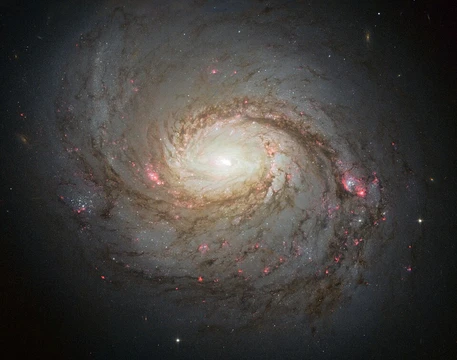
NGC 521
Barred spiral galaxy in Cetus, discovered by William Herschel in 1785.

NGC 521 (also catalogued as PGC 5190 and UGC 962) is a barred spiral galaxy in the constellation Cetus, roughly 224 million light-years away. William Herschel first spotted it on 8 October 1785. Because the galaxy is oriented face-on toward Earth, it appears large in the sky, though its apparent visual magnitude is only 11.7. On the Hubble Sequence, it falls under type SBbc.
Herschel described his find as "faint, pretty large, irregular round, brighter middle." His son John Herschel later logged it as "big" on one occasion and "very faint" on another. R. J. Mitchell noted it as "pretty big, spiral galaxy, disc enveloped in faint outlying neby and looks like an unresolved cluster." John Louis Emil Dreyer included it in the New General Catalogue, calling it "faint, pretty large, round, gradually brighter middle."
Three supernovae have been recorded in NGC 521: SN 1966G (Type Ia, magnitude 15.5), found by Gibson Reaves on 16 August 1966; SN 1982O (type unknown, magnitude 15), discovered by Miklós Lovas on 19 August 1982; and SN 2006G (Type II, magnitude 17.5), detected by the Lick Observatory Supernova Search on 13 January 2006. The galaxy’s distance—about 220 million light-years—is estimated from its redshift using Hubble’s law.
Quick Facts
- Epoch
- J2000
- Ra
- 01 · 24 · 33.8
- Dec
- +01 · 24 · 33.8
- Constellation Name
- Cetus
- Appmag B
- 12.5
- Appmag V
- 11.7
- H Radial V
- 5024.3 km/s
- Dist Ly
- 224 Mly
- Z
- 0.016902
- Names
- PGC 5190, UGC 962, GC 304, MGC +00-04-118, 2MASS J01243377+0143532, h 115, IRAS 01219+0128
Facts from the source article.
Lore & Background
William Herschel discovered NGC 521 on 8 October 1785, describing it as 'faint, pretty large, irregular round, brighter middle'. His son John Herschel later observed it, noting 'big' on his first observation and 'very faint' on his second. R. J. Mitchell described it as 'pretty big, spiral galaxy, disc enveloped in faint outlying neby and looks like an unresolved cluster.' The galaxy was later catalogued by John Louis Emil Dreyer in the New General Catalogue, where it was described as 'faint, pretty large, round, gradually brighter middle'.
Three supernovae have been observed in NGC 521: SN 1966G (Type Ia, mag. 15.5) discovered by Dr. Gibson Reaves on 16 August 1966; SN 1982O (type unknown, mag. 15) discovered by Miklós Lovas on 19 August 1982; and SN 2006G (Type II, mag. 17.5) discovered by the Lick Observatory Supernova Search on 13 January 2006.
The galaxy's large apparent size is attributed to its face-on orientation. Despite its size, it has an apparent visual magnitude of only 11.7. It is classified as type SBbc on the Hubble Sequence. Its distance of roughly 220 million light-years is estimated using its redshift and Hubble's law.
Reader's Guide
NGC 521 holds significance as a barred spiral galaxy with a well-documented observational history spanning from its discovery by William Herschel in 1785 through to modern supernova detections. Its description by multiple astronomers—Herschel, his son John, and R. J. Mitchell—provides a record of changing observational techniques and terminology. The galaxy's classification as SBbc on the Hubble Sequence places it within a common morphological type, while its face-on orientation makes it appear large despite a relatively faint apparent magnitude of 11.7. The three supernovae observed within it (SN 1966G, SN 1982O, and SN 2006G) contribute to studies of stellar explosions in barred spirals. Its distance, estimated via redshift and Hubble's law at roughly 220 million light-years, situates it within the broader cosmic scale. The galaxy's inclusion in the New General Catalogue by Dreyer ensures its continued reference in astronomical literature.
Did You Know?
- NGC 521 was discovered by William Herschel on 8 October 1785.
- Its large apparent size is due to being face-on.
More in Spiral Galaxies, Part 2 1-24
Spotted an error? Know more?
Reader corrections go straight into our review queue. Suggest an edit · How this site is sourced