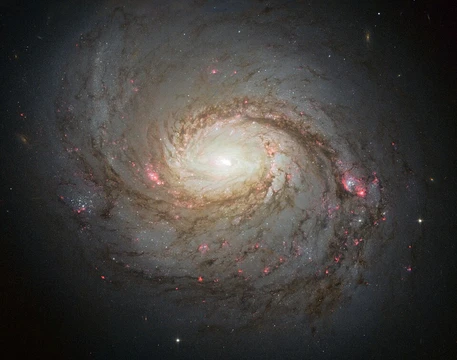
NGC 495
Barred spiral galaxy discovered by William Herschel in 1784.

NGC 495, also cataloged as PGC 5037, UGC 920, and GC 278, is a barred spiral galaxy situated in the constellation Pisces, roughly 184 million light-years from Earth. It was first spotted by William Herschel on September 12, 1784.
Herschel found the galaxy together with NGC 496 and NGC 499, initially describing the trio as extremely small and faint, arranged in a triangle. The following night, he noted they formed a right triangle, with NGC 499 at the southern right angle, NGC 495 on the short leg, and NGC 496 on the long leg to the north; he called the two in the legs the faintest imaginable, while NGC 499 was larger and brighter but still very faint. Later, Heinrich d'Arrest and Herman Schultz recorded a more precise position for NGC 495, which was adopted in the New General Catalogue.
John Dreyer, who compiled the New General Catalogue, echoed Herschel’s early description, calling NGC 495 very faint, small, and the first of three. Modern observations classify it as a barred spiral galaxy of Hubble type SB0-a, with a bright central region spanning about 1.2 by 0.8 arcminutes, plus fainter outer extensions reaching roughly 2.6 by 1.5 arcminutes.
One supernova has been recorded in NGC 495: SN 1999ej, a Type Ia event with magnitude 18.1, discovered by the Lick Observatory Supernova Search on October 18, 1999.
Quick Facts
- Epoch
- J2000
- Ra
- 01 · 22 · 56.0
- Dec
- +33 · 28 · 18
- Constellation Name
- Pisces
- Appmag V
- 13.0
- H Radial V
- (4073 ± 22) km/s
- Dist Ly
- 184 Mly
- Z
- +0.013679 ± 0.000073
- Names
- PGC 5037, UGC 920, GC 278, MCG 5-4-35, 2MASS J01225595+3328171, H 3.156
Facts from the source article.
Lore & Background
NGC 495 was discovered by William Herschel on 12 September 1784, along with NGC 496 and NGC 499. Herschel initially described the trio as 'Three, eS and F, forming a triangle.' The following night he observed them again and noted more detail: 'Three, forming a [right triangle]; the [right angle] to the south NGC 499, the short leg preceding [NGC 495], the long towards the north [NGC 496]. Those in the legs [NGC 495 and 496] the faintest imaginable; that at the rectangle [NGC 499] a deal larger and brighter, but still very faint.'
Later, Heinrich d'Arrest and Herman Schultz observed NGC 495 and first noted the object's accurate position, which is also recorded in the New General Catalogue. John Dreyer, creator of the New General Catalogue, used Herschel's initial notation to describe the position of NGC 495 as 'very faint, small, 1st of 3.' Modern observations classify NGC 495 as a barred spiral galaxy of Hubble type SB0-a, with a bright central region and fainter outer extensions.
Reader's Guide
NGC 495 holds significance as one of three galaxies discovered together by William Herschel, illustrating his systematic approach to cataloging deep-sky objects. The object's inclusion in the New General Catalogue, with its position refined by later observers Heinrich d'Arrest and Herman Schultz, demonstrates the collaborative nature of 19th-century astronomy. Its classification as a barred spiral galaxy of type SB0-a places it in a transitional category between lenticular and spiral galaxies. The galaxy's modern description as a bright central galaxy with fainter outer extensions, spanning about 2.6' by 1.5', provides a more detailed picture than Herschel's initial 'very faint, small' characterization. The observation of one supernova, SN 1999ej (Type Ia, mag. 18.1), discovered by the Lick Observatory Supernova Search on 18 October 1999, adds to its legacy as a site of stellar explosion. NGC 495 remains a subject of study for understanding barred spiral structure and supernova events in distant galaxies.
Did You Know?
- It is located approximately 184 million light-years from the Solar System.
- One supernova, SN 1999ej (Type Ia, mag. 18.1), was observed in NGC 495 on 18 October 1999.
More in Spiral Galaxies, Part 2 1-24
Spotted an error? Know more?
Reader corrections go straight into our review queue. Suggest an edit · How this site is sourced