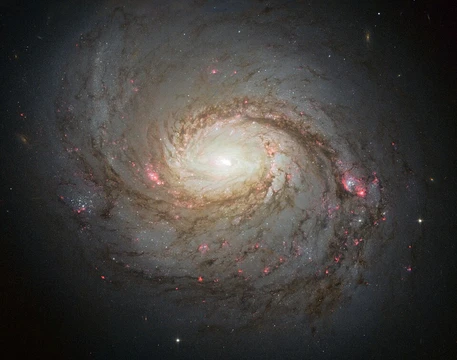
NGC 45
A low surface brightness spiral galaxy near the Sculptor Group.

NGC 45 is a spiral galaxy with low surface brightness, found in the equatorial constellation Cetus. English astronomer John Herschel first spotted it on November 11, 1835. It lies about 22 million light-years away and is moving away from us at a heliocentric radial velocity of 466 km/s. Although it sits near the Sculptor Group, it is probably a background galaxy rather than a member.
Its morphological classification is SA(s)dm, meaning it is a spiral without a prominent central bar (SA) or ring (s) feature, and it lacks a noticeable central bulge. The galaxy’s disk is tilted about 55°±5° relative to Earth’s line of sight, with its major axis oriented at a position angle of 145°±5°. Star formation proceeds at a modest rate of roughly 0.20 solar masses per year.
Unlike the Milky Way, NGC 45 has no well-defined spiral arms, and its central bar and nucleus are very small and distorted. Consequently, it does not possess a galactic habitable zone—the Milky Way’s habitable zone is typically described as an annulus with an outer radius near 10 kiloparsecs and an inner radius close to the Galactic Center, though neither boundary is sharp.
Two astronomical transients have been observed in NGC 45. AT 2018bwo, a luminous red nova (type LRN) with magnitude 16.4352, was discovered by the Distance Less Than 40 Mpc Survey (DLT40) on 22 May 2018. Such events are thought to arise from stellar mergers; its progenitor was a yellow supergiant star. AT 2018htr, a luminous blue variable (type LBV) with magnitude 17.4692, was also found by DLT40 on 3 November 2018.
Quick Facts
- Epoch
- 2000.0
- Constellation Name
- Cetus
- Ra
- 00 · 14 · 03.989
- Dec
- –23 · 10 · 55.53
- Z
- 0.001558
- Dist Ly
- 6.64 Mpc
- Mass Light Ratio
- 5.2 · 1
- Appmag V
- 10.73 · 0.03
- Appmag B
- 11.21 · 0.03
Facts from the source article.
Lore & Background
NGC 45 has a morphological class of SA(s)dm, indicating it is a spiral galaxy with no prominent inner bar or ring feature, and no central bulge to speak of. The galactic plane is inclined at an angle of 55°±5° to the line of sight from Earth, with the major axis aligned along a position angle of 145°±5°. Star formation is proceeding at a modest rate of about 0.20 solar masses per year.
Unlike the Milky Way, NGC 45 has no clearly defined spiral arms, and its center bar nucleus is very small and distorted. As a result, NGC 45 does not have a galactic habitable zone. Two astronomical transients have been observed in NGC 45: AT 2018bwo (type LRN, mag. 16.4352), discovered by the Distance Less Than 40 Mpc Survey on 22 May 2018, and AT 2018htr (type LBV, mag. 17.4692), discovered by the same survey on 3 November 2018.
Reader's Guide
NGC 45 is notable as a low surface brightness spiral galaxy that lacks the prominent bar and spiral arm structure typical of many spirals, including the Milky Way. Its classification SA(s)dm and absence of a central bulge make it an example of a relatively simple spiral morphology. The galaxy's location in the vicinity of the Sculptor Group, though likely a background object, places it in a region of interest for studies of nearby galaxy groups. The modest star formation rate of about 0.20 solar masses per year indicates ongoing but low-level stellar birth. The detection of two transients—a luminous red nova (AT 2018bwo) and a luminous blue variable (AT 2018htr)—provides direct evidence of stellar merger and massive star instability events within this galaxy. These transients were discovered by the Distance Less Than 40 Mpc Survey, highlighting the value of systematic transient surveys in nearby galaxies. NGC 45's lack of a galactic habitable zone, due to its distorted structure and absent spiral arms, contrasts with the Milky Way's habitable annulus, offering a comparative perspective on galactic environments.
Did You Know?
- NGC 45 was discovered by English astronomer John Herschel on 11 November 1835.
- The galaxy has a morphological class of SA(s)dm, meaning it has no prominent inner bar or ring.
More in Spiral Galaxies, Part 2 1-24
Spotted an error? Know more?
Reader corrections go straight into our review queue. Suggest an edit · How this site is sourced