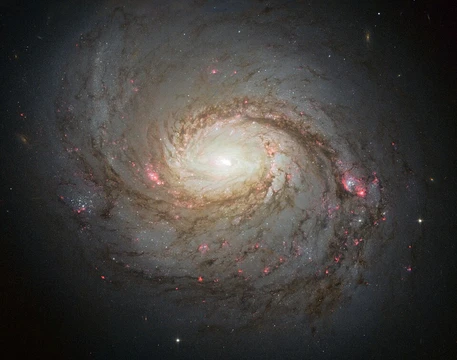
NGC 428
A distorted barred spiral galaxy possibly formed by a merger.

NGC 428 is a barred spiral galaxy located in the constellation of Cetus (The Sea Monster). Its spiral structure is distorted and warped, possibly as a result of the collision of two galaxies, and it lacks well-defined arms — a telltale sign of a galaxy merger. The galaxy is notable for a substantial amount of star formation occurring within it.
Quick Facts
- Epoch
- J2000.0
- Constellation Name
- Cetus
- Ra
- 01 · 12 · 55,709
- Dec
- +00 · 58 · 53.69
- Dist Ly
- 48 mly
- Appmag B
- 12.1
Facts from the source article.
Lore & Background
NGC 428 was discovered by William Herschel in December 1786. Its spiral structure is distorted and warped, possibly the result of the collision of two galaxies. The galaxy lacks well-defined arms and shows a substantial amount of star formation — both considered telltale signs of a galaxy merger. In 2015, the Hubble Space Telescope made a close-up shot of the galaxy using its Advanced Camera for Surveys and its Wide Field and Planetary Camera 2. The structure of NGC 428 has been compared to that of NGC 5645.
Smoker et al. reported in 1996 on the NGC 428 field, including the HI tail and LSB dwarf 0110+008. They assessed star formation properties based on molecule density distributions and concluded that the tail formation most likely originated through tidal interactions between two galaxies. One supernova has been observed in NGC 428: SN 2013ct (Type Ia, mag. 12.2), discovered by Stuart Parker of the Backyard Observatory Supernova Search (BOSS) project in Australia and New Zealand on May 11, 2013.
Reader's Guide
NGC 428 serves as a key example of a barred spiral galaxy whose morphology has been heavily influenced by a past galaxy merger. The distortion and warping of its spiral structure, along with the lack of well-defined arms and elevated star formation, are consistent with tidal interactions between two galaxies. The detection of an HI tail and a low-surface-brightness dwarf in its field, as reported by Smoker et al. in 1996, further supports the merger hypothesis. The galaxy's structure has been compared to NGC 5645, suggesting a possible class of similar post-merger spirals. The observation of a Type Ia supernova (SN 2013ct) in 2013 adds to its astrophysical interest, providing a distance indicator and a probe of stellar populations. The 2015 Hubble Space Telescope imaging with the Advanced Camera for Surveys and Wide Field and Planetary Camera 2 has provided high-resolution data for studying its disturbed morphology and star-forming regions. NGC 428 thus remains an important object for understanding the effects of galaxy interactions on spiral structure and star formation.
Did You Know?
- Its spiral structure is distorted and warped, possibly from the collision of two galaxies.
- One supernova, SN 2013ct (Type Ia, mag. 12.2), was observed in NGC 428 on May 11, 2013.
More in Spiral Galaxies, Part 2 1-24
Spotted an error? Know more?
Reader corrections go straight into our review queue. Suggest an edit · How this site is sourced