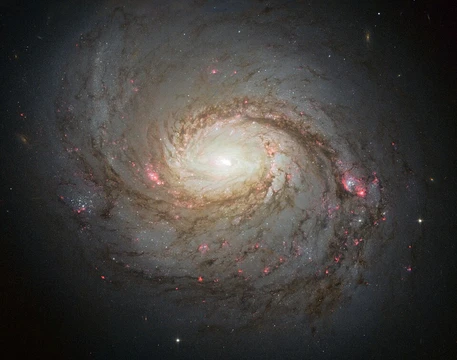
NGC 266
A massive barred spiral with an enigmatic X-ray halo.

NGC 266 is a massive barred spiral galaxy in the constellation Pisces, located at a distance of 197 megalight-years from the Milky Way. It is notable as an LINER-type active galaxy with a moderate star formation rate and a diffuse X-ray emission of unknown origin extending to at least 70,000 light-years.
Quick Facts
- Constellation Name
- Pisces
- Epoch
- J2000
- Ra
- 00 · 49 · 47.81400
- Dec
- +32 · 16 · 39.8067
- Z
- 0.015547
- Dist Ly
- 60.3 Mpc
- Group Cluster
- NGC 315 Group
- Appmag V
- 12.54
Facts from the source article.
Lore & Background
NGC 266 was discovered on September 12, 1784, by William Herschel. Its morphological classification of SB(rs)ab indicates a quasi-ring-like structure and moderate-to-tightly wound spiral arms. The galaxy is an LINER-type active galaxy, with a moderate star formation rate estimated at 2.4 M☉·yr−1. A diffuse X-ray emission from hot gas has been detected around NGC 266, extending out to a radius of at least 70,000 light-years. This emission is not being driven by winds from a starburst region, so the root cause is unknown.
According to A.M. Garcia, NGC 266 is a member of the NGC 315 Group (also known as LGG 14), which contains 42 galaxies. Additionally, a 2013 paper lists NGC 266 as the dominant member of a small group with six low-mass galaxies. One supernova has been observed in NGC 266: on 5 October 2005, Tim Puckett, Peter Ceravolo, and Yasuo Sano discovered SN 2005gl (Type IIn, mag. 18.2), positioned 29.8″ east and 16.7″ north of the galactic nucleus. An image taken on September 10 showed no supernova, so the explosion occurred after that date. The progenitor was identified as a massive hypergiant star that was most likely a luminous blue variable.
Reader's Guide
NGC 266 is significant as a massive barred spiral galaxy with an active LINER nucleus and a moderate star formation rate. Its diffuse X-ray emission, extending to at least 70,000 light-years, is notable because it is not driven by starburst winds, leaving its origin unknown. The galaxy's membership in the NGC 315 Group, a large collection of 42 galaxies, places it in a rich extragalactic environment. The supernova SN 2005gl, a Type IIn event, is particularly important because its progenitor was identified as a massive hypergiant star, most likely a luminous blue variable, providing rare direct evidence of the stellar type that can produce such explosions. The discovery of this supernova by Tim Puckett, Peter Ceravolo, and Yasuo Sano on 5 October 2005, and its absence in an image from September 10, precisely dates the event. NGC 266's legacy lies in its combination of structural features, active nucleus, and the unusual X-ray halo, which together make it a subject of ongoing astrophysical interest.
Did You Know?
- The supernova SN 2005gl was discovered on 5 October 2005 by Tim Puckett, Peter Ceravolo, and Yasuo Sano.
- The progenitor of SN 2005gl was a massive hypergiant star, most likely a luminous blue variable.
More in Spiral Galaxies, Part 2 1-24
Spotted an error? Know more?
Reader corrections go straight into our review queue. Suggest an edit · How this site is sourced