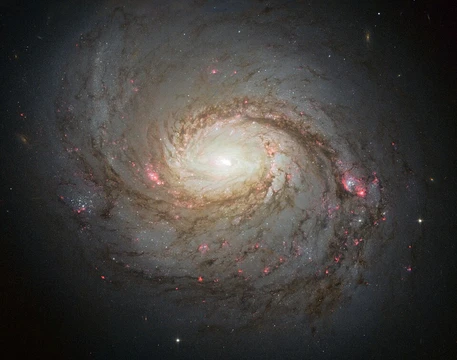
NGC 23
Barred spiral galaxy in Pegasus, luminous in infrared, with a supernova.

NGC 23 is a barred spiral galaxy in the constellation Pegasus, roughly 173.5 million light-years from Earth. Its morphological classification, SBb, means it has a central bar and spiral arms that are moderately tightly wound. This galaxy is a luminous infrared source, containing clumps where stars are actively forming. It was discovered by William Herschel on September 10, 1784. According to the Webb Society Deep-Sky Observer's Handbook, visually it appears as a bright, elongated ellipse with a notably stretched bright nucleus; two faint spiral features extend from opposite sides of the nucleus, one curving toward a bright star attached at the southern end. NGC 23 is likely interacting with the galaxy NGC 9. It is the namesake of the NGC 23 group (also cataloged as LGG 2), which includes at least six other galaxies: NGC 1, NGC 26, UGC 69, UGC 79, UGC 110, and UGC 127. One supernova has been observed in this galaxy: SN 1955C, of unknown type and magnitude 16. It was discovered by Allan Sandage in September 1958 using the Hale Telescope, after he identified a bright star on a photographic plate taken on October 23, 1955—three years earlier—located 10 arcseconds north and 10 arcseconds east of the galactic center. This star was not visible on a photograph taken 60 days prior.
Quick Facts
- Epoch
- J2000
- Constellation Name
- Pegasus
- Ra
- 00 · 09 · 53.411
- Dec
- +25 · 55 · 25.46
- Z
- 0.015054
- Dist Ly
- 53.21 Mpc
- Group Cluster
- NGC 23 Group (LGG 2)
- Appmag V
- 11.9 mag
- Absmag V
- -21.85
- Names
- UGC 89, Mrk 545, PGC 698, GC 9.
Facts from the source article.
Lore & Background
NGC 23 was discovered by William Herschel on 10 September 1784. In the Webb Society Deep-Sky Observer's Handbook, its visual appearance is described as a bright, extended ellipse with a noticeably elongated bright nuclear structure. Two weak spiral enhancements emerge from opposite sides of the nucleus, one curving toward a bright star attached on the south end. The galaxy is likely interacting with NGC 9.
Its morphological classification of SBb indicates it is a barred spiral with moderately tightly wound spiral arms. It is a luminous infrared galaxy with star-forming clumps. NGC 23 is part of the NGC 23 group (LGG 2), which includes at least six other galaxies: NGC 1, NGC 26, UGC 69, UGC 79, UGC 110, and UGC 127.
One supernova has been observed in NGC 23: SN 1955C (type unknown, mag. 16). It was discovered by Allan Sandage in September 1958 using the Hale Telescope. On a photographic plate taken 23 October 1955, a bright star with a visual magnitude around 16 was located 10″ north and 10″ east of the galactic center. The star was not visible on a photograph taken 60 days prior.
Reader's Guide
NGC 23 is significant as a luminous infrared galaxy with star-forming clumps, indicating active star formation. Its morphological classification as SBb places it among barred spirals with moderately tightly wound arms. The galaxy is likely interacting with NGC 9, a detail noted in the Webb Society Deep-Sky Observer's Handbook. As the namesake of the NGC 23 group (LGG 2), it anchors a small cluster of at least six other galaxies, including NGC 1 and NGC 26. The supernova SN 1955C, discovered by Allan Sandage in September 1958 using the Hale Telescope, was first recorded on a photographic plate from 23 October 1955, three years prior to its discovery, and was not visible on a photograph taken 60 days earlier. This supernova, of unknown type and magnitude 16, adds to the galaxy's observational history. NGC 23's discovery by William Herschel on 10 September 1784 places it among the early cataloged deep-sky objects. Its distance of 173.5 megalight-years from the Milky Way and location in Pegasus make it a target for studies of galaxy interactions and infrared emission.
More in Spiral Galaxies, Part 2 1-24
Spotted an error? Know more?
Reader corrections go straight into our review queue. Suggest an edit · How this site is sourced