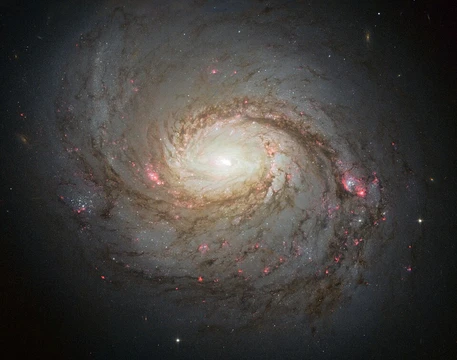
NGC 2188
Edge-on barred spiral with asymmetrical hydrogen and three companions.

NGC 2188 is a barred spiral galaxy in the constellation Columba, located approximately 25 million light years from Earth. It is notable for being observed nearly edge-on, revealing only the thin outer edge of its galactic disc, and for its asymmetrical neutral hydrogen structure suggesting a recent galactic interaction.
Quick Facts
- Epoch
- J2000
- Ra
- 06 · 10 · 09.5
- Dec
- -34 · 06 · 22
- Dist Ly
- 23.9 ± 10 Mly (7.3 ± 3.1 Mpc)
- Z
- 0.002492 ± 0.000013
- H Radial V
- 747 ± 4 km/s
- Appmag V
- 11.5
- Constellation Name
- Columba
- Names
- ESO 364-G037, AM 0608-340, MCG -06-14-008, PGC 18536
Facts from the source article.
Lore & Background
NGC 2188 was discovered by British Astronomer John Herschel on January 9, 1836. It is observed nearly edge-on from Earth, with its central bulge and spiral arms tilted away from the line of sight, so only the thin outer edge of its galactic disc is visible. The true morphology has been determined through analyses of stellar distribution in the bulge and disc, as well as studies of stellar colors. The galaxy is close enough that its stars can be resolved, with the brightest having an apparent magnitude of about 21.
Observations in neutral hydrogen HI reveal an asymmetrical structure, which may suggest a recent galactic interaction. The hydrogen gas is more abundant in one end of the galaxy and extends over 4 kpc away from the galactic plane. Other features include some filaments and a superbubble with a diameter of 15 arcseconds, associated with an HII region located in the galactic halo. The total hydrogen mass is estimated to be 3×10^8 M☉, and the galaxy has low metallicity. NGC 2188 has three smaller companions: HIPASS J0607-34, ESO364-029, and KK 55.
Reader's Guide
NGC 2188 is significant as a nearby barred spiral galaxy whose edge-on orientation and resolved stellar population allow detailed study of its structure and composition. The asymmetrical distribution of neutral hydrogen, extending far from the galactic plane, provides evidence of a possible recent galactic interaction, offering insights into the dynamics and evolution of such systems. The presence of filaments and a superbubble associated with an HII region in the halo further highlights active star formation and feedback processes. Its low metallicity and three smaller companions make it a valuable target for understanding galaxy interactions and the chemical enrichment of spiral galaxies. The galaxy's discovery by John Herschel in 1836 places it within the historical context of 19th-century astronomical surveys, while modern observations continue to refine our knowledge of its morphology and environment.
More in Spiral Galaxies, Part 2 1-24
Spotted an error? Know more?
Reader corrections go straight into our review queue. Suggest an edit · How this site is sourced