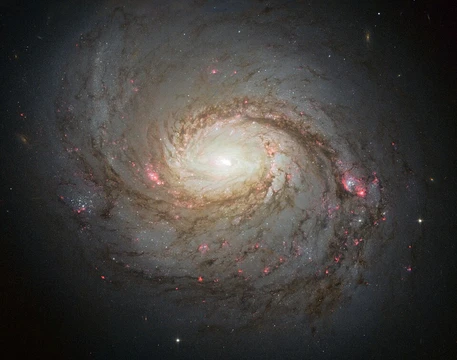
NGC 134
Barred spiral galaxy with a warped disc and possible past interaction.

NGC 134 is a barred spiral galaxy located 60 million light years away in the Sculptor constellation. It resembles the Milky Way with its loosely wrapped spiral arms around a bright, bar-shaped central region, and is notable for its warped disc and evidence of a possible past interaction with another galaxy.
Quick Facts
- Epoch
- J2000
- Ra
- 00 · 30 · 21.97
- Dec
- -33 · 14 · 38.5
- Dist Ly
- 60 million light years
- Z
- 0.005277
- Appmag V
- 10.40
- Constellation Name
- Sculptor
- Names
- ESO 350-23 / PGC 001851, MGC -06-02-012
Facts from the source article.
Lore & Background
NGC 134 is a barred spiral galaxy of Hubble type Sbc, with spiral arms loosely wrapped around a bright, bar-shaped central region. A prominent feature revealed by the VLT image is its warped disc—when viewed sideways, it does not appear flat. A trail of gas stripped from the top edge of the disc further suggests that the galaxy interacted with another galaxy, though this remains unproven. The galaxy has an abundance of ionized hydrogen regions along its spiral arms where stars are forming, appearing red in the image, and many dark lanes of dust that occlude its complete starlight.
The discovery of NGC 134 is often attributed to Sir John Herschel at the Cape of Good Hope, but he noted that it might have been the 590th object discovered by James Dunlop in his 1828 publication, six years prior to Herschel's own observations. O'Meara has suggested NGC 134 might be named the Giant Squid Galaxy. NGC 134 is part of the galaxy group LGG 7, together with NGC 115, NGC 131, IC 1554, NGC 148, IC 1555, and ESO 410-18.
One supernova has been observed in NGC 134: SN 2009gj, a Type IIb supernova of magnitude 15.9, discovered by amateur astronomer Stuart Parker in New Zealand on 20 June 2009.
Reader's Guide
NGC 134 is significant as a nearby barred spiral galaxy that closely resembles the Milky Way in structure, making it a valuable object for comparative studies of spiral galaxy morphology. Its warped disc and stripped gas trail provide compelling, though unproven, evidence of a past galactic interaction, offering insight into the dynamical processes that shape galaxies. The galaxy's abundant ionized hydrogen regions and dust lanes highlight ongoing star formation and the complex interplay between gas, dust, and stellar light. The disputed discovery history—attributed to Sir John Herschel but possibly predated by James Dunlop—adds a layer of historical interest. The single observed supernova, SN 2009gj, discovered by an amateur astronomer, underscores the role of citizen scientists in monitoring extragalactic events. NGC 134's membership in the LGG 7 group situates it within a local galactic environment, contributing to the study of group dynamics and evolution. Its informal nickname, the Giant Squid Galaxy, reflects its distinctive visual appearance.
Did You Know?
- NGC 134 is a barred spiral galaxy that resembles the Milky Way.
- Its disc is warped, and a trail of gas is stripped from its top edge, suggesting a possible past interaction with another galaxy.
- The galaxy's discovery is often attributed to Sir John Herschel, but he noted it might have been discovered earlier by James Dunlop in 1828.
- One supernova, SN 2009gj (Type IIb, mag. 15.9), was discovered in NGC 134 by amateur astronomer Stuart Parker on 20 June 2009.
More in Spiral Galaxies, Part 2 1-24
Spotted an error? Know more?
Reader corrections go straight into our review queue. Suggest an edit · How this site is sourced