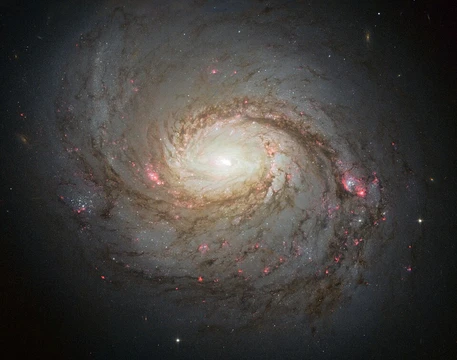
NGC 1311
A nearby barred spiral with bursty star formation and weak Seyfert candidacy.

NGC 1311 is a nearby late-type barred spiral galaxy, occasionally described as a dwarf irregular or emission-line galaxy, and a potential weak Seyfert 2 active galaxy candidate. It is located in the Horologium constellation and was discovered by John Herschel in 1837. The galaxy is notable for its membership in the IC 1954 group and its burst-like star formation history, with star clusters spanning a range of ages and masses.
Quick Facts
- Epoch
- J2000
- Ra
- 03 · 20 · 06.9
- Dec
- -52 · 11 · 08
- Dist Ly
- 4.932 ± 1.003 Mpc
- Z
- 0.001911 ± 0.000007
- H Radial V
- 573 ± 2 km/s
- Appmag V
- 13.0
- Appmag B
- 13.4
- Constellation Name
- Horologium
Facts from the source article.
Lore & Background
NGC 1311 was discovered by John Herschel in 1837. It is part of the IC 1954 galaxy group, a small assembly of nearby galaxies in Horologium and surrounding regions, which includes IC 1959, IC 1933, IC 1954, ESO 200-G045, NGC 1249, and NGC 1311 itself. The galaxy’s structure is characteristic of a Magellanic barred spiral, with a weak bar and loosely wound spiral arms. Its star formation occurs in bursts, with 13 identified candidate star clusters showing ages clustered around 10 Myr, 100 Myr, and >1 Gyr. The galaxy’s isolation and low mass contribute to its distinct star-forming behavior, following the luminosity-metallicity relation typical of late-type dwarf galaxies. The Hubble Space Telescope revealed a population of star clusters with masses ranging from ~10³ to ~10⁵ solar masses, with more massive clusters generally being older. Star formation is concentrated in two regions, each ~200 parsecs in size, at the east and west ends of a central bar-like structure. These regions host hot main-sequence stars and blue supergiants, with roughly half of the young stellar population located there.
Reader's Guide
NGC 1311 is significant as a nearby example of a late-type barred spiral that exhibits burst-like star formation, providing insight into the star-forming processes in low-mass, isolated galaxies. Its potential classification as a weak Seyfert 2 active galaxy adds to its interest, though this remains a candidate status. The galaxy’s membership in the IC 1954 group places it within a small assembly of galaxies, offering a context for studying group interactions and evolution. The Hubble Space Telescope observations have been crucial in revealing the detailed star cluster population, with ages and masses that show a clear trend of more massive clusters being older. The concentration of star formation in two ~200 parsec regions at the ends of the bar highlights the role of the bar in triggering star formation. The galaxy’s adherence to the luminosity-metallicity relation typical of late-type dwarfs underscores its nature as a low-mass system. Overall, NGC 1311 serves as a valuable laboratory for understanding the interplay between structure, star formation, and environment in dwarf galaxies.
More in Spiral Galaxies, Part 2 1-24
Spotted an error? Know more?
Reader corrections go straight into our review queue. Suggest an edit · How this site is sourced