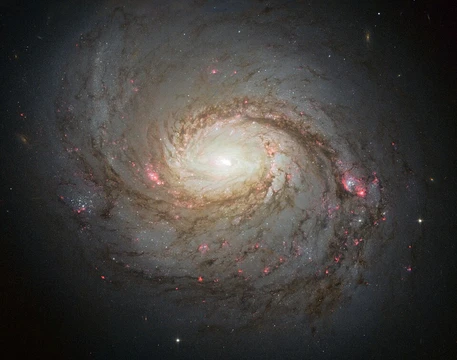
NGC 1300
A barred spiral galaxy with a grand-design inner spiral.

NGC 1300 is a barred spiral galaxy roughly 69 million light-years from Earth in the constellation Eridanus, spanning about 130,000 light-years across. It belongs to the Eridanus Cluster, a collection of 200 galaxies, and sits within a smaller subgroup of two to four galaxies called the NGC 1300 Group. British astronomer John Herschel first spotted it on December 11, 1835.
At its center, the galaxy features a "grand-design" spiral structure about 3,300 light-years long, nested inside the larger spiral arms. This inner spiral only appears in galaxies with prominent bars, creating a spiral within a spiral. Models suggest gas in the bar can be channeled inward, spiraling through this inner disk toward the center, potentially feeding a supermassive black hole. However, NGC 1300 shows no signs of an active nucleus, meaning its central black hole—with a mass of 7.3+6.9−3.5×10⁷ solar masses—is not currently pulling in matter.
One supernova has been recorded in NGC 1300: SN 2022acko, a Type II-P event with a magnitude of 16.5406, discovered by the Distance Less Than 40 Mpc Survey (DLT40) on December 6, 2022.
Related galaxies include NGC 1672, a similar barred spiral; NGC 7479, which shares a very similar size, structure, and morphology; and NGC 1232, a nearby intermediate spiral galaxy.
Quick Facts
- Epoch
- J2000
- Ra
- 03 · 19 · 41.0253 (49.920939)
- Dec
- -19 · 24 · 40.149 (−19.411153)
- Dist Ly
- 61.3 Mly (18.8 Mpc)
- Z
- 0.005260 (1577 ± 4 km/s)
- Appmag V
- 11.4
- Constellation Name
- Eridanus
- Notes
- Huge bar-shaped core and two spiral arms
Facts from the source article.
Lore & Background
NGC 1300 was discovered by British astronomer John Herschel on 11 December 1835. The galaxy is about 130,000 light-years across and lies about 69 million light-years away in the constellation Eridanus. It is part of the Eridanus Cluster, a cluster of 200 galaxies, and resides in a subgroup of 2–4 galaxies called the NGC 1300 Group.
In the core of the larger spiral structure, the nucleus shows a grand-design spiral structure about 3,300 light-years long. Only galaxies with large-scale bars appear to have these grand-design inner disks. Models suggest that gas in a bar can be funneled inward and then spiral into the center through the grand-design disk, potentially fueling a central supermassive black hole (SMBH). NGC 1300 is not known to have an active nucleus, indicating its central black hole is not accreting matter. The SMBH has a mass of 7.3+6.9−3.5×10^7 M☉.
One supernova has been observed in NGC 1300: SN 2022acko (Type II-P, magnitude 16.5406), discovered by the Distance Less Than 40 Mpc Survey (DLT40) on 6 December 2022.
Reader's Guide
NGC 1300 is significant as a classic example of a barred spiral galaxy with a grand-design inner spiral structure, a feature seen only in galaxies with large-scale bars. This spiral-within-a-spiral morphology provides a natural laboratory for studying how gas flows along bars into galactic centers, potentially feeding supermassive black holes. The galaxy's lack of an active nucleus suggests its central black hole is currently quiescent, offering insight into the conditions that suppress accretion. Its membership in the Eridanus Cluster and the NGC 1300 Group places it within a rich galactic environment. The detection of a Type II-P supernova in 2022 adds to its observational legacy, contributing to studies of stellar evolution and supernova rates in barred spirals. NGC 1300 is often compared to similar galaxies such as NGC 1672, NGC 7479, and NGC 1232, highlighting its role in understanding spiral structure and bar dynamics.
Did You Know?
- NGC 1300 was discovered by John Herschel on 11 December 1835.
- The galaxy's supermassive black hole has a mass of 7.3+6.9−3.5×10^7 solar masses.
- One supernova, SN 2022acko (Type II-P), was observed on 6 December 2022.
More in Spiral Galaxies, Part 2 1-24
Spotted an error? Know more?
Reader corrections go straight into our review queue. Suggest an edit · How this site is sourced