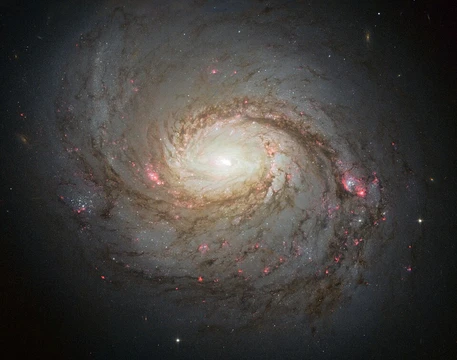
NGC 1262
Barred spiral galaxy with disputed distance and size.

NGC 1262 is a barred spiral galaxy in the constellation Eridanus. It was once thought to be the most distant object listed in the New General Catalogue, with earlier redshift and distance estimates placing it at z = 0.116 and roughly 507.0 megaparsecs (1,650 million light-years) away, giving it a large isophotal diameter of about 125.59 kiloparsecs (410,000 light-years)—nearly five times the size of the Milky Way. That status changed in 2023, when Stephen Odewahn of the McDonald Observatory, using data from Ann Isaacs at the University of Minnesota, recalculated the galaxy’s radial velocity at 15,169 km/s. This new measurement corresponds to a lower redshift of z = 0.0506 and a light-travel distance of 686 million light-years (210.3 megaparsecs), meaning NGC 1262 is no longer among the most distant NGC objects, and its isophotal diameter is now considerably smaller. The galaxy was discovered by astronomer Francis Leavenworth on November 12, 1885. A supernova, designated AT 2014fx, was found in NGC 1262 by citizen scientists using the Galaxy Zoo website; its decimal coordinates are ra=48.893766, dec=-15.884613.
Quick Facts
- Epoch
- J2000
- Ra
- 03 · 15 · 33.6
- Dec
- -15 · 52 · 46
- Dist Ly
- 1.503 Gly
- Z
- 0.0506
- Appmag V
- 15.0
- Constellation Name
- Eridanus
- Names
- IRAS 03132-1604, MCG -3-9-14, PGC 12107
Facts from the source article.
Lore & Background
NGC 1262 was discovered by astronomer Francis Leavenworth on November 12, 1885. It was formerly believed to be the most distant object in the New General Catalogue, with redshift and distance estimates placing it at z = 0.116 and roughly 507.0 megaparsecs (1,650 million light-years) from Earth. This corresponded to a large isophotal diameter of about 125.59 kiloparsecs (410,000 light-years) based on its D25.0 apparent dimension, making it nearly five times larger than the Milky Way and one of the largest spiral galaxies.
However, in 2023, using data from Ann Isaacs from the University of Minnesota, Stephen Odewahn from the McDonald Observatory used new radial velocity calculations with a new estimate of 15,169 km/s, which corresponds to a lower redshift of z = 0.0506 and hence a light-travel distance of 686 million light-years (210.3 megaparsecs). This placed NGC 1262 nowhere near the most distant NGC galaxy and resulted in a rather lower isophotal diameter.
Supernova AT 2014fx in NGC 1262 was discovered by citizen scientists using the Galaxy Zoo website. Its coordinates (decimal) are: ra=48.893766 dec=-15.884613.
Reader's Guide
NGC 1262's significance lies in its dramatic revision from being considered the most distant object in the New General Catalogue to a much nearer galaxy. The original estimates, based on redshift z = 0.116, gave it a distance of 1,650 million light-years and a diameter of 410,000 light-years, making it nearly five times larger than the Milky Way. However, in 2023, Stephen Odewahn, using data from Ann Isaacs, recalculated the radial velocity to 15,169 km/s, yielding a redshift of z = 0.0506 and a distance of only 686 million light-years. This revision not only removed NGC 1262 from the list of the most distant NGC objects but also reduced its estimated isophotal diameter. The galaxy's history illustrates how observational data can change our understanding of cosmic distances and sizes. Additionally, the discovery of supernova AT 2014fx by citizen scientists via the Galaxy Zoo website highlights the role of public participation in astronomical research.
Did You Know?
- Its original estimated diameter of 410,000 light-years made it nearly five times larger than the Milky Way.
- In 2023, Stephen Odewahn used new radial velocity calculations to revise its redshift from z = 0.116 to z = 0.0506.
More in Spiral Galaxies, Part 2 1-24
Spotted an error? Know more?
Reader corrections go straight into our review queue. Suggest an edit · How this site is sourced