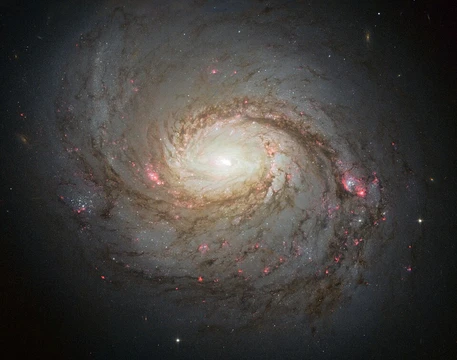
NGC 1255
Barred spiral galaxy in Fornax, namesake of a small galaxy group.

NGC 1255 is a barred spiral galaxy located about 69 million light-years from Earth in the constellation Fornax. It gives its name to the NGC 1255 group (also cataloged as LGG 86), a small cluster that includes at least five galaxies, among them NGC 1201, NGC 1302, UGCA 61, and UGCA 64.
The galaxy was first spotted on August 30, 1883, by American astronomer Edward Emerson Barnard using a 6-inch refractor at Vanderbilt University. Barnard noted it as a faint, moderately sized nebula with even light, and mentioned a faint star close to the south preceding side that might be involved, with another star about 30 arcseconds south following the nebula. A separate discovery came in 1886 from Ormond Stone, who used the 26-inch refractor at Leander McCormick Observatory and recorded dimensions of 4.1 by 2.0 arcminutes at a position angle of 315 degrees.
Two supernovae have been observed in NGC 1255. The first, SN 1980O, was a Type II event reaching magnitude 17, found by German astronomer Hans-Emil Schuster on October 30, 1980, using a 1.0-meter Schmidt telescope. It was located at right ascension 03h 13m 27s and declination −25° 44.50′ (J2000). By December 30 of that year, it had faded by about four magnitudes and displayed strong P-Cygni profiles. The second, SN 2022ame, also a Type II supernova at magnitude 17.3, was discovered by Kōichi Itagaki on January 27, 2022.
Quick Facts
- Epoch
- J2000.0
- Constellation Name
- Fornax
- Ra
- 03 · 13 · 32.04
- Dec
- -25 · 43 · 30.60
- Z
- 0.005624
- H Radial V
- 1686 ± 3 km/s
- Dist Ly
- 69 Mly
- Group Cluster
- NGC 1255 group (LGG 86)
- Appmag B
- 11.5
- Appmag V
- 10.7
- Names
- PGC 12007, UGCA 60, AM 0311-255, MCG -4-8-50, ESO 481-13
Facts from the source article.
Lore & Background
NGC 1255 was discovered by American astronomer Edward Emerson Barnard on August 30, 1883 with the 6-inch refractor at Vanderbilt University. He described it as a 'faint nebula, not large, pretty even in light. A faint star close p and slightly south probably involved. Star is s and f the nebula by about 30'.' American astronomer Ormond Stone made an independent discovery in 1886 with the 26" refractor at Leander McCormick Observatory, recording '4.1'x2.0', PA 315°'.
NGC 1255 is the namesake of the NGC 1255 group (also known as LGG 86), which contains at least 5 galaxies, including NGC 1201, NGC 1302, UGCA 61, and UGCA 64.
Two supernovae have been observed in NGC 1255: SN 1980O (Type II, mag. 17) was discovered by German astronomer Hans-Emil Schuster with the 1.0-m Schmidt telescope on October 30, 1980. The supernova was located at RA 03h 13m 27s, Dec -25° 44.50′ (J2000 epoch). By December 30, 1980 the supernova had faded by about 4 magnitudes and showed strong P-Cyg-type profiles. SN 2022ame (Type II, mag. 17.3) was discovered by Kōichi Itagaki on January 27, 2022.
Reader's Guide
NGC 1255 holds significance as a barred spiral galaxy whose discovery history involves two independent astronomers, Edward Emerson Barnard in 1883 and Ormond Stone in 1886, each using different instruments and providing distinct descriptions. Its role as the namesake of the NGC 1255 group (LGG 86) places it at the center of a small galaxy cluster of at least five members, including NGC 1201, NGC 1302, UGCA 61, and UGCA 64. The galaxy has hosted two recorded supernovae, both Type II: SN 1980O, discovered by Hans-Emil Schuster in 1980, which faded by about 4 magnitudes within two months and exhibited strong P-Cyg-type profiles; and SN 2022ame, discovered by Kōichi Itagaki in 2022. These events contribute to the study of stellar explosions in barred spiral systems. The galaxy's legacy is tied to its observational history and its membership in a small group, providing context for understanding galaxy interactions and evolution in the Fornax constellation.
Did You Know?
- NGC 1255 was discovered by Edward Emerson Barnard on August 30, 1883 using a 6-inch refractor at Vanderbilt University.
- Ormond Stone independently discovered NGC 1255 in 1886 with a 26-inch refractor at Leander McCormick Observatory.
- Two Type II supernovae have been observed in NGC 1255: SN 1980O and SN 2022ame.
More in Spiral Galaxies, Part 2 1-24
Spotted an error? Know more?
Reader corrections go straight into our review queue. Suggest an edit · How this site is sourced