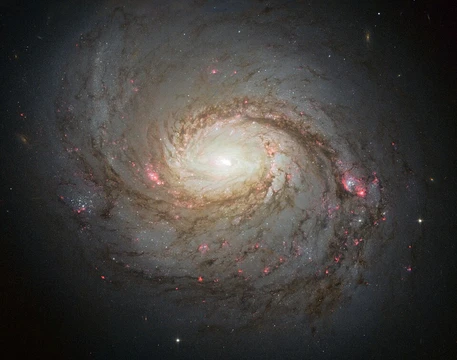
NGC 1241
Barred spiral galaxy interacting with NGC 1242 in Arp 304.

NGC 1241 is a barred spiral galaxy in the constellation Eridanus, located about 150 million light years from Earth. It is notable for its interaction with the smaller companion NGC 1242, together forming the pair Arp 304 in the Atlas of Peculiar Galaxies, and for its classification as a Seyfert galaxy with a circumnuclear star-forming ring.
Quick Facts
- Epoch
- J2000
- Ra
- 03 · 11 · 14.6
- Dec
- -08 · 55 · 20
- Dist Ly
- 144 ± 36 Mly (44.1 ± 11 Mpc)
- Z
- 0.016652 ± 0.000020
- H Radial V
- 4,052 ± 4 km/s
- Appmag V
- 12.2
- Constellation Name
- Eridanus
- Notes
- Seyfert galaxy
- Names
- ARP 304, MCG -02-09-011, VV 334a, Holmberg 068A, PGC 11887
Facts from the source article.
Lore & Background
NGC 1241 was discovered by William Herschel on January 10, 1785. It is a barred spiral galaxy seen at an inclination, with two well-defined dusty spiral arms, making it a grand design spiral galaxy. The bulge is boxy, characteristic of a barred galaxy, with arms emerging from each end of the bar; the north arm appears more tightly wound than the southern, and the main arms branch into smaller ones. A circumnuclear ring with active star formation has been detected in the central region, measuring 5.6 × 3.4 arcseconds in diameter, lying just inside the inner Lindblad resonance. It appears clumpy and inclined. A faint spiral pattern with leading arms emanates from it in Paα emission, while in Ks and J band the pattern appears trailing. NGC 1241 is one of the few galaxies with known trailing features in the nuclear regions, the other being NGC 6902. Inside the circumnuclear ring, a bar-like feature 1.6 arcseconds long was detected, almost perpendicular to the main bar. The nucleus is active, categorized as a type II Seyfert galaxy, with the energy source attributed to an accretion disk around a supermassive black hole of estimated mass 107.46 (29 million) M☉. The star formation rate is estimated at 3.07 M☉ per year based on H-alpha flux.
Reader's Guide
NGC 1241 is significant as an interacting Seyfert galaxy with a well-studied circumnuclear star-forming ring, providing insights into the dynamics of gas inflow and star formation near an active galactic nucleus. Its trailing nuclear spiral pattern is rare, shared only with NGC 6902, making it a key object for understanding the orientation and evolution of nuclear structures. The galaxy's interaction with NGC 1242, cataloged as Arp 304, highlights the role of tidal interactions in triggering nuclear activity and star formation. The presence of a secondary bar perpendicular to the main bar adds complexity to models of bar-driven secular evolution. The estimated black hole mass and star formation rate contribute to studies of the relationship between supermassive black holes and their host galaxies. As part of the galaxy group LGG 84, NGC 1241 also serves as a reference for group-scale environmental effects on galaxy evolution.
Did You Know?
- NGC 1241 is one of the few galaxies known to have trailing features in its nuclear regions, the other being NGC 6902.
- The circumnuclear ring of NGC 1241 measures 5.6 × 3.4 arcseconds and lies just inside the inner Lindblad resonance.
- The galaxy's black hole has an estimated mass of 29 million solar masses.
- NGC 1241 and its companion NGC 1242 are collectively known as Arp 304 in the Atlas of Peculiar Galaxies.
More in Spiral Galaxies, Part 2 1-24
Spotted an error? Know more?
Reader corrections go straight into our review queue. Suggest an edit · How this site is sourced