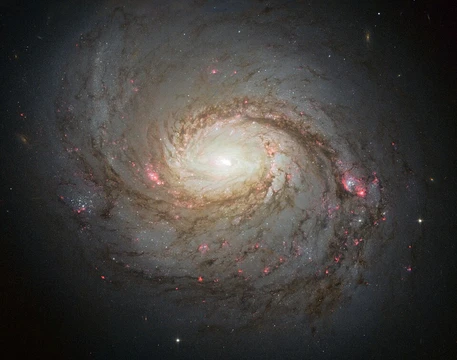
NGC 1097
A barred spiral with cannibalized dwarf galaxy jets.

NGC 1097, also cataloged as Caldwell 67, is a barred spiral galaxy located roughly 45 million light-years away in the constellation Fornax. William Herschel first spotted it on 9 October 1790. This galaxy is heavily involved in a gravitational interaction with its neighbor, NGC 1097A, leaving it with clear tidal debris and distortions.
The galaxy is classified as a Seyfert galaxy. Deep images show four thin optical jets extending from its nucleus, which are now understood to be the stellar remains of a dwarf galaxy that was torn apart and consumed. Earlier ideas—that the jets were tidal tails or produced by synchrotron or thermal free-free radiation—were ruled out by radio-to-X-ray spectral analysis and by the failure to detect atomic hydrogen gas in them using deep 21 cm observations from the Very Large Array, supported by numerical simulations.
At the center of NGC 1097 lies a supermassive black hole with a mass 140 million times that of the Sun. Surrounding this black hole is a bright ring of star-forming regions, about 5,000 light-years across, where gas and dust spiral inward from the ring toward the black hole. Material flowing toward the galaxy’s central bar triggers new star formation in this ring, while the spiral arms extend tens of thousands of light-years beyond it.
NGC 1097 has two satellite galaxies. The larger, NGC 1097A, is a peculiar dwarf elliptical that orbits about 42,000 light-years from the center. The smaller, NGC 1097B, is a dwarf irregular galaxy with a mass of about 5 million solar masses, discovered through its hydrogen emission; little else is known about it.
Four supernovae have been observed in NGC 1097: SN 1992bd (Type II, magnitude 15), found by Chris Smith and Lisa Wells on 12 October 1992; SN 1999eu (Type II-pec, magnitude 17.3), discovered by Masakatsu Aoki on 5 November 1999; SN 2003B (Type II, magnitude 15), spotted by Robert Evans on 5 January 2003; and SN 2023rve (Type II, magnitude 14), detected by Mohammad Odeh on 8 August 2023.
Quick Facts
- Epoch
- J2000
- Ra
- 02 · 46 · 19.0584
- Dec
- -30 · 16 · 29.676
- Dist Ly
- 45 million ly
- Z
- 0.004240
- Appmag V
- 10.2
- Constellation Name
- Fornax
Facts from the source article.
Lore & Background
NGC 1097 was discovered by William Herschel on 9 October 1790. It is a severely interacting galaxy, with obvious tidal debris and distortions caused by interaction with the companion galaxy NGC 1097A. Deep photographs revealed four narrow optical jets that appear to emanate from the nucleus, interpreted as manifestations of the currently weak active nucleus. Subsequent analysis of the brightest jet's radio-to-X-ray spectral energy distribution ruled out synchrotron and thermal free-free emission; the optical jets are composed of stars. Failure to detect atomic hydrogen gas in the jets using deep 21 cm HI imaging with the Very Large Array radio telescope, along with numerical simulations, led to the interpretation that the jets are the shattered remains of a cannibalized dwarf galaxy.
At its center is a supermassive black hole 140 million times the mass of the Sun, surrounded by a glowing ring of star-forming regions with a network of gas and dust spiraling from the ring to the black hole. An inflow of material toward the central bar causes new stars to be created in the ring, which is about 5,000 light-years in diameter; the spiral arms extend tens of thousands of light-years beyond the ring. NGC 1097 has two satellite galaxies: NGC 1097A, a peculiar elliptical galaxy orbiting 42,000 light-years from the center, and NGC 1097B, a dwarf irregular discovered by its HI emission with a mass of 5 million solar masses.
Reader's Guide
NGC 1097 is significant as a well-studied example of a barred spiral galaxy undergoing severe interaction, with its companion NGC 1097A producing obvious tidal debris and distortions. Its most remarkable feature is the set of four narrow optical jets emanating from the nucleus, which after extensive analysis—including ruling out synchrotron and thermal free-free emission, and failing to detect atomic hydrogen gas—are now interpreted as the shattered remains of a cannibalized dwarf galaxy. This provides a clear case of galactic cannibalism. The galaxy also hosts a supermassive black hole of 140 million solar masses, surrounded by a star-forming ring 5,000 light-years across, with gas and dust spiraling inward. Four supernovae have been observed in NGC 1097: SN 1992bd (Type II, mag. 15, discovered 12 October 1992), SN 1999eu (Type II-pec, mag. 17.3, discovered 5 November 1999), SN 2003B (Type II, mag. 15, discovered 5 January 2003), and SN 2023rve (Type II, mag. 14, discovered 8 August 2023). Its legacy lies in demonstrating the complex interplay between galaxy interaction, active nuclei, and star formation.
Did You Know?
- Its four optical jets are composed of stars, interpreted as the remains of a cannibalized dwarf galaxy.
- The central supermassive black hole has a mass of 140 million times the Sun.
- Four supernovae have been observed in NGC 1097, all of Type II.
More in Spiral Galaxies, Part 2 1-24
Spotted an error? Know more?
Reader corrections go straight into our review queue. Suggest an edit · How this site is sourced