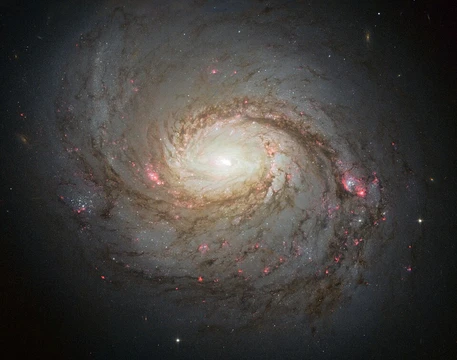
NGC 1055
Edge-on spiral galaxy with a dusty bulge and active star formation.

NGC 1055 is an edge-on spiral galaxy located in the constellation Cetus. It is notable for its prominent nuclear bulge crossed by a wide, knotty, dark lane of dust and gas, and for its spiral arm structure that appears elevated above the galaxy's plane, obscuring the upper half of the bulge. The galaxy is a bright infrared and radio source, particularly at the wavelength for warm carbon monoxide, which astronomers believe results from unusually active star formation.
Quick Facts
- Epoch
- J2000
- Constellation Name
- Cetus
- Ra
- 02 · 41 · 45.2292
- Dec
- +00 · 26 · 35.988
- Dist Ly
- 52 Mly (16 Mpc)
- Z
- 0.003322 · 0.000002ned
- Appmag V
- 10.6
Facts from the source article.
Lore & Background
NGC 1055 was discovered by German-British astronomer William Herschel on December 18, 1783, from his home in Slough, England. The galaxy is part of a binary system together with the bright spiral galaxy M77 (NGC 1068), and these two are the largest galaxies of a small galaxy group that also includes NGC 1073 and five other small irregular galaxies. NGC 1087, NGC 1090, and NGC 1094 appear close in the field of view but are background galaxies.
The galaxy has a prominent nuclear bulge crossed by a wide, knotty, dark lane of dust and gas. Its spiral arm structure appears to be elevated above the galaxy's plane and obscures the upper half of the bulge. Based on the published redshift (using a Hubble Constant of 62 km/s per Mpc), a rough distance estimate for NGC 1055 is 52 million light-years, with a diameter of about 114,400 light-years. The separation between NGC 1055 and M77 is about 7 million light-years.
NGC 1055 is a bright infrared and radio source, particularly in the wavelength for warm carbon monoxide. Astronomers believe this results from unusually active star formation. It most likely has a transitional nucleus, though there is a small chance it could be a LINER.
Reader's Guide
NGC 1055 is significant as a prominent edge-on spiral galaxy that offers a clear view of its dust lane and elevated spiral arms, providing insight into the structure of such galaxies. Its status as a binary system with M77 (NGC 1068) places it within a small galaxy group, highlighting its role in a local galactic environment. The galaxy's brightness in infrared and radio wavelengths, especially for warm carbon monoxide, indicates unusually active star formation, making it a valuable target for studies of star formation processes. The uncertainty regarding its nucleus—whether it is transitional or a LINER—adds to its interest for astronomers investigating galactic nuclei. Its discovery by William Herschel in 1783 connects it to the early history of deep-sky observation.
Did You Know?
- It is a binary system together with the bright spiral galaxy M77 (NGC 1068), with a separation of about 7 million light-years.
- The galaxy has a diameter of about 114,400 light-years and a rough distance estimate of 52 million light-years.
- NGC 1055 is a bright infrared and radio source, particularly for warm carbon monoxide, indicating unusually active star formation.
More in Spiral Galaxies, Part 2 1-24
Spotted an error? Know more?
Reader corrections go straight into our review queue. Suggest an edit · How this site is sourced