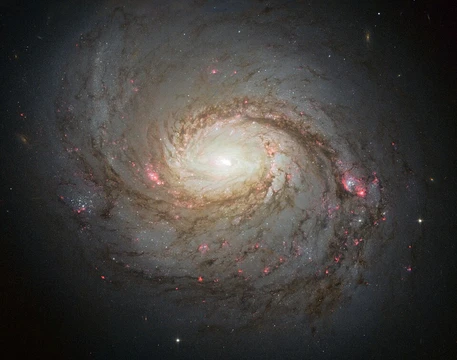
Messier 95
Barred spiral with an inner ring and a 2012 supernova.

Messier 95 (also catalogued as NGC 3351) is a barred spiral galaxy located roughly 33 million light-years from Earth in the zodiac constellation Leo. French astronomer Pierre Méchain first spotted it in 1781, and his compatriot Charles Messier added it to his catalogue four days later. The galaxy is classified as SB(r)b: the "SBb" part means it is a barred spiral whose arms fall in the middle of the tight-to-loose winding scale, while the "(r)" indicates an inner ring encircling the bar. This ring is a star-forming region about 70,000 light-years across and 2,400 light-years thick, with spiral arms extending outward from it.
The ring contains roughly 350 million solar masses of molecular gas and produces new stars at a rate of about 0.38 solar masses per year. Star formation is concentrated in at least five distinct zones, each 100 to 150 parsecs in diameter, which themselves contain multiple star clusters ranging from 1.7 to 4.9 parsecs across. These clusters hold between 1.8 and 8.7 million solar masses of stars and may eventually evolve into globular clusters.
M95 is a member of the M96 Group, a cluster of galaxies in Leo that also includes fellow Messier objects M96 and M105.
A single supernova has been observed in M95: SN 2012aw, a Type II-P (plateau) core-collapse event. It was discovered independently by Paolo Fagotti and Jure Skvarc on 16 March 2012, reaching magnitude 15. Its light curve showed a pronounced flattening after 27 days, confirming the "plateau" classification. Near-infrared images later confirmed the disappearance of the progenitor star, which was a red supergiant with an estimated mass of 12.5 ± 1.5 solar masses.
Quick Facts
- Epoch
- J2000
- Ra
- 10 · 43 · 57.7ned
- Dec
- +11 · 42 · 14
- Constellation Name
- Leo
- Z
- 778 ± 4 km/s
- Dist Ly
- 32.6 ± 1.4 Mly (10.0 ± 0.4 Mpc)jensenetal2003
- Appmag V
- 9.7seds
- Names
- NGC 3351, UGC 5850, PGC 32007
Facts from the source article.
Lore & Background
Messier 95 was discovered by Pierre Méchain in 1781 and catalogued by compatriot Charles Messier four days later. It is a barred spiral galaxy with a morphological classification of SB(r)b, where the 'SBb' indicates a barred spiral with arms intermediate in tightness, and the '(r)' denotes an inner ring surrounding the bar. This ring is a circumnuclear star-forming region with a diameter of approximately 70,000 light-years and a thickness of about 2,400 light-years, from which the spiral structure extends outward.
The ring contains about 3.5×10^8 solar masses of molecular gas and has a star formation rate of 0.38 solar masses per year. Star formation occurs in at least five regions with diameters between 100 and 150 parsecs, each composed of several star clusters ranging in size from 1.7 to 4.9 parsecs. These clusters contain (1.8–8.7)×10^6 solar masses of stars and may be on the path to forming globular clusters.
M95 is one of several galaxies within the M96 Group, a group of galaxies in Leo that also includes M96 and M105. In 2012, its most recent supernova was discovered.
Reader's Guide
Messier 95's significance lies in its well-characterized barred spiral structure with an inner ring, which provides a laboratory for studying star formation in circumnuclear regions. The ring's molecular gas mass and star formation rate are precisely measured, and the star-forming regions within it offer insight into the formation of globular clusters. The galaxy's 2012 supernova, SN 2012aw, is a Type II-P core-collapse event whose light curve displayed a plateau after 27 days. The progenitor star was identified as a red supergiant with an estimated mass of 12.5±1.5 solar masses, confirmed by near-infrared imaging. As part of the M96 Group, M95 contributes to the understanding of galaxy interactions and group dynamics. Its discovery by Pierre Méchain and cataloguing by Charles Messier place it within the historic Messier catalog, a collection of deep-sky objects still studied today.
Did You Know?
- The star-forming regions in the ring may be on the path to forming globular clusters.
- The supernova SN 2012aw was a Type II-P plateau event with a progenitor mass of 12.5±1.5 solar masses.
More in Spiral Galaxies, Part 2 1-24
Spotted an error? Know more?
Reader corrections go straight into our review queue. Suggest an edit · How this site is sourced