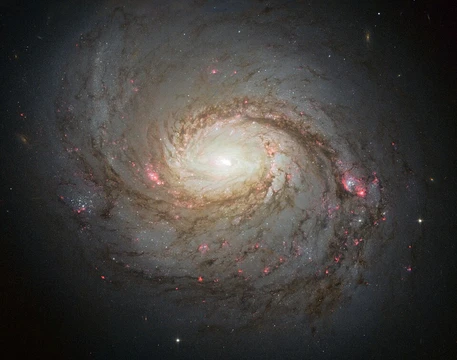
Messier 91
Faintest Messier object, a barred spiral in Virgo Cluster.

Messier 91 (also known as NGC 4548 or M91) is a barred spiral galaxy located in the south of Coma Berenices. It is part of the local supercluster and belongs to the Virgo Cluster of galaxies, approximately 63 million light-years away from the Milky Way. It is notable as the faintest object in the Messier catalog, with an apparent magnitude of 10.2, and was the last of a group of eight 'nebulae' discovered by Charles Messier in 1781.
Quick Facts
- Epoch
- J2000
- Ra
- 12 · 35 · 26.4
- Dec
- +14 · 29 · 47
- Dist Ly
- 63 ± 16 Mly (19 ± 5 Mpc)tonryetal2001
- Z
- 486 ± 4 km/s
- Appmag V
- 10.2sedsm91
- Constellation Name
- Coma Berenices
- Names
- NGC 4548, UGC 7753, PGC 41934
Facts from the source article.
Lore & Background
Messier 91 was discovered in 1781 by Charles Messier, who described it as a nebula without stars, fainter than M90. However, Messier mistakenly logged its position from Messier 58, when it should have been from Messier 89. This bookkeeping error caused M91 to be one of the few missing entries in the Messier catalog for nearly two centuries, not matching any known object in the sky. It was not until 1969 that amateur astronomer William C. Williams solved the mystery by measuring its right ascension and declination relative to M89, rather than M58, matching Messier's figures to within 0.1 arcminute in right ascension and 1 arcminute in declination. Some sources contend that the nearby spiral galaxy NGC 4571 was considered a candidate for this object by William Herschel, who had independently catalogued NGC 4548 in 1784.
The galaxy's bar is very conspicuous, with a position angle of 65 to 245 degrees when measured from the North direction to the East. Messier 91 is classified as an anemic galaxy, meaning it is a spiral galaxy with little star formation and gas compared with other galaxies of its type. Its inclusion in the Virgo Cluster was confirmed in 1997 from observing Cepheid variables, which placed it at 52±6 million light-years away. The galaxy exhibits a countering peculiar velocity toward us through the Virgo cluster of about 700 km/s within the cluster's recession velocity of about 1100 km/s, producing its observed recessional velocity of only about 400 km/s.
Reader's Guide
Messier 91's significance lies in its role as a long-lost Messier object, resolved only in 1969 due to a positional error by Charles Messier. This historical puzzle highlights the challenges of early astronomical cataloging and the importance of precise coordinate measurements. As the faintest object in the Messier catalog, it represents the observational limits of 18th-century telescopes. Its classification as an anemic galaxy provides insight into the diversity of spiral galaxies, showing that some have reduced star formation and gas content. The galaxy's membership in the Virgo Cluster, confirmed via Cepheid variables in 1997, helps calibrate the distance scale within the local supercluster. The peculiar velocity measurement—a countering motion of about 700 km/s toward us within the cluster's recession—illustrates the complex dynamics of galaxy clusters. The resolution of its identity by amateur astronomer William C. Williams underscores the ongoing contributions of non-professional astronomers to astronomical knowledge.
Did You Know?
- The galaxy was a lost Messier object until amateur astronomer William C. Williams identified it as NGC 4548 in 1969.
- Messier 91 is classified as an anemic galaxy, with little star formation and gas compared to other spirals.
More in Spiral Galaxies, Part 2 1-24
Spotted an error? Know more?
Reader corrections go straight into our review queue. Suggest an edit · How this site is sourced