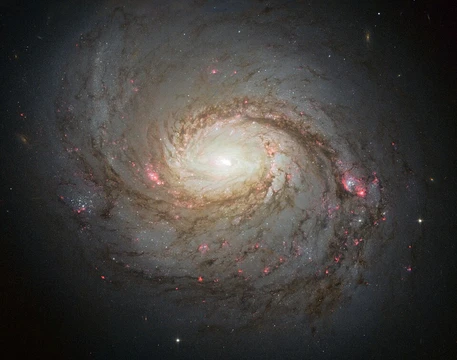
Messier 83
A bright barred spiral galaxy near Earth, visible with binoculars.

Messier 83 (M83), also cataloged as NGC 5236 and nicknamed the Southern Pinwheel Galaxy, is a barred spiral galaxy located about 15 million light-years away, straddling the borders of Hydra and Centaurus. It was first spotted on February 17, 1752, by Nicolas-Louis de Lacaille at the Cape of Good Hope, and later added to Charles Messier’s famous catalog in March 1781. Among the closest and brightest barred spirals in the sky, it can be seen with binoculars and spans an isophotal diameter of roughly 36.24 kiloparsecs (118,000 light-years). Its nickname comes from its resemblance to the Pinwheel Galaxy (M101).
Classified as SAB(s)c in the De Vaucouleurs system, M83 is a massive grand design spiral with a weak bar, pure spiral arms lacking a ring, and loosely wound structure. The nearby peculiar dwarf galaxy NGC 5253 likely interacted with M83 within the last billion years, triggering starburst activity in both galaxies’ centers. Star formation occurs preferentially along the leading edges of the spiral arms, consistent with density wave theory. In April 2008, NASA’s Galaxy Evolution Explorer reported a surprising abundance of new stars in the galaxy’s outer regions, 20 kiloparsecs from the center—areas previously thought too barren for star formation. In April 2025, astronomers published the first hints of a possible supermassive black hole at M83’s core.
Six supernovae have been observed in M83. SN 1923A (mag. 14) was found by Carl Otto Lampland on May 5, 1923. SN 1945B (mag. 14.2) was discovered by William Liller on July 13, 1945. SN 1950B (mag. 14.5) was spotted by Guillermo Haro on March 15, 1950. SN 1957D (mag. 15) was detected by Howard S. Gates on December 28, 1957. SN 1968L (Type II-P, mag. 11.9) was found by John C. Bennett on July 17, 1968. SN 1983N (Type Ia, mag. 11.9) was discovered by Robert Evans from Australia on July 3, 1983; on July 6, it became the first Type I supernova detected in radio waves using the Very Large Array. It reached peak visual brightness of mag. 11.54 on July 17. Though classified as Type I, its spectrum was unusual. A year after the explosion, about 0.3 solar masses of iron were unambiguously detected in the ejecta—the first such clear detection from any supernova. SN 1983N later became the modern prototype for hydrogen-deficient Type Ib supernovae, with its progenitor inferred to be a Wolf–Rayet star.
Quick Facts
- Epoch
- J2000
- Ra
- 13 · 37 · 00.919
- Dec
- -29 · 51 · 56.74
- Dist Ly
- 4.50 Mpc
- Appmag V
- 7.6seds
- Constellation Name
- Hydra
Facts from the source article.
Lore & Background
Nicolas-Louis de Lacaille discovered M83 on 17 February 1752 at the Cape of Good Hope. Charles Messier added it to his catalogue of nebulous objects in March 1781. Its nickname 'Southern Pinwheel' derives from its resemblance to the Pinwheel Galaxy (M101).
M83 is a massive, grand design spiral galaxy with morphological classification SAB(s)c, indicating a weak-barred spiral with pure spiral structure and loosely wound arms. The peculiar dwarf galaxy NGC 5253 lies near M83, and the two likely interacted within the last billion years, resulting in starburst activity in their central regions. The star formation rate is higher along the leading edge of the spiral arms, as predicted by density wave theory. In April 2008, NASA's Galaxy Evolution Explorer reported finding large numbers of new stars in the outer reaches—20 kpc from the center—areas previously thought to lack materials for star formation. In April 2025, first clues were published for the possible existence of a supermassive black hole at the center of M83.
Six supernovae have been observed in M83, including SN 1983N, which became the modern prototype of a hydrogen-deficient Type Ib supernova, with its progenitor inferred as a Wolf–Rayet star. M83 is at the center of one of two subgroups within the Centaurus A/M83 Group, a nearby galaxy group; the two subgroups appear not to be moving relative to each other.
Reader's Guide
Messier 83 is significant as one of the closest and brightest barred spiral galaxies, making it a key object for amateur and professional study. Its grand design spiral structure and high star formation rate, particularly along the leading edges of its arms, provide a clear example of density wave theory in action. The discovery of new stars in its outer reaches challenged previous assumptions about star formation in low-density regions. The possible supermassive black hole at its center, hinted at in 2025, adds to its astrophysical importance. The galaxy's six observed supernovae, especially SN 1983N, have contributed to the understanding of Type Ib supernovae and their Wolf–Rayet progenitors. M83's membership in the Centaurus A/M83 Group, where it anchors one subgroup, places it in a broader context of galactic interactions and group dynamics. Its visibility with binoculars and its nickname 'Southern Pinwheel' have made it a popular target for observers in the southern sky.
More in Spiral Galaxies, Part 2 1-24
Spotted an error? Know more?
Reader corrections go straight into our review queue. Suggest an edit · How this site is sourced