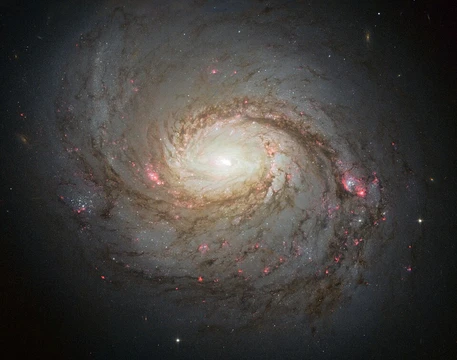
Messier 77
A bright, nearby Seyfert galaxy with an obscured active nucleus.

Messier 77 (also cataloged as NGC 1068 and nicknamed the Squid Galaxy) lies in the constellation Cetus, about 35 million light-years from Earth. Pierre Méchain first spotted it in 1780, calling it a nebula, and then told Charles Messier, who added it to his famous catalog. Both Messier and William Herschel thought it was a star cluster, but we now know it is a barred spiral galaxy. Its D25 isophotal diameter measures roughly 27.70 kiloparsecs (90,000 light-years), and it ranks among the brightest Seyfert galaxies visible from our planet.
In the De Vaucouleurs classification system, its morphology is given as (R)SA(rs)b: the "(R)" points to an outer ring-like structure, "SA" means it appears to lack a bar, "(rs)" indicates a mix of inner ring and spiral features, and "b" says the spiral arms are moderately wound. Ann et al. (2015) assigned it a class of SAa, implying tightly wound arms. Yet infrared images of its inner region reveal a clear bar that is invisible in ordinary light, so astronomers now consider it a barred spiral. This galaxy is the biggest member of a small group that includes NGC 1055—an edge-on spiral likely warped by gravitational tugs from Messier 77—along with five small irregular galaxies.
Messier 77 is an active galaxy, hosting an active galactic nucleus (AGN) that is hidden by dust at visible wavelengths. The Very Long Baseline Array and the Very Large Array first measured the size of the molecular disk and hot plasma around this obscuring material using radio waves. Later, the MIDI instrument on the Very Large Telescope measured the hot dust near the nucleus in the mid-infrared. It is one of the closest, brightest, and most thoroughly studied type 2 Seyfert galaxies, serving as a prototype for this class.
Scientists find Messier 77 especially valuable for studying active galactic nuclei because it is both nearby and luminous. One key idea is that type 2 Seyfert galaxies are actually the same kind of object as type 1 Seyferts, just seen from an angle that hides the bright core. In 1994, Tacconi and colleagues used interferometry to analyze the galaxy's spectra and concluded that a thick molecular cloud region blocks the view of its Seyfert 1 core. The galaxy also has a radio jet with northeast and southwest components, shaped by interactions with the interstellar medium.
Quick Facts
- Epoch
- J2000
- Ra
- 02 · 42 · 40.771
- Dec
- −00 · 00 · 47.84
- Dist Ly
- 10.72 ± 0.52 Mpc
- Z
- 0.003793
- Appmag V
- 8.9seds
- Constellation Name
- Cetus
- Mass
- ~112
- Notes
- One of the biggest galaxies of Messier's catalog. Inclination estimated to be 40°.
Facts from the source article.
Lore & Background
Messier 77 was discovered by Pierre Méchain in 1780, who described it as a nebula and communicated his discovery to Charles Messier, who listed it in his catalog. Both Messier and William Herschel described this galaxy as a star cluster, but today it is known to be a galaxy. Its morphological classification in the De Vaucouleurs system is (R)SA(rs)b, indicating an outer ring-like structure, a non-barred spiral, a transitional inner ring/spiral structure, and moderately wound arms. Ann et al. (2015) gave it a class of SAa, suggesting tightly wound arms. However, infrared images reveal a prominent bar not seen in visual light, so it is now considered a barred spiral.
Messier 77 is the largest member of a small group of galaxies, including NGC 1055 (an edge-on spiral likely twisted by gravitational interactions with M77) and five small irregular galaxies. It is an active galaxy with an active galactic nucleus (AGN) obscured from view at visible wavelengths by astronomical dust. The diameter of the molecular disk and hot plasma associated with the obscuring material was first measured at radio wavelengths by the Very Long Baseline Array (VLBA) and the Very Large Array (VLA). The hot dust around the nucleus was subsequently measured in the mid-infrared by the MIDI instrument at the Very Large Telescope (VLT) observatory. It is one of the brightest, closest, and best-studied type 2 Seyfert galaxies, forming a prototype of this class.
Reader's Guide
Messier 77 is of key interest to scientists due to its relative proximity and luminosity, allowing for study of its active galactic nucleus. It has been proposed that type 2 Seyfert galaxies are the same class as type 1 Seyfert galaxies, viewed from an angle that hides the type 1 core. An analysis of M77's spectra using interferometry by Tacconi et al. (1994) suggested that the galaxy's Seyfert 1 core was obstructed by a thick molecular cloud region. The galaxy has a radio jet consisting of northeast and southwest regions, caused by interactions with the interstellar medium; bow shocks in the northeast region overlap with edges of molecular outflow, suggesting the jet drives the outflow. X-ray source 1H 0244+001 was identified as M77 in 1984. In February 2022, astronomers reported a cloud of cosmic dust at the center hiding a supermassive black hole, detected through infrared interferometry. In November 2022, the IceCube Neutrino Observatory announced detection of a neutrino source from M77's AGN, the second detection by IceCube after TXS 0506+056, and only the fourth known source including SN1987A and solar neutrinos. A potential candidate for the neutrino source is the magnetic corona surrounding the AGN. To explain M77 being an energetic neutrino source but a weak gamma-ray source, a mechanism was suggested whereby helium nuclei collide with ultraviolet photons and break up, releasing neutrons that decay into neutrinos without producing gamma rays. The only supernova observed in M77 is SN 2018ivc (Type II, mag. 14.6523), discovered by the DLT40 Survey on 24 November 2018.
Did You Know?
- Messier 77 was discovered by Pierre Méchain in 1780, who originally described it as a nebula.
- Infrared images reveal a prominent bar in Messier 77 not seen in visual light, making it a barred spiral despite earlier classifications.
- In November 2022, IceCube detected a neutrino source from Messier 77's active galactic nucleus, only the fourth known neutrino source.
- The only supernova observed in Messier 77, SN 2018ivc, was a Type II supernova discovered on 24 November 2018.
Frequently Asked Questions
Who discovered Messier 77 and how did it get its name?
Pierre Méchain first observed the object in 1780 while cataloging deep-sky targets, describing it simply as a nebula. He relayed the finding to Charles Messier, who then incorporated it into his well-known list of nebulous objects, giving it the Messier 77 designation we still use today.
What kind of galaxy is Messier 77, and why is it called the Squid Galaxy?
Messier 77 is a barred spiral galaxy whose elongated, tentacle-like spiral arms gave rise to the popular nickname 'Squid Galaxy.' It also hosts an obscured active galactic nucleus, making it one of the brightest Seyfert-type galaxies observable from Earth.
How far away is Messier 77 and where in the sky can I find it?
It sits roughly 35 million light-years (about 11 megaparsecs) from us, nestled within the winter constellation Cetus. Its proximity relative to other Seyfert galaxies makes it a favorite target for both amateur and professional observers.
How big is Messier 77 compared to the Milky Way?
Its D25 isophotal diameter spans approximately 27.70 kiloparsecs, or around 90,000 light-years, which is comparable to the visible disk of our own galaxy. This substantial size, combined with its bright active core, helps explain why it stands out so prominently in the night sky.
Why do astronomers still find Messier 77 interesting today?
Its obscured Seyfert nucleus provides a natural laboratory for studying how dust and gas obscure active black holes, and its relatively short distance allows high-resolution follow-up observations. The fact that both Messier and Herschel initially misidentified it as a star cluster also makes it a classic case study in the history of extragalactic astronomy.
More in Spiral Galaxies, Part 2 1-24
Spotted an error? Know more?
Reader corrections go straight into our review queue. Suggest an edit · How this site is sourced