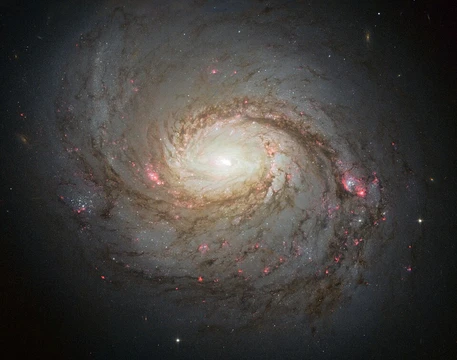
Messier 109
Barred spiral galaxy, most distant Messier object.

Messier 109, also cataloged as NGC 3992 and nicknamed the Vacuum Cleaner Galaxy, is a barred spiral galaxy located in the northern constellation Ursa Major. It lies about 67.2 million light-years away (with a margin of error of 23 million light-years) and can be found southeast of the star Phecda (Gamma Ursa Majoris). This galaxy holds the record as the most distant object in the Messier Catalog, with M91 coming in second. It also shines as the brightest member of the M109 Group, a large gathering of galaxies in Ursa Major that may contain over 50 members.
The galaxy was first spotted by Pierre Méchain in 1781. Charles Messier added it as an appendix to his catalog two years later. For much of the 20th century—from the 1920s through the 1950s—objects beyond Messier 103 were not considered official, but later additions based on Méchain's observations gained acceptance. Astronomer David H. Levy recognizes the modern 110-object catalog, while Sir Patrick Moore caps the list at 104 but includes M105 through M109 as supplementary entries. By the late 1970s, all 110 objects were widely used by astronomers, and that standard remains today.
M109 has three known satellite galaxies (UGC 6923, UGC 6940, and UGC 6969), with possibly more. Detailed observations of hydrogen gas (H I) have been made of M109 and its companions. The galaxy's H I distribution is regular, with a low-level radial extension beyond the stellar disk, but there is a central hole in the gas within the bar. This suggests that gas may have been funneled inward by the bar, and the emptiness of the hole indicates that no major accretion events have occurred recently.
One supernova has been recorded in M109: SN 1956A, a Type Ia event that reached magnitude 12.3. It was discovered on March 8, 1956, by Howard S. Gates using the 18-inch Schmidt telescope at Palomar Observatory. The explosion was located 67 arcseconds east and 9 arcseconds south of the galaxy's center.
Quick Facts
- Epoch
- J2000
- Constellation Name
- Ursa Major
- Ra
- 11 · 57 · 36.0
- Dec
- +53 · 22 · 28
- Appmag V
- 9.8seds
- Z
- 0.003496 · 0.000004
- Dist Ly
- 67.2 +/-
Facts from the source article.
Lore & Background
Messier 109 was discovered by Pierre Méchain in 1781. Two years later Charles Messier catalogued the object as an appended object to his publication. Between the 1920s through the 1950s, it was considered that Messier objects over 103 were not official, but later the additions, further referred target objects from Méchain, became more widely accepted. David H. Levy mentions the modern 110 object catalog while Sir Patrick Moore places the limit at 104 objects but has M105 to 109 listed as addenda. By the late 1970s all 110 objects were in common use among astronomers and remain so to this day.
This galaxy is the most distant object in the Messier Catalog, followed by M91. M109 has three satellite galaxies (UGC 6923, UGC 6940 and UGC 6969) and possibly more. Detailed hydrogen line observations have been obtained from M109 and its satellites. M109's H I distribution is regular with a low-level radial extension outside the stellar disc, while in the bar is a central H I hole in the gas distribution. Possibly the gas has been transported inwards by the bar, and because of the emptiness of the hole no large accretion events can have happened in the recent past.
One supernova has been observed in M109: SN 1956A (Type Ia, mag. 12.3) was discovered by Howard S. Gates on 8 March 1956, using the 18-inch Schmidt telescope at the Palomar Observatory. It was located 67" east and 9" south of the center of the galaxy.
Reader's Guide
Messier 109 holds significance as the most distant object in the Messier Catalog, a fact that underscores its value for studies of galaxy distances and the structure of the local universe. Its status as the brightest member of the M109 Group, a large group that may number over 50 galaxies, makes it a key target for understanding group dynamics and galaxy interactions. The galaxy's three known satellite galaxies and its regular H I distribution with a central hole suggest a history without recent large accretion events, providing clues about gas dynamics in barred spirals. The sole observed supernova, SN 1956A, adds to its legacy as a site of stellar explosion. The historical debate over the official status of Messier objects beyond 103, resolved by the late 1970s, places M109 in a catalog that now includes 110 objects, cementing its place in amateur and professional astronomy. Its location southeast of the star Phecda in Ursa Major makes it accessible for observation.
Did You Know?
- One supernova, SN 1956A, was observed in M109 on 8 March 1956.
- The galaxy is also known as the Vacuum Cleaner Galaxy.
More in Spiral Galaxies, Part 2 1-24
Spotted an error? Know more?
Reader corrections go straight into our review queue. Suggest an edit · How this site is sourced