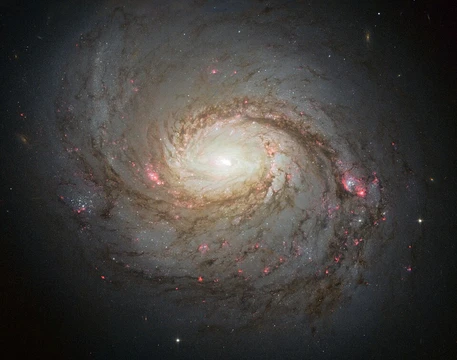
Messier 108
A barred spiral galaxy seen nearly edge-on in Ursa Major.

Messier 108 (NGC 3556, also called the Surfboard Galaxy) is a barred spiral galaxy located roughly 46 million light-years away in the northern constellation Ursa Major. Pierre Méchain found it sometime between 1781 and 1782. Seen from Earth, the galaxy appears nearly edge-on. It sits as an isolated member of the Ursa Major Cloud, a group of galaxies within the local supercluster. Its morphological classification is SBbc in the de Vaucouleurs system, meaning it’s a barred spiral with somewhat loosely wound arms. Optically, its maximum angular size measures 11.1 by 4.6 arcminutes, and it’s tilted about 75° relative to our line of sight.
The galaxy’s estimated mass is 125 billion solar masses, and it hosts roughly 290 ± 80 globular clusters. Observations of its neutral hydrogen reveal discrete, expanding shells of gas stretching several kiloparsecs—called H1 supershells. These could be driven by currents of dark matter, dust, and gas that fuel large-scale star formation and subsequent supernova explosions. Alternatively, they might result from infalling intergalactic material or originate from radio jets.
The Chandra X-ray Observatory has detected 83 X-ray sources in M108, including one at the nucleus. The brightest of these matches an intermediate-mass black hole that’s accreting matter. The galaxy also emits diffuse soft X-ray radiation within 2.6 arcminutes of its optical center. The core’s spectrum suggests an active galactic nucleus, but the Spitzer Space Telescope found no signs of activity. The supermassive black hole at the center has an estimated mass of 24 million solar masses.
Four supernovae have been observed in M108. SN 1969B (unknown type, magnitude 16) was discovered by Paul Wild on 6 February 1969 and independently by Balázs on 10 February 1969, reaching magnitude 13.9. SPIRITS 16tn, found by the Spitzer Space Telescope in August 2016, was visible only in infrared because dust heavily obscured it; its extinction was estimated at 8–9 magnitudes, making it one of the most heavily obscured supernovae ever seen. SN 2023dbc (Type Ic, magnitude 17) was discovered by the Zwicky Transient Facility on 13 March 2023; it’s likely a stripped-envelope supernova, with no hydrogen in its spectra beyond narrow emission from the underlying HII region, and it’s among the nearest Type Ic supernovae known.
Quick Facts
- Epoch
- J2000
- Constellation Name
- Ursa Majorsinnott1988
- Ra
- 11 · 11 · 31.0ned
- Dec
- +55 · 40 · 27
- Z
- 696.1 ± 0.6 km/s
- Dist Ly
- 14.1 Mpc (46 Mly)Sorce2014
- Appmag V
- 10.0seds
- Names
- NGC 3556, PGC 34030, UGC 6225
Facts from the source article.
Lore & Background
Messier 108 was discovered by Pierre Méchain in 1781 or 1782. It is an isolated member of the Ursa Major Cloud of galaxies in the local supercluster. The galaxy has a morphological classification of type SBbc in the de Vaucouleurs system, indicating a barred spiral with somewhat loosely wound arms. Its maximum angular size in the optical band is 11′.1 × 4′.6, and it is inclined 75° to the line of sight. The galaxy has an estimated mass of 125 billion solar masses and bears about 290 ± 80 globular clusters. Examination of the distribution of neutral hydrogen shows discrete shells of expanding gas extending for several kiloparsecs, known as H1 supershells. These may be driven by currents of dark matter, dust and gas contributing to large star formation, having caused supernovae explosions, or may result from an infall from the intergalactic medium or arise from radio jets. Observations with the Chandra X-ray Observatory have identified 83 X-ray sources, including a source at the nucleus. The brightest of these is consistent with an intermediate-mass black hole accreting matter. The galaxy also emits diffuse soft X-ray radiation within 2.6 arcminutes of the optical galaxy. The spectrum of the core source is consistent with an active galactic nucleus, but an examination with the Spitzer Space Telescope showed no indication of activity. The supermassive black hole at the core has an estimated mass of 24 million solar masses.
Reader's Guide
Messier 108 is significant as a nearby barred spiral galaxy seen nearly edge-on, offering a clear view of its structure and the dynamics of its interstellar medium. The discovery of H1 supershells—expanding shells of neutral hydrogen extending for several kiloparsecs—highlights ongoing processes such as star formation, supernova explosions, or interactions with the intergalactic medium. The galaxy's X-ray emission, including 83 identified sources and a central source consistent with an intermediate-mass black hole, adds to its astrophysical interest, though the nature of its nucleus remains ambiguous: the X-ray spectrum suggests an active galactic nucleus, but Spitzer observations found no indication of activity. The supermassive black hole at the core has an estimated mass of 24 million solar masses. Four supernovae have been observed in M108, including SN 1969B, SPIRITS 16tn (one of the most heavily obscured supernovae ever observed), SN 2023dbc (a nearby Type Ic stripped-envelope supernova), and SN 2025ahqr (a low-luminosity Type Iax supernova). These events make M108 a valuable laboratory for studying supernova diversity and dust extinction.
Did You Know?
- Messier 108 is nicknamed the Surfboard Galaxy.
- The galaxy has about 290 ± 80 globular clusters.
- Four supernovae have been observed in M108, including one of the most heavily obscured ever seen.
More in Spiral Galaxies, Part 2 1-24
Spotted an error? Know more?
Reader corrections go straight into our review queue. Suggest an edit · How this site is sourced