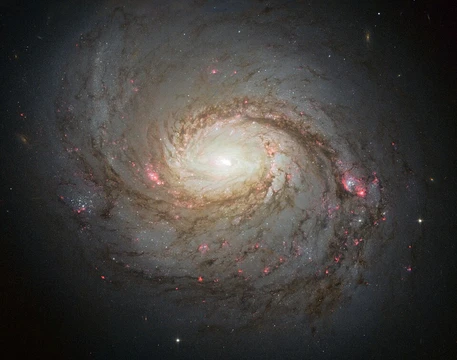
Markarian 817
A barred spiral Seyfert galaxy with a variable active nucleus.

Markarian 817 is a barred spiral galaxy located in the constellation Draco, approximately 456 million light-years from Earth. It is a Seyfert galaxy notable for its active nucleus, which has shown strong variability in X-rays and ultraviolet rays, and for hosting a complex, structured ultra-fast outflow. The galaxy has become a key target of the AGN STORM 2 project, monitored extensively with the Neil Gehrels Swift Observatory.
Quick Facts
- Epoch
- J2000
- Constellation Name
- Draco
- Ra
- 14h 36m 22.068s
- Dec
- +58d 47m 39.38s
- Z
- 0.031328
- H Radial V
- 9,392 km/s
- Dist Ly
- 456 Mly (140 Mpc)
- Appmag V
- 14.6
- Notes
- Seyfert galaxy
- Names
- UGC 9412, SBS 1434+590, CGCG 296-015, IRAS 14349+5900, PGC 52202
Facts from the source article.
Lore & Background
The nucleus of Markarian 817 is active, classified as Seyfert 1.5 or Seyfert 1.2 according to Koss et al. 2017. It sits in a barred spiral galaxy close to face-on, with evidence of dust along the bar from Hubble imagery. A study from February 2011 showed the active core varies strongly in X-rays and ultraviolet rays, with X-ray luminosity varying by a factor of ~40 over 20 years and UV continuum/emission lines varying by a factor of ~2.3 over 30 years.
A 2021 study revealed highly absorbed X-ray spectra and new blueshifted, broad, and narrow UV absorption lines, indicating a dust-free, ionized obscurer in the inner broad-line region. During the first 55 days of observation, the UV continuum and broad emission line variability decoupled; the next 42 days showed the correlation recovering as the galaxy entered a less obscured state. Short C IV and Lyα lags suggest the accretion disk extends beyond the UV broad-line region.
Further observations in 2022 showed the source flux had declined compared to a prior point in the 19-year mission. Deep XMM Newton and NuSTAR observations revealed a complex X-ray wind with neutral and ionized absorption zones, including three velocity components: v/c = 0.043 (+0.007,-0.003), v/c = 0.079 (+0.003,-0.0008), and v/c = 0.074 (+0.004,-0.005), suggesting the wind arises at radii smaller than the optical broad line region.
Reader's Guide
Markarian 817 is significant for its highly variable active nucleus and complex outflows, which provide insights into the dynamics of Seyfert galaxies. The galaxy's central black hole, with an estimated mass of (4.9±0.8)×10^7 solar masses, drives winds moving at many millions of kilometers per hour, cleaning interstellar gas and suppressing star formation. This behavior, described as a 'temper tantrum,' suggests the black hole shapes its host galaxy. The galaxy's inclusion in the AGN STORM 2 project, led by Edward M. Cackett from Wayne State University, underscores its importance for understanding AGN variability and accretion processes. Studies comparing Markarian 817 with NGC 7469 revealed time lags in broad emission lines consistent with Keplerian motion, with outflowing components indicated by larger time lags in the red wing than the blue wing. The detection of a structured ultra-fast outflow with three velocity components further highlights its role in studying AGN feedback and the connection between black hole activity and galaxy evolution.
Did You Know?
- Markarian 817 is located 456 million light-years from Earth in the constellation Draco.
- Its X-ray luminosity varies by a factor of ~40 over 20 years.
- The galaxy's ultra-fast outflow has three velocity components, including v/c = 0.043.
Frequently Asked Questions
What is Markarian 817?
Markarian 817 is a barred spiral galaxy classified as a Seyfert 1.5 or 1.2 type, meaning it hosts a highly active central nucleus. It sits roughly 456 million light-years away in the constellation Draco.
How big is Markarian 817?
The galaxy spans about 94,000 light-years across. Its central supermassive black hole carries a mass of roughly 49 million solar masses, with an uncertainty of about 8 million.
What makes Markarian 817's active nucleus unusual?
Its nucleus displays strong variability in both X-ray and ultraviolet emission, and it drives a complex, structured ultra-fast outflow of material. These features make it a prime example of an active galactic nucleus in action.
Where in the sky can I find Markarian 817?
Look toward the constellation Draco, where the galaxy sits approximately 456 million light-years from Earth. Because of that vast distance, it is far beyond the reach of any backyard telescope.
Why do astronomers keep studying Markarian 817?
It has become a key target of the AGN STORM 2 project, which uses the Neil Gehrels Swift Observatory to monitor its changing nuclear activity over time. Tracking its variability helps researchers understand how supermassive black holes feed and expel energy.
More in Spiral Galaxies, Part 2 1-24
Spotted an error? Know more?
Reader corrections go straight into our review queue. Suggest an edit · How this site is sourced