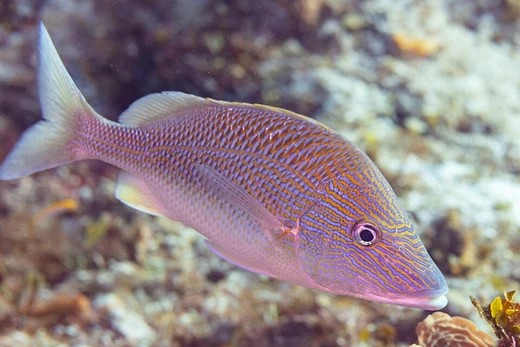
Haemulidae
A fish family known for sound production via pharyngeal teeth.

The grunts, scientifically known as Haemulidae, are a fish family belonging to the order Acanthuriformes. This group splits into two subfamilies: Haemulinae (the grunts proper) and Plectorhynchinae (the sweetlips). Worldwide, the family includes roughly 133 species spread across 19 genera. These fish typically live in tropical, subtropical, and warm temperate zones, and they occupy marine, brackish, and occasionally freshwater environments. Their feeding strategies vary widely, ranging from preying on bottom-dwelling creatures to filtering plankton from the water column. The common name "grunts" comes from the Haemulinae subfamily’s ability to make noise by grinding their pharyngeal teeth. Some species also form mutualistic relationships with cleaner gobies from the genus *Elacatinus*, allowing the gobies to feed on external parasites attached to their bodies.
Quick Facts
- Taxon
- Haemulidae
Facts from the source article.
Lore & Background
The family Haemulidae is divided into two subfamilies: Haemulinae (grunts) and Plectorhynchinae (sweetlips). The subfamily Haemulinae includes genera such as Anisotremus, Boridia, Brachydeuterus, Brachygenys, Conodon, Emmelichthyops, Haemulon, Haemulopsis, Isacia, Microlepidotus, Orthopristis, Parakuhlia, Paranisotremus, Pomadasys, Rhencus, Rhonciscus, and Xenichthys. The subfamily Plectorhynchinae includes Diagramma, Genyatremus, Parapristipoma, and Plectorhinchus. One of the earliest known fossil grunts is †Pomadasys sadeki (formerly placed in its own genus, Kemtichthys) from the Middle Eocene-aged Mokattam Formation of Egypt. The family is named for the ability of Haemulinae to produce sounds by grinding their pharyngeal teeth. Some species engage in mutualistic relationships with cleaner gobies of the genus Elacatinus, allowing them to feed on ectoparasites on their bodies.
Reader's Guide
The family Haemulidae is notable for its ecological diversity and behavioral adaptations. The family shows many feeding adaptations from bottom-feeding predation to water-column planktivory, indicating a wide range of trophic roles in marine, brackish, and sometimes fresh waters. Its common name 'grunts' derives from the sound-producing ability of Haemulinae, which grind their pharyngeal teeth. This acoustic behavior is a distinctive characteristic within the order Acanthuriformes. Additionally, some species participate in mutualistic relationships with cleaner gobies of the genus Elacatinus, allowing the gobies to feed on ectoparasites. The family's fossil record includes †Pomadasys sadeki from the Middle Eocene-aged Mokattam Formation of Egypt, providing evidence of its ancient lineage. With about 133 species in 19 genera, Haemulidae represents a significant component of tropical, subtropical, and warm temperate fish communities worldwide.
A Name Carried Across Centuries
The white grunt's formal entry into scientific record traces back to 1801, when the French naturalist Bernard German de Lacépède published a description under the name Labrus plumierii. Lacépède, who lived between 1756 and 1825, did not work from a live or preserved specimen; instead, he relied on a drawing produced by Charles Plumier, a Franciscan friar and naturalist who had died in 1704. Plumier's name was immortalized in the species' epithet as a tribute to his earlier observations, and the type locality was recorded as Martinique, anchoring the description to the Caribbean. Over time, the fish was moved out of the genus Labrus and into the family Haemulidae, where it sits alongside two close relatives: the bluestriped grunt (Haemulon sciurus) and the French grunt (Haemulon flavolineatum). This taxonomic placement reflects shared anatomical traits, particularly the robust, fixed lower jawbone that distinguishes grunts from look-alike families such as groupers and snappers. The lineage underscores how a single sketch by a seventeenth-century friar helped shape modern ichthyological nomenclature.
A Living Canvas of Stripes and Scales
At a glance, the white grunt presents a striking palette: a silvery-cream base overlaid with numerous narrow yellow and blue longitudinal stripes that run the length of its body. Its head is elongated with a pronounced snout, the pectoral fins curve in a falcate shape, and the caudal fin splits into a forked tail. Along the back, a row of dorsal spines adds a defensive texture, while the mouth is armed with rough teeth suited to crushing small invertebrates. One of the most distinctive anatomical features is the strong, fixed lower jawbone, a trait that sets grunts apart from superficially similar families like Serranidae. In terms of size, most individuals measure between six and twelve inches, though specimens exceeding twenty inches and weighing more than fifteen pounds have been documented. Perhaps most remarkable is the fish's ability to subtly shift its coloration, darkening or lightening to blend with whatever background it occupies, from sunlit reef to shadowed dock pilings.
Schools, Snaps, and the Sound of Distress
The white grunt is a creature of structure, favoring mangrove roots, coral reefs, dock pilings, and virtually any man-made or natural formation throughout its range. That range stretches impressively from Chesapeake Bay down through the Caribbean Sea and the Gulf of Mexico all the way to the waters off Brazil, typically at depths between the surface and roughly thirty meters. It rarely travels alone; mixed schools with its close kin, the bluestriped grunt and the French grunt, are a common sight. Its diet is broad and opportunistic, centered on shrimp but extending to other crustaceans, annelid worms, and bivalve mollusks. At the top of the food chain, barracuda, sharks, groupers, and snappers all take grunts, drawn by their abundance and tendency to school in large numbers. When threatened—say, by a closing predator or a sudden hook strike—the fish produces its namesake grunt, a grinding sound generated by pharyngeal teeth rubbing together deep in the throat.
From the Angler's Line to the Aquarium Tank
On the commercial fishing scene the white grunt plays only a minor role, yet it holds a warm place in recreational angling. Its ease of capture, combined with a willingness to strike both natural and artificial lures, makes it a favorite target for children, beginners, and seasoned fishermen alike. Once landed, the fish offers clean, flaky white flesh that cooks well, and in Florida it stars in the traditional dish known as grits and grunts. Beyond the plate, grunts serve as effective live or cut bait for larger predatory species. In the ornamental trade, their vivid yellow-and-blue striping against a pale body gives them high aesthetic value, and they are a popular choice for saltwater aquariums. This multi-faceted utility—as game fish, food source, bait, and display animal—reflects a species that has woven itself into coastal human culture across the western Atlantic, even if it never achieved the commercial prominence of some of its reef-dwelling neighbors.
Frequently Asked Questions
What is Haemulidae?
Haemulidae is the scientific family name for the grunt fishes, a group within the order Acanthuriformes that contains roughly 133 species across 19 genera. The family is divided into two subfamilies: Haemulinae (the true grunts) and Plectorhynchinae (the sweetlips).
Where do grunts live in the wild?
Grunts are found in tropical, subtropical, and warm-temperate waters around the world. They occupy marine and brackish habitats, and some species even venture into freshwater environments.
What makes grunts stand out from other reef fish?
Grunts are best known for producing distinctive vocalizations by grinding their pharyngeal teeth, which is the trait behind their common name. This sound-making ability is a defining feature that sets them apart from many other reef-dwelling families.
How do grunts differ from snappers?
Although both are colorful reef fish, grunts belong to the family Haemulidae under the order Acanthuriformes, while snappers sit in a separate taxonomic group. Grunts also show a broader spread of feeding strategies, ranging from picking up benthic invertebrates to filtering plankton from the water column.
What are the two subfamilies inside Haemulidae?
The family splits into Haemulinae, which holds the grunts proper, and Plectorhynchinae, home to the sweetlips. Together the two subfamilies account for approximately 133 species spread across 19 genera worldwide.
More in Snappers and Grunts 1-24
Spotted an error? Know more?
Reader corrections go straight into our review queue. Suggest an edit · How this site is sourced