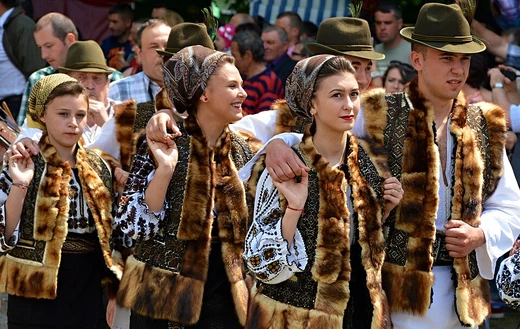
Nunta mortului
Romanian symbolic wedding for the unmarried dead.

Nunta mortului (Romanian for 'wedding of the dead' or 'death-wedding') is a Romanian symbolic wedding incorporated into the funeral of a person who died unmarried, usually at an age when marriage was socially expected. The rite answers a death understood as occurring out of sequence within the customary progression from birth through marriage to death, and is especially well documented in Maramureș, including Ieud, Botiza, Breb, Lăpuș and the Vișeu area, while records of bridal burial dress and the decorated funeral fir extend through Transylvania, Bukovina, Moldavia, Wallachia, Dobruja and the Banat.
- Type
- Romanian funeral custom
- Also called
- death-wedding, înmormântarea cu brad
- Documented regions
- Maramureș, Transylvania, Bukovina, Moldavia, Wallachia, Dobruja, Banat
- Key studies
- Simion Florea Marian (1892), Gail Kligman (1988)
- Purpose
- complete missing life-cycle transition, honor and pacify the soul, guard the living against return of the dead
Lore & Background
The rite treats the deceased in selected parts of the ceremony as a bride or bridegroom, but the burial remains a funeral and does not bind any living participant as a spouse. Wedding clothing, a crown or veil, a ceremonial flag, unmarried attendants, a living or divine symbolic spouse, wedding vocabulary in laments, and a decorated funeral tree may appear in different local combinations. Christian imagery places the dead maiden in a union with Christ or a divine bridegroom, while a dead bachelor may be accompanied by a living surrogate bride who remains free to marry afterward. The joy, color, music, procession, kinship and commensality of an ordinary wedding are not reproduced unchanged; funeral mourning repeatedly negates and reverses them.
Reader's Guide
The death-wedding differs from a legal posthumous marriage because it does not bind a living person to the deceased. A living surrogate is not treated as a widow, and Kligman's Ieud informants explicitly regarded the surrogate bride as free to marry another man. The Orthodox priest performs the customary services for the dead, while references in laments to a priest coming to 'crown' the deceased at home transform the last rites into the image of a wedding service. The rite also addressed beliefs about unfinished obligations: Kligman's Ieud material links unresolved enmity, an unfinished love affair and the failure to marry with the possibility that the dead could return as a strigoi in search of satisfaction. The death-wedding was therefore performed both as an act of care for the soul and as a precaution intended to protect the living. Kligman distinguishes this symbolic reconciliation from violent anti-strigoi measures because the wedding gives the deceased an honored social place rather than expelling the dead as an enemy.
Did You Know?
- In Maramureș, lamenters apply the regional forms 'mnire' (bridegroom) and 'mnireasă' (bride) directly to the deceased.
- Simion Florea Marian's 1892 ethnographic survey provides a major early synthesis of the clothing, tree and songs.
- A living surrogate bride in a death-wedding remains free to marry another man afterward.
Frequently Asked Questions
What is Nunta mortului?
It is a Romanian funeral rite in which a symbolic wedding is staged for a person who died before ever marrying. The ceremony treats the death as a disruption of the expected life sequence of birth, marriage, and then death.
Who is Nunta mortului performed for?
The rite is reserved specifically for individuals who passed away unmarried, usually at an age when the community expected them to have already wed. It is not a general burial practice but a corrective aimed at filling that missing life-stage transition.
Where is Nunta mortului documented?
The richest ethnographic records come from Maramureș, especially villages such as Ieud, Botiza, Breb, Lăpuș, and the Vișeu area. Broader traces of bridal burial dress and the decorated funeral fir extend across Transylvania, Bukovina, Moldavia, Wallachia, Dobruja, and Banat.
What is the purpose of the death-wedding rite?
The ceremony completes the life-cycle transition the deceased never experienced, thereby honoring and pacifying their soul. It also serves a protective function, guarding the living against the unsettled dead returning.
What are the key ritual elements of Nunta mortului?
The most recognizable symbols are the decorated funeral fir tree (înmormântarea cu brad) and dressing the deceased in bridal or groom's attire. Together these elements visually enact the wedding that was never held in life.
More in Romanian folklore 1-21
Spotted an error? Know more?
Reader corrections go straight into our review queue. Suggest an edit · How this site is sourced