Ileana Simziana
Romanian fairy tale of a princess who becomes a prince.

Ileana Simziana (also spelled Ileana Sînziana) is a Romanian fairy tale collected and written down by Petre Ispirescu between 1872 and 1886. The story is known in English translations as 'Ileana Simziana' or 'The Girl Who Pretended to be a Boy.' It is significant as a variant of the Aarne–Thompson–Uther tale type 514, 'The Shift in Sex,' which scholars often interpret as a tale of transgender identity and transition.
Quick Facts
- Folk Tale Name
- The Princess Who Would be a Prince
- Aka
- Iliane of the Golden Tresses; Helena Goldengarland; The Girl Who Pretended to be a Boy
- Aarne-Thompson Grouping
- ATU 514, "The Shift of Sex"
- Mythology
- Romanian
- Country
- Romania
Facts from the source article.
Lore & Background
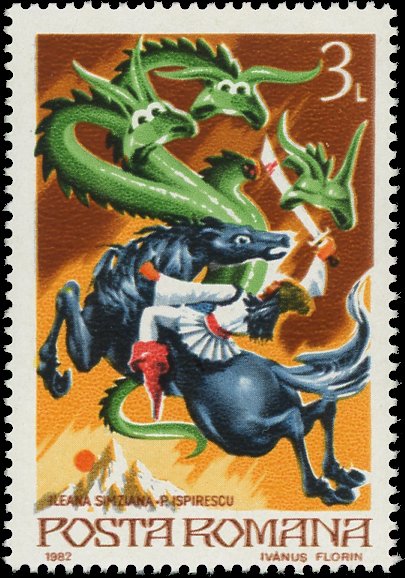
The tale begins with an emperor who has three daughters and laments having no son. The two elder daughters attempt to serve another emperor as soldiers but are frightened back by a wolf on a copper bridge. The youngest daughter, Ileana Simziana, rides her father's old horse and defeats the emperor in three forms—wolf, lion, and twelve-headed dragon—on three bridges. She then arrives at the court of a 'great and strong emperor' and is tasked with rescuing his daughter from a giant. After succeeding, she retrieves the emperor's herd of enchanted mares. Finally, at the emperor's daughter's request, she obtains the Holy Water from a small church above the Jordan guarded by sleepless nuns. A monk curses the thief: if a man, to become a woman; if a woman, to become a man. The protagonist transforms into a man named Făt-Frumos, a Prince Charming figure, and marries the emperor's daughter.
Reader's Guide
Ileana Simziana is a key example of the international tale type ATU 514, 'The Shift in Sex,' which appears across Europe and sporadically in Asia and the Americas. According to mid-20th century scholarship, most variants are found in Finland, Turkey, Ireland, and Lithuania, with four recorded in Romania. Scholars such as Rainer Wehse and Stith Thompson note the great variety in motifs and sequences within this type, but the core remains a woman's transformation into a man. Richard MacGillivray Dawkins outlined a general pattern: a king's three daughters, the youngest valiant, disguises herself as a man, performs brave deeds, marries a princess, and is transformed by a magical being's curse. The tale's significance lies in its treatment of gender transition, often interpreted by scholars as a narrative of transgender identity. Variants exist in Moldova, North Macedonia, Albania, Greece, and Norway, among other regions, each adapting the core motifs to local traditions.
Did You Know?
- The tale was collected by Petre Ispirescu between 1872 and 1886.
- The protagonist, Ileana Simziana, transforms into a man named Făt-Frumos after a monk's curse.
- A variant titled 'The Girl Who Pretended to be a Boy' was published in Andrew Lang's The Violet Fairy Book in 1901.
The Narrative Arc of the Tale
The story centers on an emperor's youngest daughter who, moved by her father's grief over lacking a male heir, volunteers to serve a foreign emperor in his stead. Her two elder sisters attempt the same journey but are driven back in fear as the emperor reshapes himself into a wolf, a lion, and a twelve-headed dragon across three bridges. The youngest, riding her father's old horse, overcomes all three trials. At the court of a great and strong emperor, she is set to tasks: rescuing Ileana Simziana from a giant, retrieving a herd of enchanted mares, and finally stealing the Holy Water from a small church above the Jordan, guarded by nuns who never sleep. A monk's prayer to God inverts the thief's sex, turning the princess into Făt-Frumos, a Prince Charming figure, who then marries Ileana in the tale's joyful conclusion.
Scholarly Classification and Interpretation
Within the Aarne-Thompson-Uther system, this tale and its numerous variants are catalogued under type 514, 'The Shift in Sex.' Rainer Wehse, writing in the Enzyklopädie des Märchens, observed that while the narratives display considerable variety in their motifs and sequence of events, they consistently orbit a shared structural core: a woman's transformation into a man. Stith Thompson echoed this observation, noting the wide diversity among tales indexed under this single type. Richard MacGillivray Dawkins offered a broader schematic, describing a king with three daughters whose most valiant one disguises herself as a soldier, performs heroic deeds, and is ultimately sent on a mission where a magical being's curse permanently changes her sex. Modern scholars frequently read these narratives as explorations of transgender identity and transition, lending the old folk plots a contemporary resonance that extends well beyond their nineteenth-century collection.
Geographic Spread and Regional Variants
Mid-twentieth-century scholarship mapped the tale type across a remarkably wide area. In Europe, the highest concentrations of variants appear in Finland with seventeen recorded tales, followed by Turkey at thirteen, then Ireland and Lithuania at ten each, Denmark at nine, and Greece and Poland at six. Romania contributes four tales to the count. Beyond the continent, sporadic versions were documented in Indonesia, Malaysia, Spain, Portugal, and former Iberian colonies including the Cape Verde Islands, Mexico, and Chile. Within the Romanian-speaking world, a version titled 'The Girl Who Pretended to be a Boy' appeared in Andrew Lang's 1901 Violet Fairy Book, translated from the 1894 Sept Contes Roumains edited by Jules Brun and Leo Bachelin. A Moldavian variant, Prince Theodor and the Magic Stag, published by Grigore Botezatu, reworks the plot around a daughter named Theodora who rescues a white stag from a dragon and is cursed into manhood by witches after retrieving a hazelnut-encased maiden.
Publication and Cultural Transmission
Ileana Simziana was first committed to writing by Romanian collector Petre Ispirescu, who recorded the tale sometime between 1872 and 1886. The story has since been rendered into English under several evocative titles, including 'The Princess Who Would Be a Prince' and 'Iliane of the Golden Tresses,' as well as 'Helena Goldengarland,' reflecting the difficulty of translating Romanian folk nomenclature. Its journey into the broader English-speaking literary world came through Andrew Lang's 1901 anthology The Violet Fairy Book, which carried an English translation of a variant originally published in the 1894 collection Sept Contes Roumains, edited by Jules Brun and Leo Bachelin. In another Romanian variant collected by Pauline Schullerus from Harbachtal and titled 'The Valiant King's Daughter,' the Red Emperor, a frail ninety-nine-year-old, is summoned to war by his friend the Green Emperor; his youngest daughter crosses an iron-toothed wolf's territory, retrieves a golden swine rib, finds a golden-haired maiden, and steals the Sword of God, after which God and Saint Peter decree her transformation into a man.
Gallery
Frequently Asked Questions
What is Ileana Simziana?
Ileana Simziana is a Romanian fairy tale about a princess who assumes a male identity and lives as a prince. The story was recorded by the folklorist Petre Ispirescu in the late 19th century and is known in English as 'The Girl Who Pretended to be a Boy.'
Who collected and published Ileana Simziana?
The tale was gathered and written down by Petre Ispirescu, a major Romanian folklorist, between 1872 and 1886. His fieldwork preserved numerous oral narratives that might otherwise have disappeared.
What is Ileana Simziana's tale-type classification?
Scholars place the story under Aarne–Thompson–Uther type 514, 'The Shift in Sex.' It is recognized as a Romanian variant of this broader cross-cultural pattern in which a character undergoes a gender transformation.
Why is Ileana Simziana significant in folklore studies?
The tale is widely discussed as a literary representation of transgender identity, with the protagonist's shift read as a genuine reclamation of self rather than mere deception. It has become one of the most frequently cited Romanian stories in academic conversations about gender and folk narrative.
More in Romanian folklore 1-21
Spotted an error? Know more?
Reader corrections go straight into our review queue. Suggest an edit · How this site is sourced